
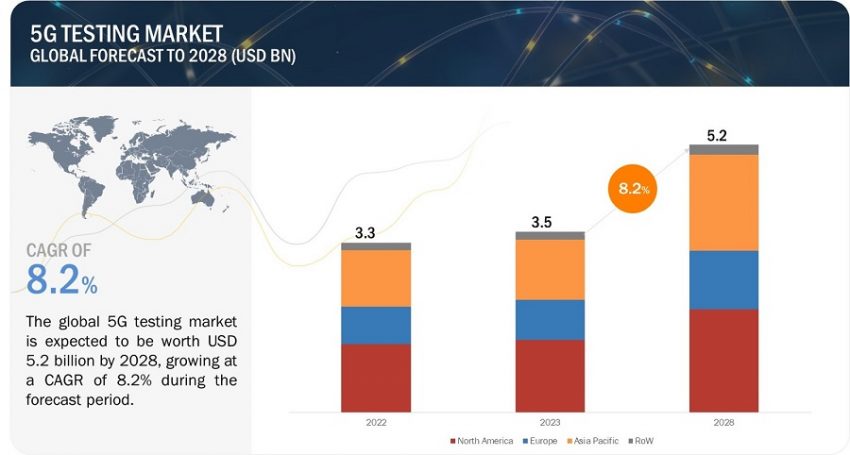
The 5G Testing Market is witnessing substantial growth as Industrial Internet of Things connectivity continues transforming manufacturing, logistics, energy, healthcare, and industrial automation sectors worldwide. Industrial IoT systems rely on interconnected sensors, machines, robotics, cloud platforms, and intelligent monitoring systems to improve operational efficiency, automation, and real-time decision-making. The deployment of 5G infrastructure is significantly enhancing Industrial IoT capabilities by enabling ultra-fast communication, low-latency connectivity, high device density, and reliable wireless data transmission. As industries increasingly adopt smart manufacturing and connected industrial ecosystems, the demand for advanced 5G testing solutions capable of ensuring network performance, device interoperability, communication reliability, and cybersecurity is expanding rapidly.
One of the major trends driving the 5G testing market in Industrial IoT connectivity is the rapid adoption of Industry 4.0 technologies. Modern industrial facilities increasingly rely on connected machines, predictive maintenance systems, intelligent robotics, and automated production lines to optimize manufacturing operations and reduce operational costs. These highly connected industrial environments require stable and low-latency communication networks capable of supporting real-time machine-to-machine interaction. 5G testing technologies help manufacturers evaluate communication reliability, signal quality, and network responsiveness across industrial IoT ecosystems. The growing global shift toward smart manufacturing is expected to remain a significant driver for the wireless testing industry.
Download PDF Brochure @ https://www.marketsandmarkets.com/pdfdownloadNew.asp?id=175814056

Edge computing integration is another important trend influencing Industrial IoT connectivity and 5G testing operations. Industrial applications often require immediate data processing and real-time analytics to support critical operational decisions and automation systems. Edge computing allows data to be processed closer to industrial devices and machinery instead of relying entirely on centralized cloud systems, reducing communication delays and improving operational efficiency. Testing solutions are increasingly being developed to evaluate communication performance between edge infrastructure, connected industrial devices, and cloud platforms. The combination of edge computing and 5G connectivity is strengthening the need for advanced wireless testing technologies within industrial environments.
Artificial intelligence and machine learning integration are also transforming Industrial IoT connectivity and driving innovation within the 5G testing market. AI-powered industrial systems generate massive amounts of operational data that require reliable and high-speed communication for analysis and automation. Machine learning algorithms improve predictive maintenance, optimize production workflows, and support intelligent decision-making across connected industrial ecosystems. AI-based testing platforms can automatically identify communication issues, optimize network configurations, and improve testing accuracy within Industrial IoT environments. These intelligent testing capabilities are helping industries improve operational reliability and reduce downtime across manufacturing and industrial operations.
The increasing deployment of smart sensors and connected monitoring devices is significantly contributing to market growth. Industrial facilities use sensors to monitor equipment performance, environmental conditions, energy consumption, and production efficiency in real time. These connected systems require scalable and reliable wireless communication infrastructure capable of supporting large numbers of simultaneously connected devices. 5G testing solutions help organizations validate network scalability, communication stability, and device interoperability across complex Industrial IoT ecosystems. The growing adoption of sensor-driven automation and intelligent monitoring technologies is expected to increase demand for advanced testing systems through the coming years.
Inquiry Before Buying @ https://www.marketsandmarkets.com/Enquiry_Before_BuyingNew.asp?id=175814056

Industrial robotics and automated material handling systems are further supporting the expansion of the 5G testing market. Robotics systems used in manufacturing, warehousing, and logistics operations require continuous communication with centralized control systems, AI platforms, and surrounding equipment. 5G connectivity enables faster response times and more precise coordination between robotic systems and industrial infrastructure. Testing technologies are critical for validating communication latency, network reliability, and operational safety within automated industrial environments. As robotics adoption continues accelerating globally, the need for high-performance wireless testing solutions is becoming increasingly important.
Cybersecurity and network protection are becoming major priorities within Industrial IoT connectivity environments. Industrial systems often manage critical infrastructure and sensitive operational data, making secure communication essential for maintaining business continuity and operational safety. The increasing number of connected devices within industrial ecosystems also expands the potential attack surface for cyber threats. 5G testing solutions help industries identify network vulnerabilities, evaluate security protocols, and validate communication resilience against potential cyberattacks. The growing focus on industrial cybersecurity is driving additional investment in advanced wireless testing and monitoring technologies.
Cloud computing adoption within industrial operations is also creating new opportunities for the 5G testing market. Enterprises increasingly use cloud-based platforms for industrial analytics, remote monitoring, predictive maintenance, and operational management. The integration of cloud computing with Industrial IoT systems enables centralized control and improved scalability across geographically distributed operations. Testing systems help validate communication performance between cloud infrastructure, industrial devices, and wireless networks while ensuring low latency and reliable data transfer. The continued expansion of cloud-connected industrial environments is strengthening the demand for advanced 5G testing technologies.
Private 5G network deployment is emerging as a major trend within Industrial IoT connectivity. Many industrial enterprises are implementing private 5G networks to improve security, network control, and operational reliability within manufacturing plants, warehouses, and industrial campuses. Private wireless networks allow organizations to customize communication infrastructure based on specific operational requirements and performance standards. Testing solutions are essential for evaluating network coverage, communication quality, and infrastructure scalability within private industrial networks. The increasing adoption of private 5G infrastructure is expected to create substantial growth opportunities for wireless testing providers.
View detailed Table of Content here – https://www.marketsandmarkets.com/Market-Reports/5g-testing-market-175814056.html

Smart logistics and connected supply chain management systems are also influencing trends within the Industrial IoT connectivity market. Warehouses, transportation systems, and distribution centers increasingly rely on connected tracking systems, automated inventory management platforms, and intelligent fleet coordination technologies. These systems require stable wireless communication and real-time data exchange to support operational efficiency and supply chain visibility. 5G testing technologies help logistics providers evaluate communication performance and ensure seamless connectivity across connected industrial operations.
Research and development activities are playing a central role in advancing Industrial IoT testing technologies. Telecommunications companies, industrial automation providers, semiconductor manufacturers, and software developers are investing heavily in next-generation wireless testing platforms capable of supporting increasingly complex industrial communication environments. Innovations in software-defined networking, AI-driven analytics, virtualization, and automated testing systems are improving the scalability and efficiency of industrial wireless infrastructure. These advancements are expected to accelerate the commercialization and deployment of advanced Industrial IoT solutions.
Regional market trends indicate strong growth opportunities across North America, Europe, and Asia-Pacific. North America remains a leading market due to rapid industrial digitalization, advanced telecommunications infrastructure, and strong investments in smart manufacturing technologies. Europe is focusing heavily on Industry 4.0 initiatives, industrial automation, and connected mobility infrastructure. Asia-Pacific countries such as China, Japan, South Korea, and India are rapidly expanding manufacturing capabilities, industrial automation systems, and 5G infrastructure deployment, creating substantial demand for Industrial IoT testing technologies.
Despite strong growth potential, certain challenges continue affecting Industrial IoT connectivity adoption. High infrastructure costs, interoperability complexity, cybersecurity risks, and evolving communication standards can impact deployment efficiency and operational scalability. However, continuous advancements in wireless communication technologies, artificial intelligence, and industrial automation systems are expected to overcome these challenges and support long-term market expansion.
Industrial IoT connectivity is playing a transformative role in shaping trends within the 5G testing market. The increasing adoption of smart manufacturing, connected industrial infrastructure, edge computing, industrial robotics, and AI-powered automation systems is accelerating demand for advanced wireless testing solutions across industries. As Industrial IoT ecosystems continue expanding globally and digital industrial transformation advances further, 5G testing technologies will remain essential for ensuring communication reliability, operational efficiency, cybersecurity, and seamless industrial connectivity.