Overview of the US Testing, Inspection, and Certification (TIC) Market
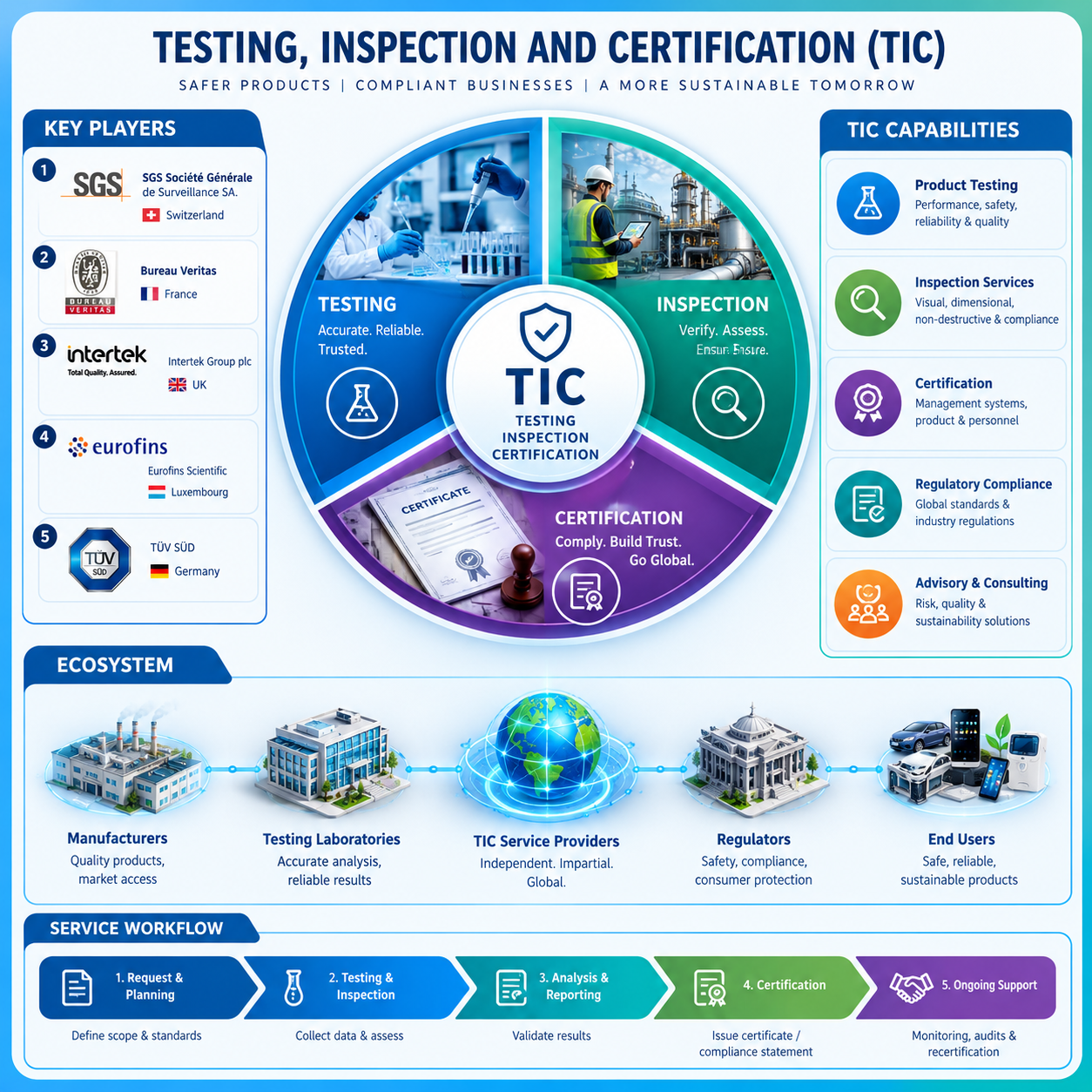
The US Testing, Inspection, and Certification (TIC) market plays a critical role in ensuring product quality, operational safety, regulatory compliance, and reliability across industries. TIC services help manufacturers, infrastructure developers, technology companies, and service providers verify that products, processes, equipment, and facilities meet applicable standards and performance requirements. As businesses face increasingly complex supply chains, evolving regulations, and rising expectations for quality assurance, independent testing and certification are becoming important components of risk management and operational efficiency.
According to MarketsandMarkets, the US TIC market is projected to grow from USD 50.66 billion in 2026 to USD 55.56 billion by 2031, registering a compound annual growth rate (CAGR) of 1.86% during the forecast period. The market’s expansion reflects sustained demand for regulatory compliance, third-party validation, and quality assurance across established industrial sectors.
Download PDF Brochure @ https://www.marketsandmarkets.com/cutoutform.asp?page=PDF_Download&id=5352498&childreportID=1704&segment=country
Key Growth Drivers in the US TIC Market
Regulatory compliance is a fundamental driver of the US Testing, Inspection, and Certification market. Industries such as healthcare, food and beverages, automotive, aerospace, chemicals, and consumer electronics must comply with applicable safety, quality, and performance standards. TIC providers support organizations by conducting laboratory testing, facility inspections, product evaluations, and certification assessments. These services help businesses identify potential non-compliance issues, reduce operational risks, and maintain confidence among customers, regulators, and supply chain partners.
Increasing product complexity is another important growth driver. Advanced electronic components, connected devices, electric vehicle systems, industrial automation equipment, and semiconductor technologies require specialized testing to validate functionality, reliability, electromagnetic compatibility, and safety. As manufacturers introduce new products and integrate sophisticated technologies, demand for specialized testing capabilities is expected to remain important to the US TIC industry.
Supply chain resilience is also influencing market demand. Companies increasingly need to verify the quality and compliance of materials, components, suppliers, and finished products across geographically distributed operations. Independent inspection and certification services provide documented evidence of quality and conformity, helping businesses manage supplier risks and maintain consistent standards.
Emerging Trends Shaping the US TIC Market
Digital Transformation and AI-Enabled Testing
Digital technologies are changing how TIC providers deliver services. Artificial intelligence, machine vision, data analytics, connected sensors, and automated laboratory systems can improve inspection consistency, identify anomalies, and accelerate data processing. Remote inspection platforms and digital reporting tools can also reduce administrative workloads and improve visibility into compliance activities.
For TIC providers, the opportunity lies in combining traditional technical expertise with digital capabilities. Automated testing workflows, predictive analytics, and centralized compliance platforms can help improve turnaround times while supporting more data-driven decision-making.
Growing Demand for Semiconductor and Electronics Testing
The development of advanced semiconductor devices and increasingly sophisticated electronic systems is creating demand for precise testing and validation. Semiconductor manufacturing involves complex production processes, stringent quality requirements, and specialized equipment. Testing services help evaluate component performance, reliability, and conformity with relevant technical standards.
Automotive electronics, telecommunications equipment, industrial control systems, and connected consumer devices also require testing for electrical safety, electromagnetic compatibility, and operational performance. These applications offer opportunities for TIC providers with specialized laboratories and advanced technical capabilities.
Sustainability and Environmental Compliance
Sustainability considerations are expanding the scope of testing and verification services. Businesses increasingly need to evaluate environmental performance, material composition, energy efficiency, emissions, and product conformity with relevant environmental requirements. TIC providers can support these efforts through environmental testing, sustainability verification, energy performance assessments, and supply chain audits.
As companies integrate sustainability objectives into product development and manufacturing, independent verification can help strengthen transparency and support compliance with applicable standards.
Market Opportunities Across Key Applications
The US TIC market serves a broad range of applications, including consumer goods and retail, agriculture and food, automotive, aerospace, construction and infrastructure, energy and power, industrial manufacturing, chemicals, and information technology.
Consumer goods and retail represent an important area for product safety testing, material analysis, quality inspection, and certification. Agriculture and food applications require testing for contamination, product quality, traceability, and food safety compliance. In automotive, the transition toward electric vehicles, battery systems, and advanced electronic components is increasing the need for specialized validation and reliability testing.
Construction and infrastructure projects require materials testing, structural inspections, and quality assessments to support safety and performance requirements. Meanwhile, energy and power applications create opportunities in equipment inspection, asset integrity assessment, renewable energy infrastructure, and battery technology validation.
These diverse applications enable TIC companies to serve customers across multiple industries and develop specialized service portfolios that respond to changing technical and regulatory requirements.
Challenges in the US TIC Industry
Despite stable demand, the US TIC industry faces several challenges. Maintaining accredited laboratories, advanced testing equipment, qualified personnel, and specialized technical infrastructure can require substantial investment. Smaller service providers may find it difficult to expand into highly specialized testing categories or meet the requirements of multiple industries.
Workforce availability is another consideration, particularly for services requiring expertise in advanced electronics, materials science, cybersecurity, environmental analysis, and complex industrial systems. TIC providers must also manage changing standards, customer expectations for faster turnaround times, and competition from established multinational companies and specialized laboratories.
To address these challenges, providers can invest in workforce development, laboratory automation, digital reporting systems, and strategic partnerships. Developing integrated testing, inspection, and certification offerings may also help improve service efficiency and strengthen long-term customer relationships.
Competitive Landscape and Strategic Outlook
Competition in the US TIC market is shaped by technical expertise, laboratory capacity, geographic reach, accreditation capabilities, service quality, and turnaround time. Companies that can provide consistent testing results, reliable inspection services, and comprehensive certification support are positioned to serve customers operating in highly regulated environments.
Market participants can pursue growth through investments in specialized laboratories, expansion into emerging technology applications, digital service development, and partnerships with manufacturers and infrastructure operators. Combining multiple TIC services into integrated compliance programs may also help customers manage complex requirements more efficiently.
Looking toward 2031, the US TIC market is expected to maintain steady growth as businesses continue to prioritize product reliability, safety, quality assurance, and regulatory compliance. Although the market is relatively mature, opportunities remain in semiconductor and electronics testing, digital inspection, environmental verification, automotive technologies, and advanced manufacturing.
The US Testing, Inspection, and Certification (TIC) market is positioned for continued expansion through 2031, supported by regulatory requirements, increasingly complex products, supply chain quality management, and technological advancements. According to MarketsandMarkets, the market is forecast to reach USD 55.56 billion by 2031, growing at a CAGR of 1.86% from 2026 to 2031.
For industry participants, future competitiveness will depend on specialized technical capabilities, efficient service delivery, digital transformation, and the ability to adapt to evolving customer and regulatory requirements. Companies that combine established testing expertise with innovative inspection technologies and reliable certification services can strengthen their market position and capitalize on emerging opportunities across the US economy.
For more info: https://www.marketsandmarkets.com/Market-Reports/geography/testing-inspection-certification-market/US