
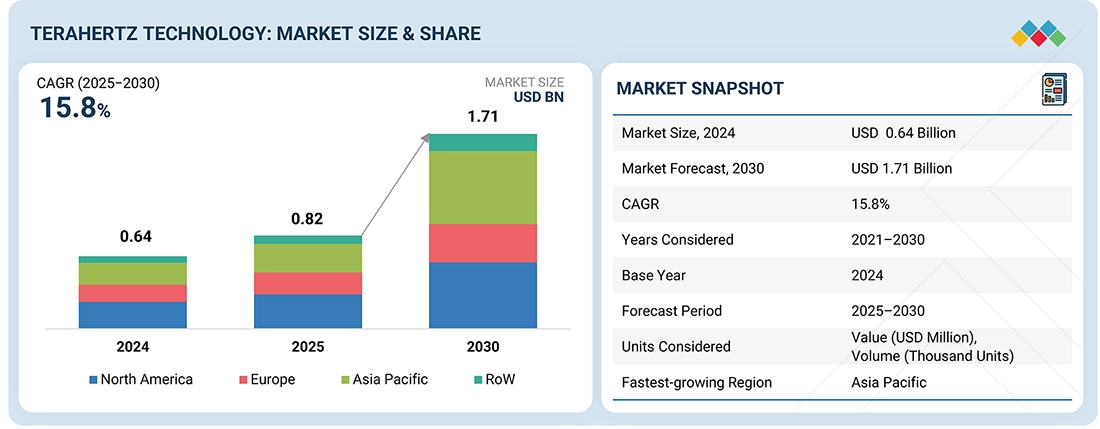
The Terahertz Technology Market is gaining opportunities from the growing demand for contactless measurement techniques in medical research, healthcare diagnostics, and biomedical analysis. Terahertz technology operates between microwave and infrared frequencies, providing distinctive capabilities for examining material composition, tissue hydration, and structural characteristics without requiring direct physical contact with the sample. These properties are attracting interest from researchers and healthcare technology developers seeking non-invasive methods for specialized medical assessment. Advances in terahertz sources, detectors, imaging systems, and signal-processing technologies are supporting the development of contactless measurement platforms for laboratory investigations, tissue analysis, pharmaceutical inspection, and selected diagnostic research applications.
Growing Demand for Contactless Medical Measurement
Healthcare and biomedical research increasingly require measurement techniques that minimize sample disturbance and reduce the need for invasive procedures. Contactless technologies can support repeated observations, improve measurement flexibility, and enable the assessment of sensitive biological materials under controlled conditions.
Terahertz systems can measure reflected, transmitted, or emitted signals depending on the system configuration and sample properties. The resulting information can help researchers evaluate variations in moisture content, dielectric characteristics, and material structure. These capabilities are creating opportunities for terahertz technology in applications where conventional contact-based measurements may be difficult or where complementary analytical information is valuable.
Download PDF Brochure @ https://www.marketsandmarkets.com/pdfdownloadNew.asp?id=71182197
Applications in Non-Invasive Tissue Assessment
Tissue assessment is an important research area for contactless terahertz measurement. Biological tissues contain different proportions of water and other components, influencing their interaction with terahertz radiation. Researchers can investigate these responses to understand variations in tissue hydration, composition, and structure.
Potential applications include superficial tissue characterization, skin hydration studies, wound assessment, and laboratory investigations of abnormal tissue. Contactless measurements may help reduce disturbance to delicate samples and allow researchers to collect additional information during repeated examinations.
However, strong absorption of terahertz radiation by water limits penetration into many biological tissues. Consequently, most applications remain focused on research and specialized assessment rather than established routine clinical diagnosis.
Skin Hydration and Dermatological Research
Dermatology offers promising opportunities for contactless medical measurement because skin hydration and surface conditions can influence terahertz signal responses. Researchers are exploring whether terahertz spectroscopy can provide quantitative information about moisture variations and changes in selected skin characteristics.
Such measurements may complement conventional methods used to evaluate skin hydration, barrier function, and treatment responses. Contactless operation can be particularly useful when repeated measurements are required or when direct contact could affect the sample.
Developments in compact terahertz instruments and improved signal interpretation may expand research applications in dermatology and cosmetic science. Clinical adoption will depend on measurement accuracy, repeatability, and validation against established assessment techniques.
Inquiry Before Buying @ https://www.marketsandmarkets.com/Enquiry_Before_BuyingNew.asp?id=71182197
Wound Monitoring and Healing Assessment
Wound care is another potential application area for terahertz-based contactless measurement. Changes in wound moisture, tissue condition, and healing progress are important considerations when evaluating recovery.
Terahertz systems may help researchers examine hydration-related differences around wound surfaces and investigate how these characteristics change over time. Repeated contactless measurements could support experimental studies of wound healing and the evaluation of selected treatment approaches.
Integration with digital imaging and analytical software may enable researchers to compare measurements across different stages of recovery. Nevertheless, further evidence is needed to establish standardized procedures and demonstrate reliable clinical benefits.
Pharmaceutical and Biomedical Laboratory Applications
Contactless measurement also offers opportunities in pharmaceutical research and biomedical laboratories. Terahertz spectroscopy and imaging can help investigate material composition, crystalline structure, tablet coatings, and selected pharmaceutical properties without necessarily damaging the sample.
These capabilities can support research into drug formulation, material characterization, and quality assessment. In laboratory environments, contactless analysis may reduce sample handling and complement techniques such as microscopy, spectroscopy, and conventional chemical testing.
As pharmaceutical manufacturers increase automation and adopt advanced process analytical technologies, terahertz systems may find additional roles in specialized inspection and research workflows.
Advances in Terahertz Sources and Detectors
The performance of contactless medical measurement systems depends on the quality of their sources, detectors, optics, and signal-processing components. Advances in photonic generation, semiconductor technologies, detector sensitivity, and system integration are helping improve measurement capabilities.
More compact systems can make laboratory integration easier, while improved signal-to-noise ratios can support the analysis of subtle material differences. Advances in calibration and measurement software are also important for ensuring reproducibility across samples and operating conditions.
Continued component innovation is expected to influence the practicality and cost of terahertz-based measurement platforms.
View detailed Table of Content here – https://www.marketsandmarkets.com/Market-Reports/terahertz-technology-market-71182197.html
Artificial Intelligence and Signal Analysis
Artificial intelligence is creating new possibilities for interpreting terahertz measurement data. Contactless systems can generate complex spectral and imaging datasets that require advanced methods to identify meaningful patterns.
Machine learning algorithms can support noise reduction, image reconstruction, spectral classification, and anomaly detection. In biomedical research, these capabilities may help compare tissue samples and identify variations that warrant further investigation.
Reliable results require representative datasets, transparent analytical methods, and independent validation. AI should therefore complement experimental evidence rather than replace established diagnostic evaluation.
Challenges Affecting Market Growth
Despite its potential, contactless terahertz medical measurement faces challenges related to water absorption, limited tissue penetration, equipment cost, measurement standardization, and system complexity. Environmental conditions and sample characteristics can also influence signal quality.
Healthcare adoption requires evidence that terahertz measurements provide useful and reproducible information compared with existing technologies. Regulatory requirements, clinician familiarity, integration costs, and the availability of validated applications will influence the pace of commercialization.
Future Market Outlook
The Terahertz Technology Industry is expected to benefit from continued research into contactless medical measurement, non-invasive tissue assessment, dermatology, wound monitoring, and pharmaceutical analysis. Improvements in sources, detectors, imaging software, and artificial intelligence could strengthen the technology’s role in specialized biomedical research.
Collaboration among healthcare institutions, research laboratories, semiconductor developers, and medical technology companies will be important for translating experimental capabilities into practical solutions. As measurement performance improves and validated applications emerge, terahertz technology may become an increasingly valuable complement to established medical assessment and laboratory analysis methods.