
The Generative AI Server Market is becoming a critical component of the global data center ecosystem as enterprises accelerate the adoption of generative AI, large language models (LLMs), AI agents, and other compute-intensive applications. Unlike traditional workloads, generative AI requires significantly higher computing capacity, memory bandwidth, networking performance, and energy resources.
As organizations move from AI experimentation to production-scale deployments, data centers are being redesigned around the needs of accelerated computing. This transformation is creating opportunities across servers, GPUs, AI accelerators, storage, networking, cooling, and power infrastructure.
Why Is the Generative AI Server Market Growing?
The rapid development of generative AI applications is one of the primary factors driving demand for specialized servers.
Generative AI models require large-scale computing resources for both training and inference. Training involves processing massive datasets and optimizing billions or even trillions of model parameters, while inference requires high-performance infrastructure to deliver AI-generated responses quickly and efficiently.
As enterprises integrate generative AI into customer service, software development, healthcare, financial services, manufacturing, media, and other applications, demand for high-performance AI servers is increasing.
AI Workloads Are Redefining Data Center Infrastructure
Traditional enterprise servers were largely designed around CPU-based workloads. Generative AI is changing this architecture by increasing demand for GPU-based and accelerator-based computing.
AI servers typically combine:
- High-performance GPUs or AI accelerators
- High-bandwidth memory
- High-speed networking
- Advanced storage
- Efficient power-management systems
- Advanced air or liquid cooling
- AI-optimized software stacks
This shift is turning the data center into a highly specialized computing environment designed to move and process enormous volumes of data efficiently.
Download PDF Brochure @ https://www.marketsandmarkets.com/pdfdownloadNew.asp?id=242200223
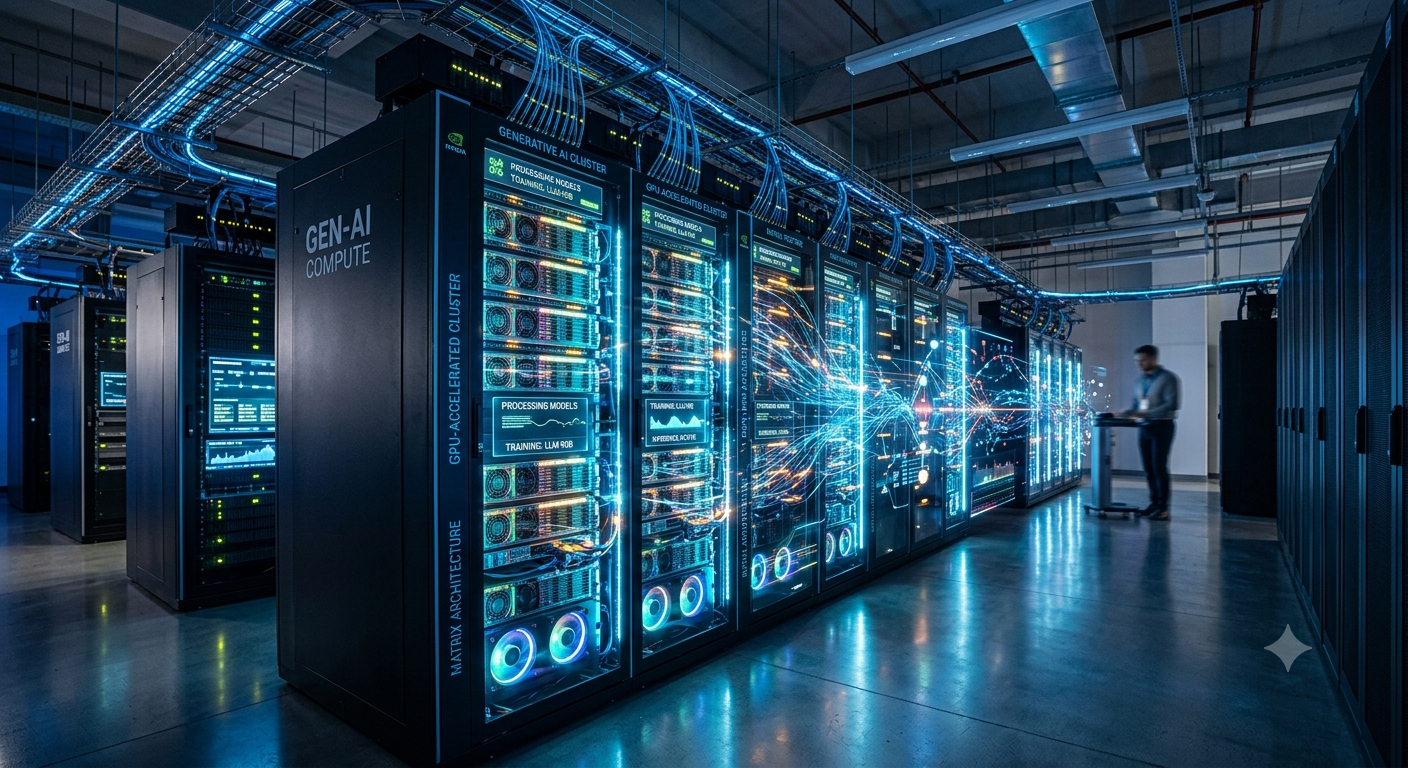
GPUs Remain Central to AI Computing
Graphics processing units (GPUs) have become fundamental to generative AI infrastructure because their parallel processing capabilities are well suited to deep-learning workloads.
The growing complexity of AI models is encouraging data center operators and cloud providers to deploy increasingly powerful GPU-based servers.
At the same time, the market is expanding beyond conventional GPUs. AI accelerators, application-specific integrated circuits (ASICs), and other specialized processors are gaining attention as organizations look for improved performance, efficiency, and cost optimization.
This diversification is likely to be an important trend shaping the Generative AI Server Market.
Inference Is Creating a New Growth Opportunity
Early AI infrastructure investments focused heavily on model training. However, as generative AI applications move into production, inference workloads are becoming increasingly important.
Inference occurs every time an AI model generates an answer, image, code, recommendation, or other output. Large-scale deployment of AI assistants and enterprise applications can therefore generate continuous demand for computing resources.
This is creating opportunities for servers optimized for:
- Low-latency inference
- High throughput
- Energy efficiency
- Edge AI
- Real-time AI applications
- Cost-effective model serving
The growing importance of inference could significantly influence the design and purchasing priorities of future AI data centers.
Memory and Networking Are Becoming Critical
AI performance is no longer determined solely by processor speed.
Large AI models require enormous amounts of data to move between processors and memory. Consequently, high-bandwidth memory and high-speed interconnects are becoming essential components of AI server architectures.
Similarly, networking infrastructure must support fast communication between multiple accelerators operating as a single computing cluster.
This is driving demand for advanced networking technologies, high-speed switches, optical connectivity, and specialized interconnects.
AI Servers Are Increasing Data Center Power Demand
One of the biggest challenges associated with the Generative AI Server Market is energy consumption.
AI servers can consume substantially more power than traditional enterprise computing systems, particularly when deployed in high-density clusters.
As AI workloads expand, data center operators are increasingly focusing on:
- Power-efficient processors
- Advanced power-management technologies
- Renewable energy
- Improved power distribution
- Higher-density rack architectures
- Energy-efficient cooling
Power availability is becoming a strategic consideration when selecting locations and designing new AI data centers.
Liquid Cooling Is Gaining Importance
Higher compute density is also transforming data center cooling requirements.
Traditional air cooling can become less effective as server power densities increase. As a result, liquid cooling technologies are gaining attention for high-performance AI environments.
Direct-to-chip cooling, immersion cooling, and other advanced thermal-management approaches can help manage heat generated by dense AI computing systems.
The expansion of liquid cooling is therefore creating opportunities not only for server manufacturers but also for data center infrastructure providers.
Hyperscale Data Centers Are Leading Adoption
Hyperscale cloud providers are among the largest adopters of generative AI infrastructure. Their ability to deploy large clusters of accelerators enables them to provide AI services to thousands or millions of users.
Hyperscalers are investing in purpose-built infrastructure designed around AI workloads, including:
- AI-optimized server architectures
- High-speed networking
- Advanced storage
- Liquid cooling
- Dedicated AI clusters
- Custom accelerators
This trend is also encouraging colocation providers to develop facilities capable of supporting high-density AI deployments.
Enterprise AI Adoption Creates Additional Opportunities
The Generative AI Server Market is not limited to hyperscale cloud providers.
Large enterprises are increasingly exploring private and hybrid AI infrastructure to support applications involving proprietary data, security requirements, regulatory compliance, and low-latency processing.
Industries creating demand include:
Healthcare
Generative AI can support medical research, clinical documentation, drug discovery, and healthcare analytics.
Financial Services
Banks and financial institutions are exploring AI for customer service, fraud detection, risk analysis, software development, and financial research.
Manufacturing
Generative AI can support engineering, predictive maintenance, quality management, supply-chain optimization, and industrial automation.
Automotive
AI infrastructure is supporting vehicle development, autonomous-driving research, simulation, and intelligent manufacturing.
Media & Entertainment
Generative AI is accelerating content creation, video processing, image generation, and personalization.
Retail
Retailers are using generative AI for customer engagement, product recommendations, marketing, inventory management, and demand forecasting.
Edge AI Could Expand the Market Further
While centralized data centers will remain essential for large-scale model training, some generative AI applications are moving closer to end users.
Edge AI servers can support applications requiring low latency, data privacy, or limited dependence on cloud connectivity.
This could create opportunities for smaller AI-optimized servers across manufacturing facilities, healthcare environments, telecommunications networks, retail locations, and other distributed sites.
Key Trends Shaping the Generative AI Server Market
Several trends are expected to influence the market over the coming years:
- Rapid growth of GPU and AI accelerator deployments
- Increasing focus on inference infrastructure
- Expansion of high-bandwidth memory
- Adoption of high-speed AI networking
- Growth of liquid cooling
- Increasing server rack power densities
- Development of custom AI chips
- Expansion of hyperscale AI data centers
- Growing enterprise and private AI deployments
- Increasing adoption of edge AI infrastructure
Together, these trends are transforming the economics and architecture of modern data centers.
Growth Opportunities for Market Participants
The transformation of data centers creates opportunities throughout the AI infrastructure value chain.
Server manufacturers can differentiate through higher performance, energy efficiency, modular designs, and optimized accelerator configurations.
Chip manufacturers have opportunities to develop processors and accelerators designed specifically for training and inference.
Networking companies can benefit from growing demand for high-bandwidth, low-latency connectivity.
Cooling and power-management providers are positioned to benefit from rising rack densities and increasing energy requirements.
Meanwhile, software providers can develop solutions for AI workload orchestration, server optimization, monitoring, resource allocation, and data center management.
Challenges Facing the Market
Despite strong growth potential, the Generative AI Server Market faces several challenges.
High infrastructure costs can make large-scale AI deployment expensive. Semiconductor supply constraints, energy availability, cooling requirements, data center construction timelines, and rapidly evolving processor architectures can also create challenges for operators.
Another major issue is utilization. AI servers are expensive assets, and organizations need to ensure that their infrastructure is sufficiently utilized to justify the investment.
The Future of the Generative AI Server Market
The future of the Generative AI Server Market will be closely connected to the evolution of AI models themselves.
As models become larger and more capable, infrastructure providers will need to deliver greater computational performance while simultaneously improving energy efficiency, cooling, networking, memory capacity, and total cost of ownership.
The data center of the future will increasingly be designed around AI from the ground up rather than adapting conventional infrastructure to support AI workloads.
The Generative AI Server Market is transforming data centers from general-purpose computing facilities into highly optimized AI infrastructure platforms.
The convergence of GPUs, AI accelerators, high-bandwidth memory, high-speed networking, liquid cooling, advanced power systems, and AI software is creating a new generation of data center architecture.
As generative AI moves from experimentation to everyday enterprise use, the demand for scalable and efficient AI computing infrastructure is expected to continue expanding.