
As global data consumption continues to surge, traditional wireless communication technologies are facing increasing pressure to deliver faster, more secure, and interference-free connectivity. This has paved the way for next-generation optical wireless technologies such as Free Space Optics (FSO) and Visible Light Communication (VLC), commonly known as Li-Fi. These technologies are redefining how data is transmitted, offering ultra-high-speed communication using light instead of radio frequencies.
The FSO and Li-Fi market is gaining traction across industries due to its ability to address bandwidth limitations, enhance data security, and support emerging applications such as smart cities, autonomous systems, and IoT networks. As demand for high-speed connectivity grows, these technologies are becoming critical components of the future communication ecosystem.
Top Key Takeaways
- FSO and Li-Fi enable high-speed data transmission using light.
- These technologies address RF spectrum congestion challenges.
- Li-Fi offers enhanced security due to limited signal penetration.
- FSO provides reliable long-distance communication.
- Smart cities and IoT are major growth drivers.
- Line-of-sight requirements remain a key challenge.
- Integration with 5G networks presents new opportunities.
- Healthcare and defense sectors are key adopters.
- Hybrid communication systems are an emerging trend.
- The market is poised for strong growth in the coming years.
Market Overview
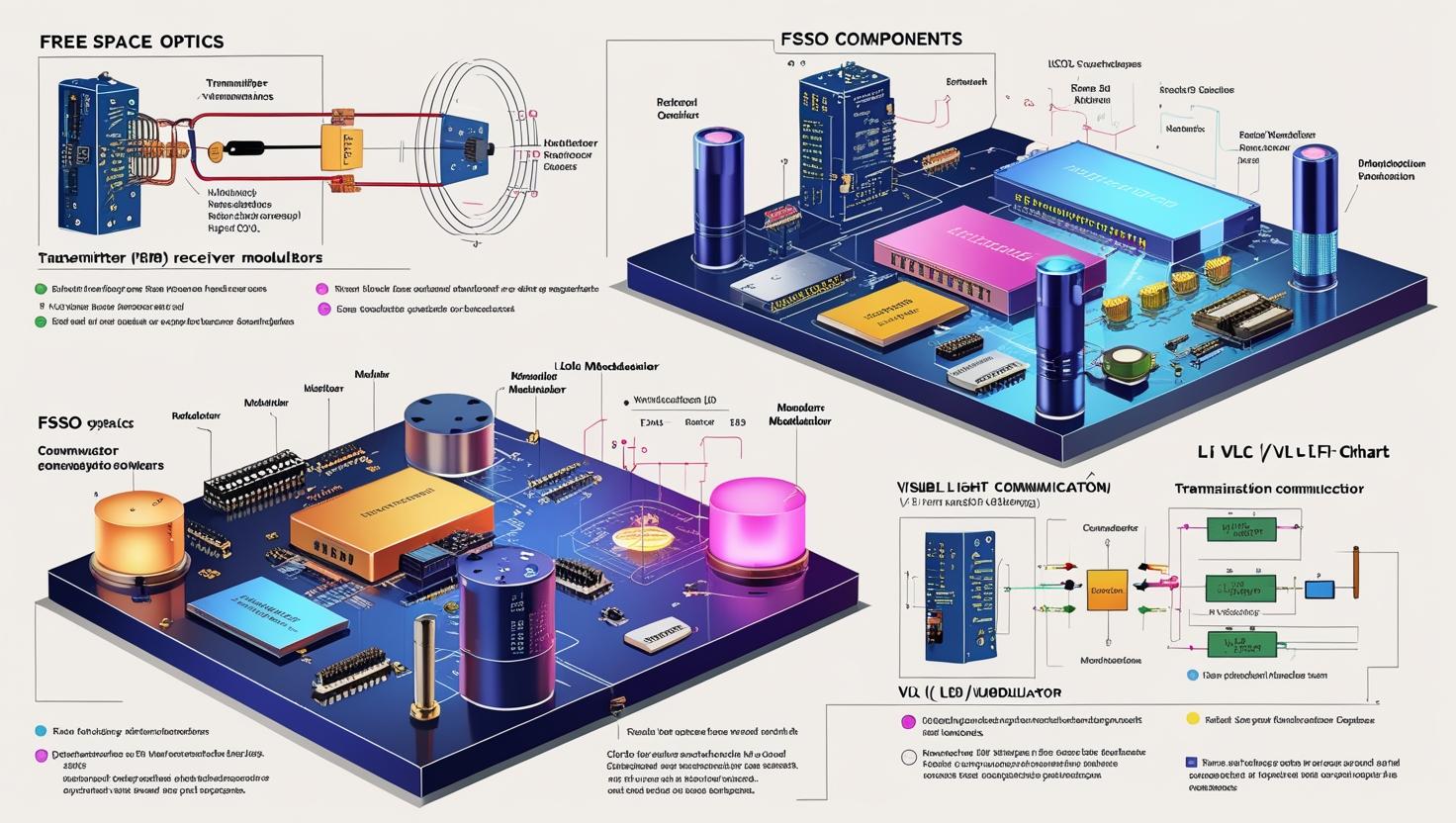
Free Space Optics (FSO) uses laser-based communication to transmit data through the air over long distances, while Li-Fi relies on LED light sources to enable high-speed data transfer in indoor environments. Together, these technologies offer complementary solutions for both outdoor and indoor communication challenges.
FSO is particularly effective for point-to-point communication, providing high bandwidth and low latency without the need for physical cables. On the other hand, Li-Fi enables secure, high-speed wireless communication within confined spaces such as offices, hospitals, and industrial facilities.
The increasing demand for faster internet speeds, combined with the limitations of traditional RF-based systems like Wi-Fi, is driving the adoption of optical wireless technologies. These solutions are not only faster but also more secure and less prone to interference.
Key Market Drivers
1. Growing Demand for High-Speed Connectivity
The exponential growth in data traffic, fueled by video streaming, cloud computing, and IoT devices, is a major driver for the FSO and Li-Fi market. These technologies offer significantly higher bandwidth compared to traditional wireless systems, making them ideal for handling large volumes of data.
2. Spectrum Congestion in RF Communication
With the increasing number of connected devices, radio frequency (RF) spectrum is becoming congested. FSO and Li-Fi operate outside the RF spectrum, providing an alternative communication channel that reduces network congestion and improves performance.
3. Enhanced Security Capabilities
Security is a critical concern in modern communication systems. Li-Fi, in particular, offers enhanced security as light signals cannot penetrate walls, reducing the risk of data interception. Similarly, FSO provides secure point-to-point communication, making it suitable for defense and enterprise applications.
4. Rising Adoption in Smart Cities and IoT
Smart city initiatives and IoT deployments require reliable, high-speed communication networks. FSO and Li-Fi technologies are well-suited for these applications, enabling efficient data transfer between devices and systems.
Download PDF Brochure @ https://www.marketsandmarkets.com/pdfdownloadNew.asp?id=946
Market Restraints
1. Line-of-Sight Limitations
Both FSO and Li-Fi technologies require a clear line of sight between the transmitter and receiver. Any obstruction can disrupt communication, posing challenges in certain environments.
2. Weather Sensitivity in FSO
FSO systems can be affected by environmental factors such as fog, rain, and dust, which may reduce signal strength and reliability.
Market Opportunities
1. Integration with 5G and Beyond
FSO and Li-Fi technologies can complement 5G networks by providing high-speed backhaul and indoor connectivity solutions. This integration can enhance network performance and capacity.
2. Expansion in Healthcare Sector
Hospitals require secure and interference-free communication systems. Li-Fi is ideal for such environments, as it does not interfere with medical equipment and ensures data privacy.
3. Growth in Defense and Aerospace
FSO is widely used in defense and aerospace applications for secure, high-speed communication. The increasing focus on advanced military communication systems is expected to drive market growth.
Market Segmentation
By Component
Transmitters
Receivers
Modulators
Demodulators
Transmitters and receivers form the core of FSO and Li-Fi systems, enabling data transmission and reception.
By Application
Indoor Networking
Outdoor Networking
Enterprise Connectivity
Defense and Aerospace
Healthcare
Smart Cities
Indoor networking is dominated by Li-Fi, while FSO is primarily used for outdoor and long-distance communication.
By End-User Industry
IT & Telecommunications
Aerospace & Defense
Healthcare
Automotive
Industrial
The IT and telecommunications sector holds a significant share, driven by the need for high-speed data transmission and network expansion.
Regional Insights
North America
North America leads the market due to early adoption of advanced technologies and strong investment in communication infrastructure.
Europe
Europe is witnessing steady growth, supported by smart city initiatives and technological innovation.
Asia-Pacific
Asia-Pacific is expected to grow at the fastest rate, driven by increasing urbanization, digitalization, and demand for high-speed connectivity.
Competitive Landscape
The FSO and Li-Fi market is highly competitive, with companies focusing on innovation, partnerships, and product development. Key players are investing in research and development to enhance performance, reliability, and scalability of their solutions.
Startups and technology firms are also entering the market, contributing to rapid advancements and increased competition.
Emerging Trends
1. Hybrid Communication Systems
Combining FSO, Li-Fi, and RF technologies to create hybrid communication systems is an emerging trend. These systems offer improved reliability and flexibility.
2. Miniaturization and Cost Reduction
Advancements in technology are leading to smaller, more cost-effective devices, making FSO and Li-Fi solutions more accessible.
3. Integration with AI and IoT
The integration of AI and IoT with optical communication technologies is enabling smarter and more efficient networks.
Future Outlook
The future of the FSO and Li-Fi market looks promising, with increasing adoption across industries and continuous technological advancements. As the demand for high-speed, secure, and reliable communication grows, these technologies are expected to play a crucial role in shaping the future of connectivity.
With ongoing research and development, challenges such as line-of-sight limitations and environmental sensitivity are likely to be addressed, further boosting market growth.
FSO and Li-Fi technologies are bridging the gap in high-speed connectivity by offering innovative solutions to the limitations of traditional wireless systems. Their ability to deliver fast, secure, and interference-free communication makes them essential for modern digital ecosystems.
As industries continue to embrace digital transformation, the adoption of optical wireless technologies will accelerate, paving the way for a more connected and efficient future.
Frequently Asked Questions (FAQs)
1. What is Free Space Optics (FSO)?
FSO is a communication technology that uses laser beams to transmit data through the air over long distances.
2. What is Li-Fi?
Li-Fi is a wireless communication technology that uses visible light from LED sources to transmit data at high speeds.
3. What are the advantages of FSO and Li-Fi?
They offer high bandwidth, enhanced security, low latency, and reduced interference compared to traditional RF systems.
4. What are the challenges of these technologies?
Key challenges include line-of-sight requirements and environmental sensitivity for FSO systems.
5. What industries benefit from FSO and Li-Fi?
Industries such as telecommunications, healthcare, defense, automotive, and smart cities benefit from these technologies.
About MarketsandMarkets™
MarketsandMarkets™ has been recognized as one of America’s Best Management Consulting Firms by Forbes, as per their recent report.
MarketsandMarkets™ is a blue ocean alternative in growth consulting and program management, leveraging a man-machine offering to drive supernormal growth for progressive organizations in the B2B space. With the widest lens on emerging technologies, we are proficient in co-creating supernormal growth for clients across the globe.
Today, 80% of Fortune 2000 companies rely on MarketsandMarkets, and 90 of the top 100 companies in each sector trust us to accelerate their revenue growth. With a global clientele of over 13,000 organizations, we help businesses thrive in a disruptive ecosystem.
The B2B economy is witnessing the emergence of $25 trillion in new revenue streams that are replacing existing ones within this decade. We work with clients on growth programs, helping them monetize this $25 trillion opportunity through our service lines – TAM Expansion, Go-to-Market (GTM) Strategy to Execution, Market Share Gain, Account Enablement, and Thought Leadership Marketing.
Built on the ‘GIVE Growth’ principle, we collaborate with several Forbes Global 2000 B2B companies to keep them future-ready. Our insights and strategies are powered by industry experts, cutting-edge AI, and our Market Intelligence Cloud, KnowledgeStore™, which integrates research and provides ecosystem-wide visibility into revenue shifts.
To find out more, visit www.MarketsandMarkets™.com or follow us on Twitter , LinkedIn and Facebook .
Contact:
Mr. Rohan Salgarkar
MarketsandMarkets™ INC.
1615 South Congress Ave.
Suite 103, Delray Beach, FL 33445
USA: +1-888-600-6441