
The Chiplet Market is emerging as a major growth area in the semiconductor industry as chip manufacturers look for new ways to improve computing performance, reduce design complexity, and overcome the limitations of traditional monolithic chip architectures. The rapid expansion of artificial intelligence (AI), high-performance computing (HPC), cloud data centers, and 5G infrastructure is increasing demand for scalable and energy-efficient semiconductor solutions.
According to MarketsandMarkets, the global Chiplet Market was valued at USD 51.94 billion in 2025 and is projected to reach USD 157.23 billion by 2030, growing at a compound annual growth rate (CAGR) of 24.8% during the forecast period. The adoption of advanced packaging technologies and the growing need for high-performance computing are among the key factors supporting market growth.
The rapid development of chiplet-based architectures is creating investment opportunities across semiconductor design, advanced packaging, interconnect technologies, testing equipment, and chip manufacturing. Companies that develop scalable chiplet solutions and strengthen their semiconductor ecosystems are positioned to benefit from the growing demand for next-generation computing.
Understanding the Chiplet Market
Chiplets are smaller, specialized semiconductor dies that can be integrated into a single package to function as a larger computing system. Instead of manufacturing all processor components on one monolithic die, chiplet architectures allow designers to combine multiple dies with different functions, technologies, or manufacturing characteristics.
For example, a processor can integrate separate chiplets for CPU cores, graphics processing, input/output functions, memory connectivity, and AI acceleration. These components communicate through high-speed interconnects within the package.
This modular approach provides several potential advantages. Chip designers can reuse proven components, select suitable manufacturing processes for different dies, and scale product configurations to meet different performance and cost requirements. Smaller dies may also improve manufacturing economics by reducing the impact of certain fabrication defects, although overall cost savings depend on packaging complexity, yield, and testing requirements.
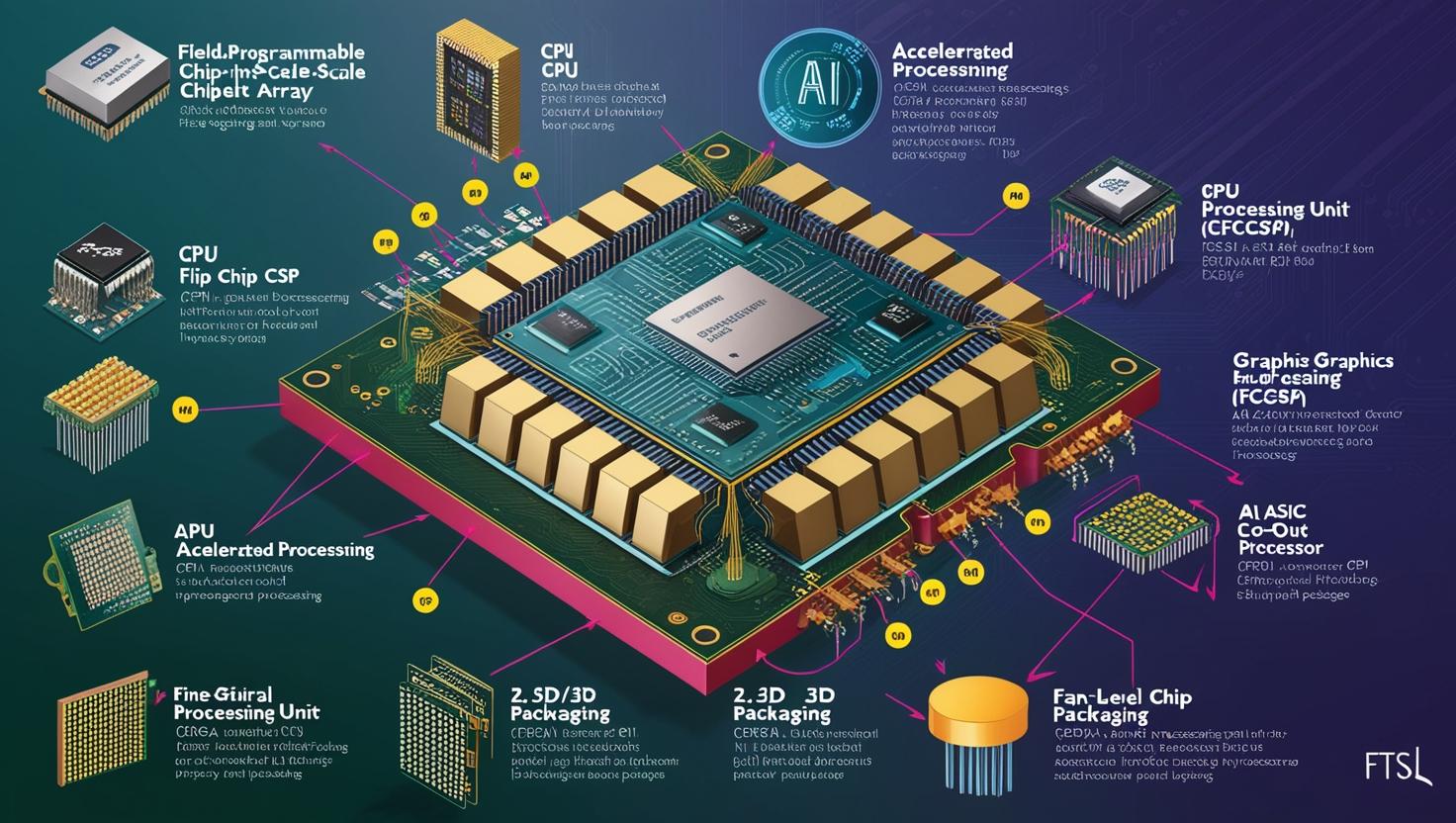
The Chiplet Market encompasses processor categories such as central processing units (CPUs), graphics processing units (GPUs), field-programmable gate arrays (FPGAs), systems-on-chip (SoCs), and AI ASIC co-processors. Packaging technologies include system-in-package (SiP), flip-chip chip-scale packaging (FCCSP), flip-chip ball grid array (FCBGA), 2.5D/3D packaging, wafer-level chip-scale packaging (WLCSP), and fan-out packaging.
As computing workloads become more demanding, chiplets are gaining importance as an architectural approach for building complex semiconductor systems with greater flexibility.
Key Growth Drivers Shaping the Chiplet Market
1. Rising Demand for AI and High-Performance Computing
The expansion of AI workloads is one of the most important growth drivers for the Chiplet Market. Generative AI, large language models, machine learning, and advanced analytics require processors capable of handling massive datasets and complex computations.
Traditional monolithic chip designs can face challenges related to die size, manufacturing yield, power consumption, and design complexity. Chiplet architectures provide an alternative by allowing manufacturers to integrate specialized processing units and high-bandwidth connectivity within a single package.
Data center operators are investing in AI accelerators, advanced CPUs, GPUs, and networking processors to support increasingly demanding workloads. Chiplets can help semiconductor companies develop scalable products by combining computing and connectivity functions in different configurations.
The adoption of chiplets in AI infrastructure also creates opportunities for companies supplying advanced packaging, silicon interposers, high-speed interfaces, and semiconductor testing solutions.
2. Increasing Adoption of Advanced Packaging Technologies
Advanced packaging is central to the development of chiplet-based systems. As traditional transistor scaling becomes more challenging and expensive, semiconductor manufacturers are exploring packaging approaches that integrate multiple dies within a single package.
2.5D packaging places multiple dies side by side, often using a silicon interposer or another high-density interconnect structure. This enables communication between components with shorter connections and higher bandwidth than many conventional board-level approaches.
3D packaging stacks dies vertically to improve integration density and reduce interconnect distances. Depending on the architecture, this can support improved bandwidth, smaller package footprints, and more efficient communication between computing components.
These technologies are particularly relevant to AI accelerators, high-performance processors, and advanced memory integration. As demand for more powerful semiconductor systems grows, companies with advanced packaging expertise may benefit from increasing investment in chiplet manufacturing.
Download PDF Brochure @ https://www.marketsandmarkets.com/pdfdownloadNew.asp?id=131809383
3. Expansion of Cloud Data Centers and 5G Infrastructure
The expansion of cloud computing and 5G networks is increasing demand for high-performance, energy-efficient semiconductor components. Data centers require processors that can support virtualization, distributed computing, AI inference, and large-scale data processing.
Chiplet-based processors can combine computing, networking, and input/output functions to support different system requirements. This modularity enables semiconductor vendors to develop products for multiple workloads while reusing selected design components.
Meanwhile, 5G infrastructure requires high-speed processing and efficient data transmission across networking equipment. Chiplet-based architectures can support complex systems by integrating specialized processing and communication functions.
These applications create opportunities for semiconductor designers, networking equipment suppliers, foundries, and advanced packaging providers.
4. Growing Need for Design Flexibility and Cost Optimization
Developing advanced monolithic chips can involve high engineering costs, long development cycles, and substantial manufacturing risks. As chip complexity increases, designing every function on a single die may become less practical for certain products.
Chiplet architectures allow companies to divide a complex design into smaller functional components. Designers can potentially reuse existing dies, combine components manufactured using different process technologies, and develop product variants without redesigning an entire monolithic chip.
This approach can improve design flexibility and accelerate product development. However, the economic benefits depend on the cost of packaging, interconnects, validation, and integration.
For investors, the opportunity extends beyond chip designers to companies developing reusable semiconductor intellectual property, chiplet interface technology, design automation software, and advanced packaging equipment.
Chiplet Market Analysis: Investment Opportunities
The Chiplet Market presents opportunities across the semiconductor value chain. Investors evaluating this industry should consider not only chip manufacturers but also the suppliers that enable chiplet-based systems to be designed, packaged, tested, and commercialized.
The Role of Open Standards
Interoperability is an important factor in expanding the chiplet ecosystem. Industry standards such as the Universal Chiplet Interconnect Express (UCIe) specification aim to establish common approaches for die-to-die connectivity.
Standardized interfaces could make it easier to integrate chiplets from different suppliers, potentially reducing the barriers to developing heterogeneous semiconductor systems. This creates opportunities for companies that provide compatible IP, interface controllers, packaging technologies, and design tools.
However, widespread interoperability also depends on validation, security, thermal compatibility, and consistent performance across different implementations.
For investors, companies enabling open and interoperable chiplet ecosystems may offer exposure to a broader range of semiconductor applications rather than relying on a single processor product.
Competitive Landscape of the Chiplet Market
The competitive landscape includes semiconductor designers, integrated device manufacturers, foundries, outsourced semiconductor assembly and test (OSAT) providers, and companies specializing in chip design software and interconnect IP.
According to MarketsandMarkets, key players include Intel Corporation, Advanced Micro Devices (AMD), Apple Inc., IBM, and Marvell Technology. Other participants include NVIDIA, MediaTek, Achronix Semiconductor, Ranovus, and ASE Technology Holding.
Competitive Strategies Shaping Market Positioning
Companies are using a combination of product innovation, partnerships, acquisitions, and investments to strengthen their positions in the Chiplet Market.
-
Research and development: Improving chiplet architecture, interconnect performance, power efficiency, and packaging density.
-
Strategic partnerships: Collaborating with foundries, packaging providers, and technology companies to expand manufacturing and integration capabilities.
-
Advanced packaging investments: Building access to technologies that support high-bandwidth and high-density chiplet integration.
-
Ecosystem development: Supporting interoperable interfaces and reusable IP to make chiplet solutions easier to develop and integrate.
-
Application diversification: Expanding into AI accelerators, automotive computing, networking, edge devices, and enterprise infrastructure.
Competition is not limited to semiconductor designers. Foundries and OSAT providers also play a crucial role because chiplet adoption depends on reliable manufacturing, packaging, testing, and supply-chain coordination.
For investors, evaluating the competitive landscape requires looking at technology differentiation, customer relationships, manufacturing capacity, product adoption, and exposure to fast-growing end markets. Company revenue alone does not necessarily indicate chiplet-specific market share.
Segment-Wise Opportunities in the Chiplet Market
By Processor Type
The Chiplet Market covers CPUs, GPUs, FPGAs, SoCs, and AI ASIC co-processors.
CPU chiplets: CPUs remain important for server infrastructure, enterprise computing, and consumer devices. Modular CPU designs can improve scalability and allow manufacturers to combine processing cores with input/output and memory connectivity functions.
GPU chiplets: GPU architectures are relevant to graphics processing, scientific computing, and AI workloads. Growing demand for accelerated computing creates opportunities for advanced integration and high-bandwidth interconnect technologies.
AI ASIC co-processors: Application-specific integrated circuits designed for AI workloads can provide specialized acceleration for training, inference, and other computational tasks. MarketsandMarkets identifies this category as the fastest-growing processor segment during the forecast period, driven by demand for specialized computing in data centers and edge applications.
FPGA and SoC chiplets: These technologies support customizable processing, embedded systems, and integrated computing functions. Their modularity can be useful in applications requiring flexibility and specialized system configurations.
By Packaging Technology
Packaging technology is a major differentiator in chiplet manufacturing because it determines how individual dies are connected and integrated.
2.5D and 3D packaging are important growth areas because they enable high-density integration and shorter interconnect distances. System-in-package solutions can combine different functional dies, while fan-out and flip-chip packaging provide options for different performance, size, and cost requirements.
As chiplet designs incorporate more processing power and memory, packaging innovation will become increasingly important to manage bandwidth, power delivery, thermal performance, and reliability.
Companies investing in advanced packaging infrastructure and process development may benefit from the increasing complexity of next-generation semiconductor systems.
By End-User Industry
Enterprise computing is a significant market for chiplet technologies because data centers and cloud infrastructure require scalable processors for complex workloads. MarketsandMarkets identifies the enterprise end-user industry as the segment expected to hold the largest market share during the forecast period.
Other important end-user industries include telecommunications, consumer electronics, automotive, and industrial applications.
Automotive systems are becoming more computationally intensive as manufacturers integrate advanced driver-assistance systems, infotainment, and centralized vehicle computing. Consumer electronics also offer opportunities for specialized processors and increasingly integrated system designs.
These applications broaden the market beyond traditional server processors and create potential opportunities for suppliers that can tailor chiplet architectures to different performance, power, and cost requirements.
Regional Outlook: Investment Opportunities Across Semiconductor Hubs
Asia Pacific and North America are important regions for chiplet development, supported by semiconductor manufacturing capacity, technology investment, and demand for advanced computing.
Asia Pacific
Asia Pacific has a strong semiconductor ecosystem, with major manufacturing and packaging capabilities in Taiwan, South Korea, China, and Japan. The region also benefits from demand for electronics, telecommunications infrastructure, and high-performance computing.
According to MarketsandMarkets, Asia Pacific is expected to hold the largest share of the Chiplet Market, supported by semiconductor manufacturing infrastructure, advanced packaging investments, and growing demand for AI and 5G applications.
For investors, potential opportunities include foundry services, OSAT providers, packaging equipment, semiconductor materials, and specialized testing technologies.
India also presents emerging opportunities as semiconductor manufacturing, design, and infrastructure investments develop. Growth in domestic electronics production and computing demand could support participation in the wider semiconductor value chain.
North America
North America has a strong ecosystem of semiconductor designers, AI technology developers, cloud service providers, and advanced computing companies. The region’s investment in AI infrastructure and high-performance processors creates opportunities for chiplet architecture and packaging innovation.
MarketsandMarkets identifies North America as the fastest-growing region during the forecast period. Its technology ecosystem, demand for advanced computing, research capabilities, and supportive policy initiatives contribute to this outlook.
Europe
Europe offers opportunities in semiconductor research, automotive electronics, industrial computing, and advanced packaging development. Collaboration between research organizations, semiconductor companies, and industrial manufacturers can support innovation in chiplet integration and interoperability.
Investments in semiconductor research and specialized manufacturing technologies may create opportunities for companies providing design tools, testing solutions, and advanced packaging capabilities.
Challenges and Risks for Chiplet Market Investors
Although the market offers significant growth potential, investors should consider several technical and commercial risks.
Thermal management: Integrating multiple dies into a single package can increase power density and complicate heat dissipation. Advanced cooling, package design, and thermal validation can add cost and complexity.
Manufacturing and packaging costs: Chiplet designs can reduce some manufacturing costs, but advanced packaging and interconnect technologies may require significant investment. The overall economics depend on yield, package complexity, production volume, and testing requirements.
Intellectual property protection: Combining chiplets from different suppliers introduces questions about licensing, ownership, security, and liability. Clear agreements and effective protection mechanisms are essential for broader ecosystem participation.
Interoperability: Differences in interfaces, electrical characteristics, and validation methods can complicate integration. Standards such as UCIe can help, but compatibility and reliability still need to be established for individual implementations.
Supply-chain concentration: Advanced manufacturing and packaging capacity is concentrated among a limited number of specialized providers. Capacity constraints, geopolitical developments, or manufacturing disruptions could affect commercialization and costs.
Investors should therefore assess technology maturity, customer commitments, capital expenditure, manufacturing capacity, and the financial resilience of companies across the chiplet ecosystem.
Future Outlook of the Chiplet Market
The future of the Chiplet Market will be shaped by the continued growth of AI, cloud computing, high-performance computing, and advanced semiconductor packaging.
As transistor scaling becomes more challenging, modular chip architectures offer a way to combine specialized processing functions and different manufacturing technologies within a single package. This approach can provide design flexibility while supporting higher system-level performance.
Several developments are likely to influence the next phase of growth:
-
Advanced 2.5D and 3D integration: Improved packaging density and interconnect performance will support increasingly complex processors.
-
AI-specific chiplets: Specialized accelerators will create opportunities for customized computing architectures.
-
Open chiplet ecosystems: Interoperability standards can encourage collaboration between designers, foundries, and packaging providers.
-
Chiplet testing and validation: Growing integration complexity will increase the importance of quality assurance, reliability testing, and thermal analysis.
-
Quantum chiplet research: Research into integrating quantum and conventional semiconductor components may create longer-term opportunities, although commercial adoption remains uncertain.
MarketsandMarkets also identifies quantum chiplet development as an emerging opportunity, while highlighting intellectual property protection and thermal management as important industry challenges.
For companies seeking to participate in this market, success will depend on developing reliable architectures, securing manufacturing capacity, improving integration economics, and establishing partnerships across the semiconductor value chain.
Conclusion
The Chiplet Market is becoming an important part of the semiconductor industry’s response to growing computing demands. AI, high-performance computing, data center expansion, 5G infrastructure, and advanced packaging are creating opportunities for semiconductor designers, foundries, packaging providers, and testing companies.
With the global market projected to grow from USD 51.94 billion in 2025 to USD 157.23 billion by 2030 at a CAGR of 24.8%, the industry presents substantial growth potential.
Intel, AMD, Apple, IBM, and Marvell are among the major market participants, while companies specializing in advanced packaging, interconnect IP, and semiconductor testing also have important roles to play.
For investors, the strongest opportunities may lie in businesses that combine differentiated technology with scalable manufacturing, established customer relationships, and exposure to growing AI and data center demand. However, thermal challenges, packaging costs, intellectual property risks, and supply-chain constraints remain important considerations.
As chiplet ecosystems mature, modular semiconductor design is expected to become an increasingly important approach to developing high-performance, energy-efficient computing systems.