
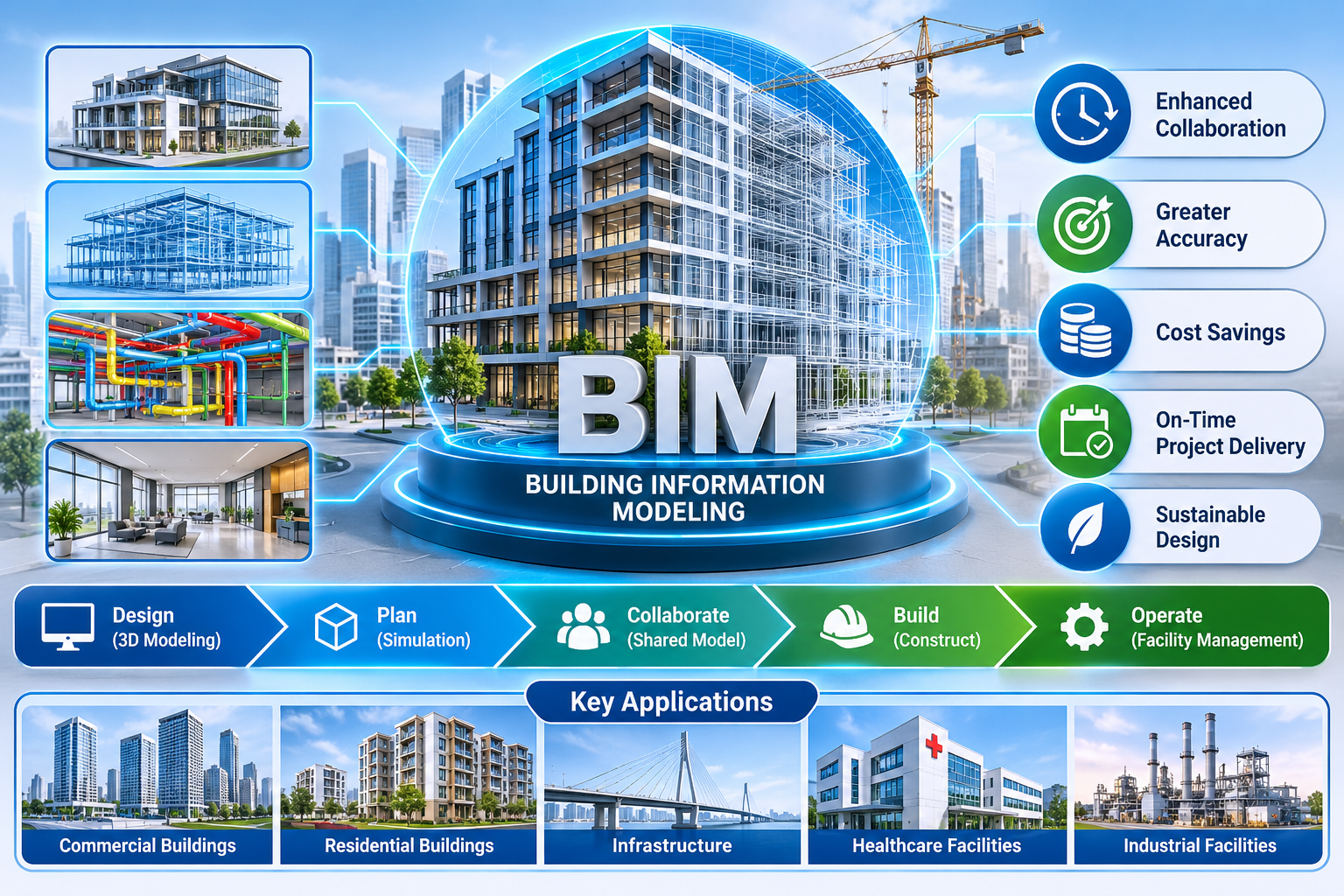
The report building information modeling market is projected to reach USD 18.51 billion by 2032 from USD 9.86 billion in 2026, at a CAGR of 11.1% during the forecast period. The key factor supporting the growth of the building information modeling market is the increasing adoption of digital construction technologies to improve design coordination, project planning, and construction efficiency. The expansion of commercial and residential construction, industrial facilities, and infrastructure projects is increasing demand for BIM software and related services. Growing project complexity and the need to reduce design errors, rework, and construction delays are also encouraging architects, engineers, and contractors to adopt BIM solutions for 3D modeling, cost estimation, quantity takeoff, and construction scheduling. In addition, integrating BIM platforms with cloud collaboration tools, digital twins, project management software, and other construction technologies is supporting the modernization of building and infrastructure workflows. Growing adoption of cloud-based BIM, real-time project data, and AI-enabled design tools is further driving demand for scalable, connected BIM solutions. The growing focus on design accuracy, multidisciplinary coordination, project cost control, and lifecycle asset management is expected to further support market growth.
Download PDF Brochure @ https://www.marketsandmarkets.com/pdfdownloadNew.asp?id=95037387
Based on offering, the software segment is likely to hold the largest market share throughout the forecast period.
Software is expected to account for the largest market share, as it forms the core of BIM adoption across building and infrastructure projects. Architects, engineers, and contractors use BIM software to create 3D models, develop designs, coordinate different building components, and prepare construction documents. The growing need to identify design conflicts, make design changes, estimate project costs, and plan construction activities before execution is supporting software adoption. In addition, BIM software is expanding its use across different project stages for structural design, construction scheduling, quantity estimation, and facility management. Increasing adoption of cloud-based platforms is also making it easier for project teams to share models and collaborate. These factors are expected to sustain demand for BIM software during the forecast period.
Based on vertical, the civil infrastructure segment is expected to witness the highest CAGR during the forecast period.
The civil infrastructure segment is expected to witness the highest CAGR during the forecast period, supported by the increasing use of BIM in large-scale infrastructure projects such as roads, bridges, railways, airports, tunnels, and water infrastructure. These projects involve complex designs, multiple engineering disciplines, and coordination among various stakeholders, increasing the need for accurate digital models and integrated project information. BIM enables infrastructure developers, engineers, and contractors to visualize project designs, assess site conditions, identify design conflicts, and coordinate structural, architectural, and engineering components before and during construction. It also supports quantity estimation, construction scheduling, progress monitoring, and design change management, helping project teams improve planning and control project execution. In addition, the growing focus on infrastructure modernization, transportation network expansion, and smart city development is increasing the need for digital tools that support project coordination and information management. The use of BIM for managing infrastructure assets beyond construction, including maintenance planning and lifecycle information management, is further expanding its application in this vertical. These factors are expected to support the growing adoption of BIM solutions across civil infrastructure projects.
Based on region, Asia Pacific is expected to witness the highest CAGR during the forecast period.
Asia Pacific is expected to register the highest CAGR during the forecast period, supported by increasing construction activities, rapid urbanization, and growing investments in residential, commercial, industrial, and infrastructure projects across the region. Countries such as China, India, Japan, and South Korea are witnessing expanding construction and infrastructure development, increasing the need for digital tools to manage complex projects. The growing use of BIM by architects, engineers, contractors, and infrastructure developers is supporting demand for solutions that improve design coordination, 3D modeling, cost estimation, and construction planning. In addition, government initiatives promoting digital construction, smart city development, and infrastructure modernization are encouraging the adoption of BIM technologies. Increasing use of cloud-based BIM platforms is also enabling project stakeholders to share models, manage design changes, and collaborate across different project locations. Furthermore, the growing focus on reducing construction delays, improving project coordination, and managing infrastructure assets throughout their lifecycle is expected to support BIM adoption across Asia Pacific.
Key Players
The building information modeling market includes several major players, including Autodesk Inc. (US), Nemetschek Group (Germany), Bentley Systems, Incorporated (US), Trimble Inc. (US), and Dassault Systèmes (France). These companies have a strong market presence across North America, Europe, Asia Pacific, and other regions, serving architects, engineers, contractors, infrastructure developers, and facility managers. Their product portfolios include BIM software, 3D design and modeling solutions, construction simulation and scheduling tools, cost estimation and quantity takeoff solutions, project collaboration platforms, and facility and asset management applications. These solutions support building design, construction planning, design coordination, project documentation, infrastructure development, and asset management across various project types and lifecycle stages.
For more info: https://www.marketsandmarkets.com/Market-Reports/building-information-modeling-market-95037387.html