
The Asia Pacific LiDAR market is rapidly transforming the region’s infrastructure, urban planning, and industrial operations. With growing demand for high-resolution spatial data, LiDAR (Light Detection and Ranging) technologies are enabling governments, private enterprises, and infrastructure developers to optimize planning, monitor assets, and enhance operational efficiency.
Driven by urban expansion, smart city initiatives, and transportation modernization, the market is projected to experience robust growth over the next decade. Investors are increasingly recognizing the region’s potential, with applications spanning from aerial surveys to ground-based infrastructure monitoring.
The Asia Pacific LiDAR market is projected to reach USD 4.01 billion by 2030 from USD 0.92 billion in 2025, at a CAGR of 34.1% from 2025 to 2030
Market Segmentation by Installation
1. Airborne LiDAR
Airborne systems, often mounted on aircraft or drones, are ideal for large-scale mapping, environmental monitoring, and disaster management. They allow rapid coverage of vast terrains, including forests, urban areas, and transport corridors. Increasing use of UAVs is lowering operational costs and making airborne LiDAR accessible to mid-sized infrastructure projects.
2. Ground-Based LiDAR
Ground-based LiDAR is widely adopted for infrastructure inspection, construction monitoring, and asset management. Its high accuracy and ability to capture detailed 3D models make it indispensable for roads, bridges, pipelines, and urban development projects.
Investor Takeaway: Ground-based LiDAR offers high-margin opportunities in urban and industrial projects, while airborne systems capture strategic large-scale applications.
Market Segmentation by Type
1. Mechanical LiDAR
Mechanical LiDAR remains a workhorse in the market, providing precise and long-range measurements. Its rotating scanners are preferred in traditional surveying, transportation planning, and corridor mapping where reliability and accuracy are critical.
2. Solid-State LiDAR
Solid-state LiDAR is emerging as the fastest-growing segment due to its compact form, durability, and cost efficiency. Ideal for autonomous vehicles, robotics, and industrial automation, solid-state LiDAR is expected to attract substantial investment in technology-driven sectors.
Investor Takeaway: Solid-state technology represents the next wave of innovation, while mechanical systems continue to dominate established infrastructure applications.
Download PDF Brochure @ https://www.marketsandmarkets.com/pdfdownloadNew.asp?id=9461196
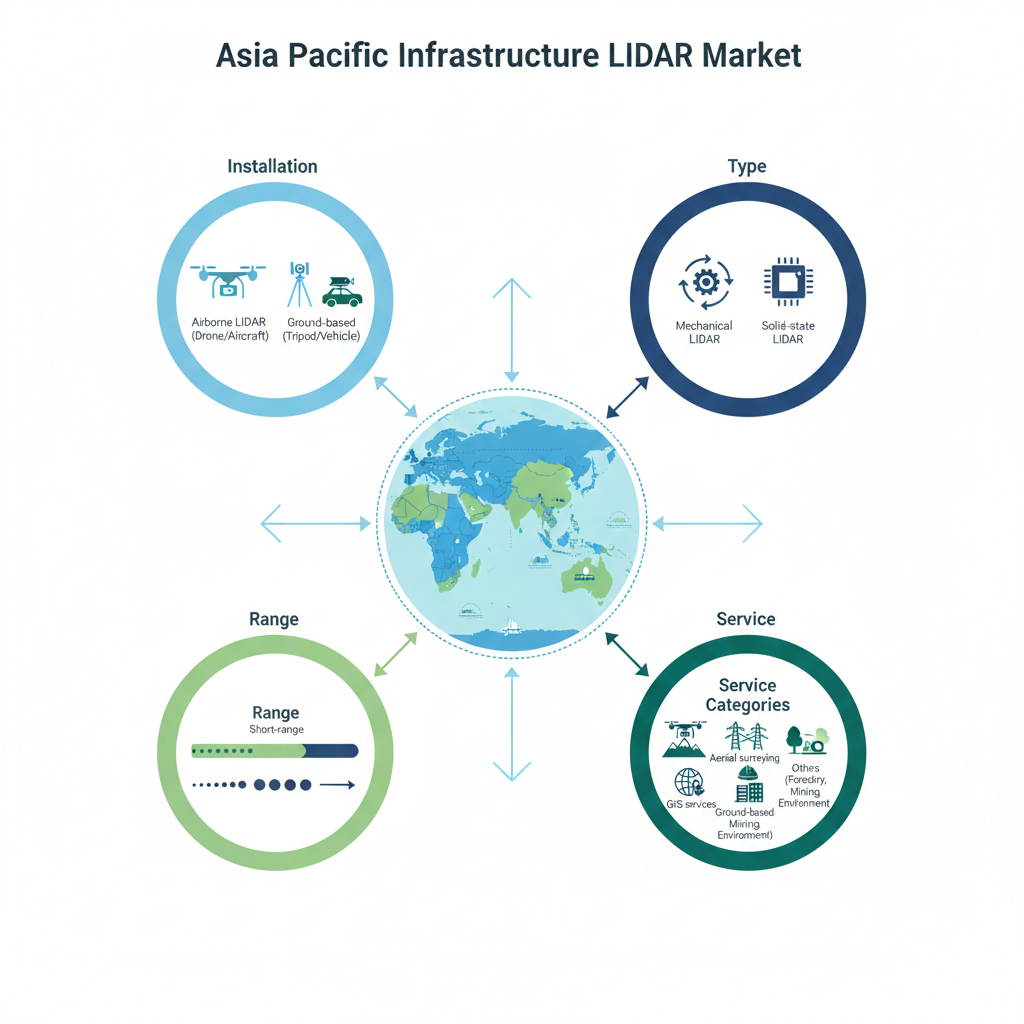
Market Segmentation by Range
-
Short-Range LiDAR: Suited for robotics, industrial automation, and asset inspections in confined spaces.
-
Medium-Range LiDAR: Often applied in construction monitoring, urban mapping, and mid-scale surveying.
-
Long-Range LiDAR: Essential for airborne applications, autonomous highways, and large-terrain modeling, particularly in infrastructure and environmental monitoring projects.
A diversified portfolio across ranges ensures investors can capture both emerging tech opportunities and established surveying applications.
Market Segmentation by Service
-
Aerial Surveying: Dominates projects requiring broad terrain coverage, including forestry, flood risk mapping, and urban planning.
-
Asset Management & GIS Services: Critical for governments and private companies to optimize asset lifecycles, monitor maintenance, and manage spatial data efficiently.
-
Ground-Based Surveying & Others: Provides detailed insights into infrastructure health, construction progress, and mining operations.
Service-oriented investments allow recurring revenue opportunities as governments and corporations increasingly adopt LiDAR solutions for continuous monitoring and planning.
Regional Insights
China leads the Asia Pacific LiDAR market due to massive infrastructure programs, smart city initiatives, and investments in autonomous systems.
India is witnessing rapid adoption of LiDAR for urban planning, transportation, and precision agriculture.
Japan, South Korea, and ASEAN countries are investing in LiDAR for environmental monitoring, urban development, and transportation modernization.
Australia & New Zealand are leveraging LiDAR for infrastructure inspection, mining, and environmental assessment.
Investment Outlook
The Asia Pacific LiDAR market presents multiple investment avenues:
-
High Growth: Rapid adoption in infrastructure and urban development ensures strong revenue potential.
-
Technology Innovation: Solid-state LiDAR and UAV-integrated airborne systems are attracting R&D investments.
-
Service Expansion: GIS and asset management services provide recurring revenue streams.
-
Government Support: Public infrastructure projects and environmental regulations drive adoption.
Investors who strategically target both technology and service segments can tap into a market that combines high-margin opportunities with long-term growth potential.
The Asia Pacific LiDAR market is poised for transformative growth, powered by urbanization, technological innovation, and demand for precise spatial intelligence. By understanding market segmentation—installation, type, range, and service—investors can identify opportunities across emerging technologies and infrastructure projects. As LiDAR adoption expands across APAC, early investors and technology providers stand to gain a competitive edge in one of the world’s most dynamic markets.
FAQ
1. What is the expected market size by 2030?
The market is expected to grow to USD 4.01 billion by 2030.
2. What is the projected growth rate of the market?
The market is expected to grow at a Compound Annual Growth Rate (CAGR) of 34.1% from 2025 to 2030.
3. What factors are driving the growth of the LiDAR market in the Asia Pacific region?
Key growth drivers include:
-
Increasing adoption of LiDAR technology in autonomous vehicles and advanced driver-assistance systems (ADAS).
-
Growing demand for geospatial mapping and surveying solutions.
-
Rising investments in smart city infrastructure and transportation systems.
-
Technological advancements reducing the cost and size of LiDAR sensors.
4. Which countries are leading the LiDAR market in Asia Pacific?
Countries like China, Japan, South Korea, and India are key contributors, driven by strong automotive, robotics, and industrial automation sectors.
5. What are the key applications of LiDAR technology in this region?
Major applications include:
-
Automotive and autonomous vehicles
-
Mapping and surveying
-
Agriculture and forestry management
-
Smart city planning and infrastructure
-
Industrial automation and robotics
6. Which industries are adopting LiDAR technology the fastest?
The automotive industry is the largest adopter due to the push for autonomous vehicles, followed by geospatial mapping, construction, and agriculture secto