
The aerospace industry is entering a new era of technological transformation, and the need for sophisticated testing is growing alongside it. As aircraft manufacturers introduce lightweight composites, advanced avionics, autonomous systems, electrified propulsion, and next-generation aircraft technologies, testing has become increasingly important for validating safety, reliability, performance, and regulatory compliance.
The global aerospace testing market is projected to reach USD 5.50 billion in 2025 and USD 6.91 billion by 2030, registering a CAGR of 4.6% during the forecast period. Rising demand for commercial aircraft in developing economies and the growing use of unmanned aerial vehicles (UAVs) in military and commercial applications are among the major factors supporting market growth.
Advanced Aircraft Technologies Create New Testing Demand
The development of advanced aircraft technologies is creating a growing need for specialized testing solutions. Manufacturers are increasingly using lightweight materials, hybrid-electric propulsion systems, autonomous flight technologies, and sophisticated electronic systems to improve aircraft efficiency and performance.
These innovations require testing methodologies capable of validating technologies under increasingly complex operating conditions. MarketsandMarkets identifies the development of advanced aircraft technologies as a major opportunity for aerospace testing providers.
As aircraft architectures become more complex, testing is also moving beyond traditional structural and material evaluation toward integrated testing of electronic, software, propulsion, and autonomous systems.
AI and Digital Twins Reshape Aerospace Testing
Artificial intelligence is becoming an important technology in the modernization of aerospace testing. AI-driven predictive tools can analyze large volumes of test data and help identify potential performance issues, anomalies, and failure patterns.
MarketsandMarkets highlights AI-driven predictive tools and digital twins among the trends reshaping aerospace testing. Digital twins can create virtual representations of aircraft, components, or systems, allowing engineers to simulate conditions and evaluate potential issues before or alongside physical testing.
The adoption of these technologies can support faster development cycles and more efficient testing while helping aerospace companies manage the complexity of next-generation aircraft programs.
Download PDF Brochure @ https://www.marketsandmarkets.com/pdfdownloadNew.asp?id=32924426
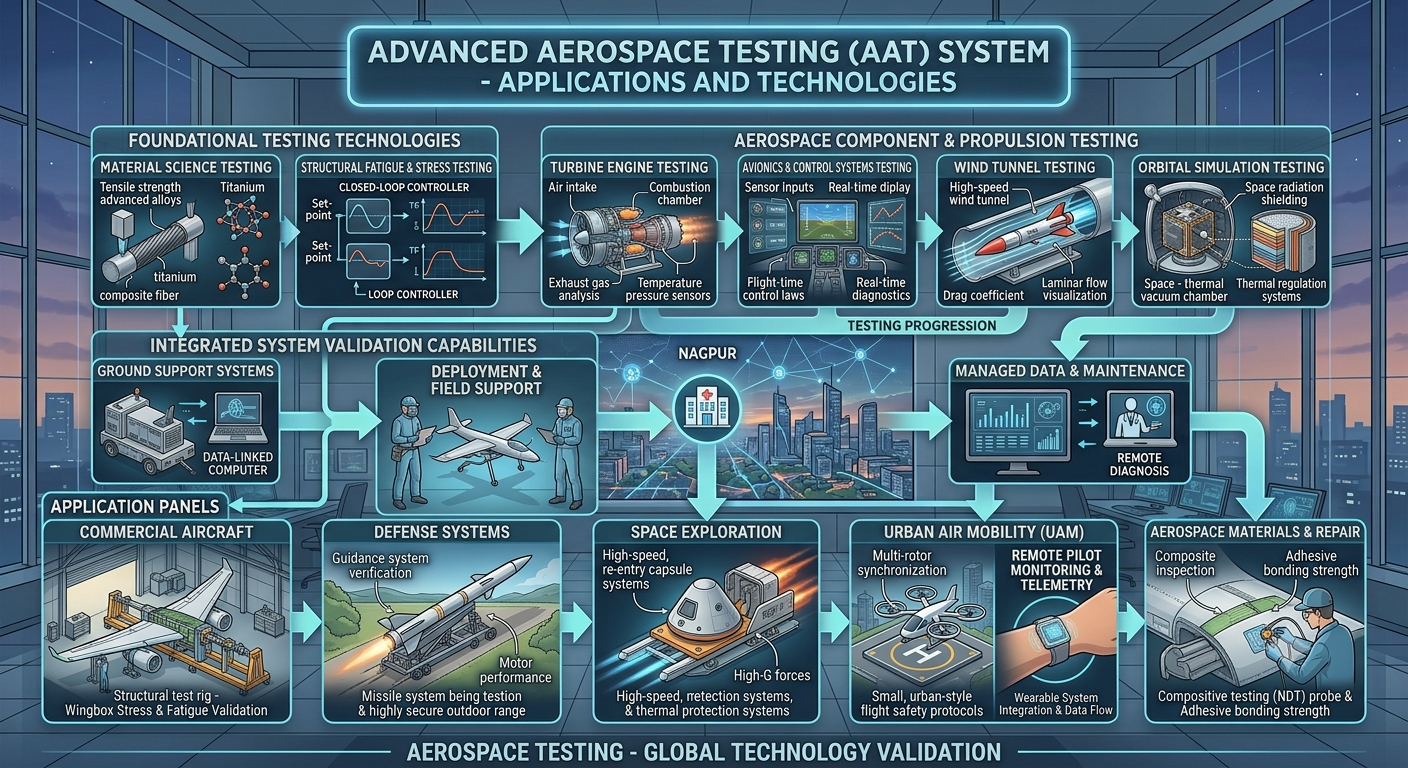
Advanced Composites Increase Material Testing Requirements
The growing use of lightweight composite materials is another major trend influencing the aerospace testing market. Composites can help reduce aircraft weight and improve fuel efficiency, but their performance must be carefully evaluated under mechanical, environmental, thermal, and other stresses.
Testing solutions are therefore needed to assess composite material reliability and structural integrity throughout the aircraft lifecycle. Environmental testing, structural testing, and nondestructive testing (NDT) are becoming increasingly important as composite-rich aircraft platforms enter service.
The transition toward lighter and more efficient aircraft is consequently creating opportunities for testing companies with advanced materials-testing capabilities.
Avionics and Electronics Testing Emerges as a Fast-Growing Segment
Among testing types, the avionics/flight and electronics testing segment is projected to grow at the fastest rate from 2025 to 2030. The growth is linked to rapid advances in flight-control systems, communication technologies, navigation systems, and autonomous aircraft systems.
Modern aircraft increasingly depend on sophisticated electronics for navigation, communication, flight management, safety, and operational efficiency. This growing reliance makes comprehensive testing essential to ensure that avionics systems function correctly under demanding operating conditions.
The rise of electric aircraft and UAVs is adding another layer of demand. These platforms require extensive validation of their electrical, electronic, control, and communication systems before they can be deployed at scale.
Commercial Aviation Remains a Major Market Driver
Commercial aviation accounted for the largest share of the aerospace testing market in 2024. Growing passenger traffic, fleet expansion, and demand for fuel-efficient next-generation aircraft are encouraging airlines and manufacturers to invest in new aircraft platforms.
Every new aircraft program requires extensive material, structural, environmental, propulsion, and electronics testing. Increasing regulatory requirements and the industry’s emphasis on safety and reliability further reinforce the need for comprehensive testing throughout aircraft development and operation.
Developing economies are particularly important to this growth story. Rising urbanization and expanding middle-class populations are increasing demand for air travel, encouraging airlines to expand their fleets and manufacturers to develop new aircraft.
UAVs Open New Testing Opportunities
The growing use of UAVs across military and commercial applications is another significant market driver. UAVs are being developed for applications ranging from defense and surveillance to commercial operations and specialized missions.
Their diverse designs and operating environments create new testing requirements covering flight performance, avionics, communications, propulsion, structures, environmental conditions, and autonomous capabilities.
As UAV technologies become more sophisticated, testing providers are expected to play an increasingly important role in validating new platforms and ensuring compliance with applicable safety requirements.
Space Exploration Is Expected to Grow Rapidly
The space exploration segment is expected to register the highest CAGR among end users, at 7.4% during the forecast period. Growing investments in space programs and the development of advanced space systems are creating additional demand for specialized testing.
Spacecraft and related systems must operate in highly demanding environments, requiring rigorous testing of structures, materials, propulsion systems, electronics, and environmental performance.
The expansion of commercial space activities and government-backed space programs could therefore become an increasingly important source of growth for aerospace testing providers.
Asia Pacific Emerges as the Fastest-Growing Region
Asia Pacific is expected to be the fastest-growing regional market for aerospace testing during the forecast period. Rapid economic development in countries such as China, India, and Japan is contributing to growth in commercial and military aircraft production.
Growing air travel demand is encouraging airlines to invest in new, fuel-efficient aircraft, while government investments in defense and space programs are generating additional testing requirements.
The region’s expanding aerospace manufacturing ecosystem is also creating opportunities for local testing infrastructure, specialized laboratories, and third-party testing providers.
Outsourcing Creates Opportunities for Testing Providers
While many aerospace companies maintain in-house testing capabilities because of the specialized nature of aerospace programs, the outsourced segment is expected to register a CAGR of 5.7% during the forecast period.
Outsourcing can provide access to specialized equipment, accredited laboratories, advanced expertise, and testing capabilities that may be costly to develop internally.
Testing providers with global laboratory networks and capabilities spanning materials, NDT, environmental, structural, engine, and avionics testing are positioned to benefit from this trend.
Regulatory Complexity Remains a Challenge
Aerospace testing is subject to stringent safety and quality requirements. Extensive documentation, validation, certification, and regulatory compliance can make testing processes complex and time-consuming.
At the same time, aerospace companies face pressure to control development costs and bring new technologies to market faster. Budget constraints can therefore encourage companies to seek more efficient testing methodologies while maintaining required safety standards.
This creates an opportunity for advanced testing technologies that can improve data analysis, automation, predictive maintenance, and testing efficiency without compromising certification requirements.
Competitive Landscape
The aerospace testing market includes major testing and certification companies as well as aerospace manufacturers with extensive internal testing capabilities. Key players identified by MarketsandMarkets include Element Materials Technology, SGS, Intertek, Applus+, TÜV SÜD, TÜV Rheinland, TÜV NORD Group, Rohde & Schwarz, Eurofins Scientific, Boeing, Airbus, MISTRAS Group, Lockheed Martin, Bureau Veritas, and DEKRA.
Companies are strengthening their positions through advanced testing equipment, global laboratory networks, certification capabilities, partnerships, and specialized services across the aerospace value chain.
Outlook for the Aerospace Testing Market
The aerospace testing industry is moving from conventional testing toward a more connected and technology-driven model. AI, digital twins, advanced NDT, structural health monitoring, automated testing, and sophisticated avionics validation are expected to reshape how aircraft and aerospace systems are tested.
The market’s projected growth to USD 6.91 billion by 2030 reflects the expanding testing requirements associated with next-generation aircraft, UAVs, advanced materials, electrified propulsion, sophisticated avionics, and space exploration.
As aerospace technology continues to evolve, testing will remain a critical component of innovation. The companies that can combine advanced testing methodologies with speed, accuracy, regulatory expertise, and data-driven technologies will be well positioned to capture emerging opportunities across commercial aviation, defense, UAVs, and space exploration.
FAQs
1. What is the projected size of the aerospace testing market by 2030?
The global aerospace testing market is projected to grow from USD 5.50 billion in 2025 to USD 6.91 billion by 2030, representing a 4.6% CAGR from 2025 to 2030.
2. What are the key factors driving aerospace testing market growth?
Major growth drivers include rising demand for commercial aircraft in developing economies, increasing UAV adoption in military and commercial applications, and government investments in military and defense aircraft.
3. Which aerospace testing segment is expected to grow fastest?
The avionics/flight and electronics testing segment is projected to grow at the fastest rate from 2025 to 2030. Increasing use of advanced flight-control, communication, navigation, autonomous, and electronic systems is driving demand for comprehensive testing.
4. What emerging technologies are creating opportunities in aerospace testing?
AI-driven predictive tools, digital twins, advanced nondestructive testing (NDT), structural health monitoring, autonomous systems, and avionics cybersecurity are among the technologies reshaping aerospace testing. The development of lightweight materials, hybrid-electric propulsion, and autonomous flight is also creating demand for specialized testing methodologies.
5. Which region is expected to experience the fastest growth?
Asia Pacific is expected to be the fastest-growing regional market during the forecast period. Increasing commercial and military aircraft production, rising air-travel demand, and government investments in defense and space programs are supporting growth across countries including China, India, and Japan.