
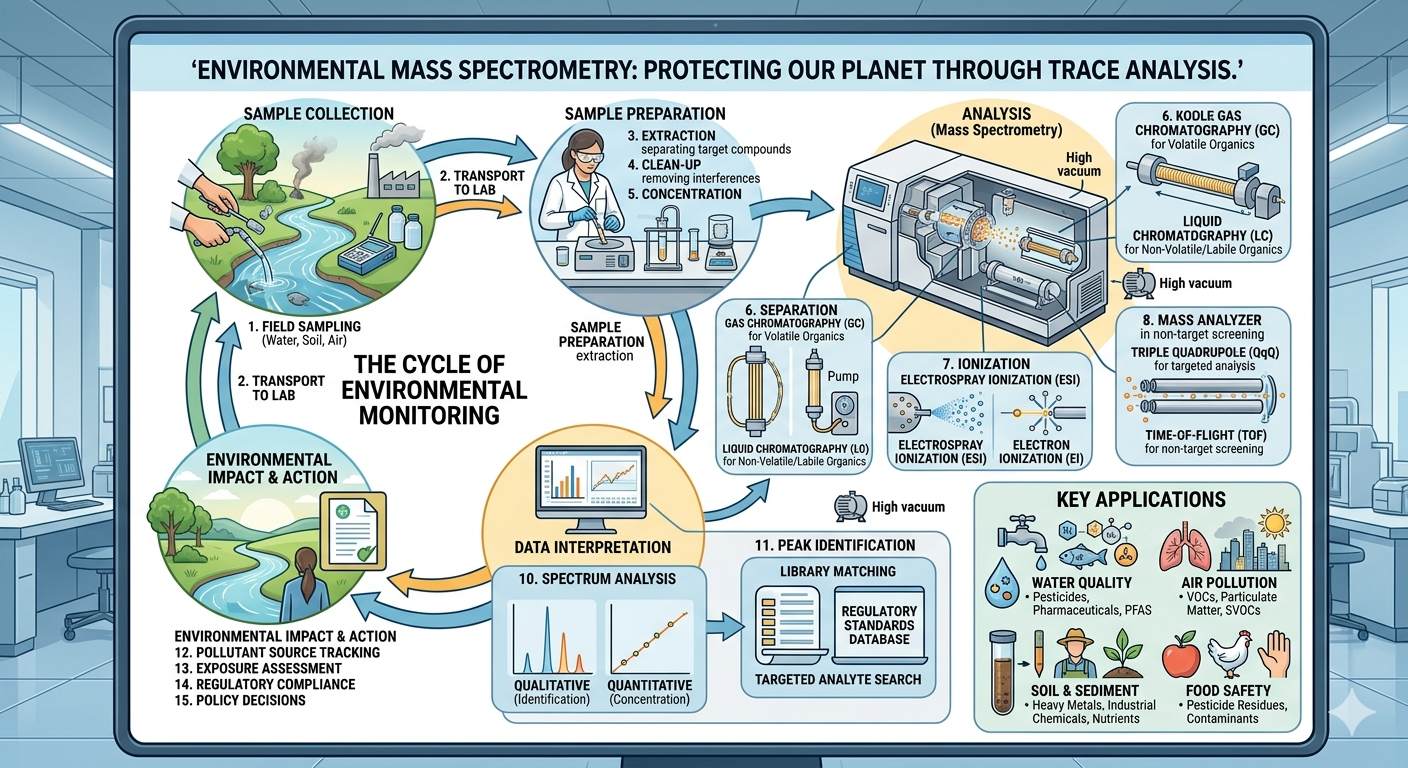
The environmental mass spectrometry market is entering a phase of accelerated evolution, driven by increasingly stringent regulatory frameworks, rapid technological innovation, and the global shift toward real-time environmental intelligence. Valued at US$0.86 billion in 2024, the market reached US$0.93 billion in 2025 and is projected to grow at a CAGR of 7.3% through 2031, ultimately reaching US$1.47 billion.
This growth trajectory reflects not only expanding analytical requirements but also a structural transformation in how environmental monitoring is conducted—shifting from periodic testing to continuous, predictive analysis.
Market Snapshot: Key Takeaways
- North America dominated with a 40% market share in 2025, supported by strong regulatory enforcement and advanced laboratory infrastructure.
- Water analysis is the fastest-growing application segment, registering a CAGR of 8.5%, fueled by concerns around contaminants like PFAS and micro-pollutants.
- Contract testing laboratories are emerging as high-growth end users, with a CAGR of 9.5%, reflecting outsourcing trends and the need for specialized analytical capabilities.
- Leading companies include major instrumentation providers with extensive portfolios and global reach, while niche players are gaining traction through specialized technologies and targeted applications.
Download PDF Brochure @ https://www.marketsandmarkets.com/pdfdownloadNew.asp?id=226984101
Market Drivers: Precision, Compliance, and Real-Time Intelligence
1. Rising Regulatory Pressure for Ultra-Low Detection Limits
Global environmental agencies are tightening permissible limits for contaminants in water, air, and soil. This is pushing laboratories and industries to adopt high-sensitivity platforms such as GC-MS/MS and LC-MS/MS, capable of detecting compounds at ultra-trace levels.
2. Increasing Demand for Real-Time VOC Monitoring
Industries are prioritizing continuous monitoring of volatile organic compounds (VOCs) and very volatile organic compounds (VVOCs). Technologies such as Proton Transfer Reaction–Mass Spectrometry (PTR-MS) and Molecular Beam Mass Spectrometry (MBMS) are enabling near real-time detection, supporting faster decision-making and regulatory compliance.
3. Integration of AI and Machine Learning
The integration of AI/ML into mass spectrometry workflows is transforming data interpretation. Advanced algorithms now enable:
- Predictive environmental risk modeling
- Automated compound identification
- High-throughput data processing
This shift is moving environmental monitoring toward predictive and preventive frameworks, rather than reactive testing.
Emerging Trends Reshaping the Market
Ultra-Trace Contaminant Detection
There is a sharp increase in demand for detecting:
- PFAS in drinking water using LC-MS/MS
- Pesticides in soil and crops via GC-MS and triple quadrupole systems
- Dioxins and PCBs in water supplies
- VOCs in ambient air through PTR-TOF-MS
Adoption of High-Resolution Mass Spectrometry
Technologies such as:
- Q-TOF-MS
- Orbitrap MS
- ICP-MS (for elemental analysis)
are gaining traction due to their superior sensitivity, mass accuracy, and ability to handle complex environmental matrices.
Automation and Workflow Optimization
Laboratories are increasingly adopting automated sample preparation, integrated data pipelines, and cloud-based platforms to improve throughput and reduce turnaround times.
Market Dynamics
Drivers
- Rising demand for real-time monitoring of VOCs & VVOCs
- Regulatory mandates for ultra-low detection limits
Restraints
- Limited portability of high-end MS systems
- High capital and operational costs
Opportunities
- Growing need to monitor:
- Disinfection by-products
- Industrial organic pollutants
- Antimicrobial residues
- Agricultural chemicals
- Expansion of predictive environmental monitoring using real-time MS
Challenges
- Low ionization efficiency of non-polar and thermally labile compounds
- Integration complexity with complementary analytical techniques
- Throughput and data processing limitations in large-scale deployments
Strategic Implications for Stakeholders
For Instrument Manufacturers
There is a clear opportunity to invest in:
- Portable and field-deployable MS systems
- AI-driven analytics platforms
- Hybrid technologies combining multiple detection techniques
For Contract Testing Labs
Scaling high-throughput capabilities and adopting automation will be critical to meet rising demand and maintain competitive differentiation.
For Regulators and Environmental Agencies
The transition toward real-time monitoring systems offers improved enforcement capabilities and more proactive environmental management.
Future Outlook: From Monitoring to Prediction
The environmental mass spectrometry market is moving beyond traditional analytical chemistry into a data-centric ecosystem. The convergence of high-resolution instrumentation, AI-driven analytics, and real-time monitoring technologies is redefining environmental surveillance.
Organizations that align their strategies with these technological shifts—particularly in predictive analytics and automation—will be best positioned to capitalize on this growth phase.
Inquire Before Buying @ https://www.marketsandmarkets.com/Purchase/purchase_reportNew.asp?id=226984101