
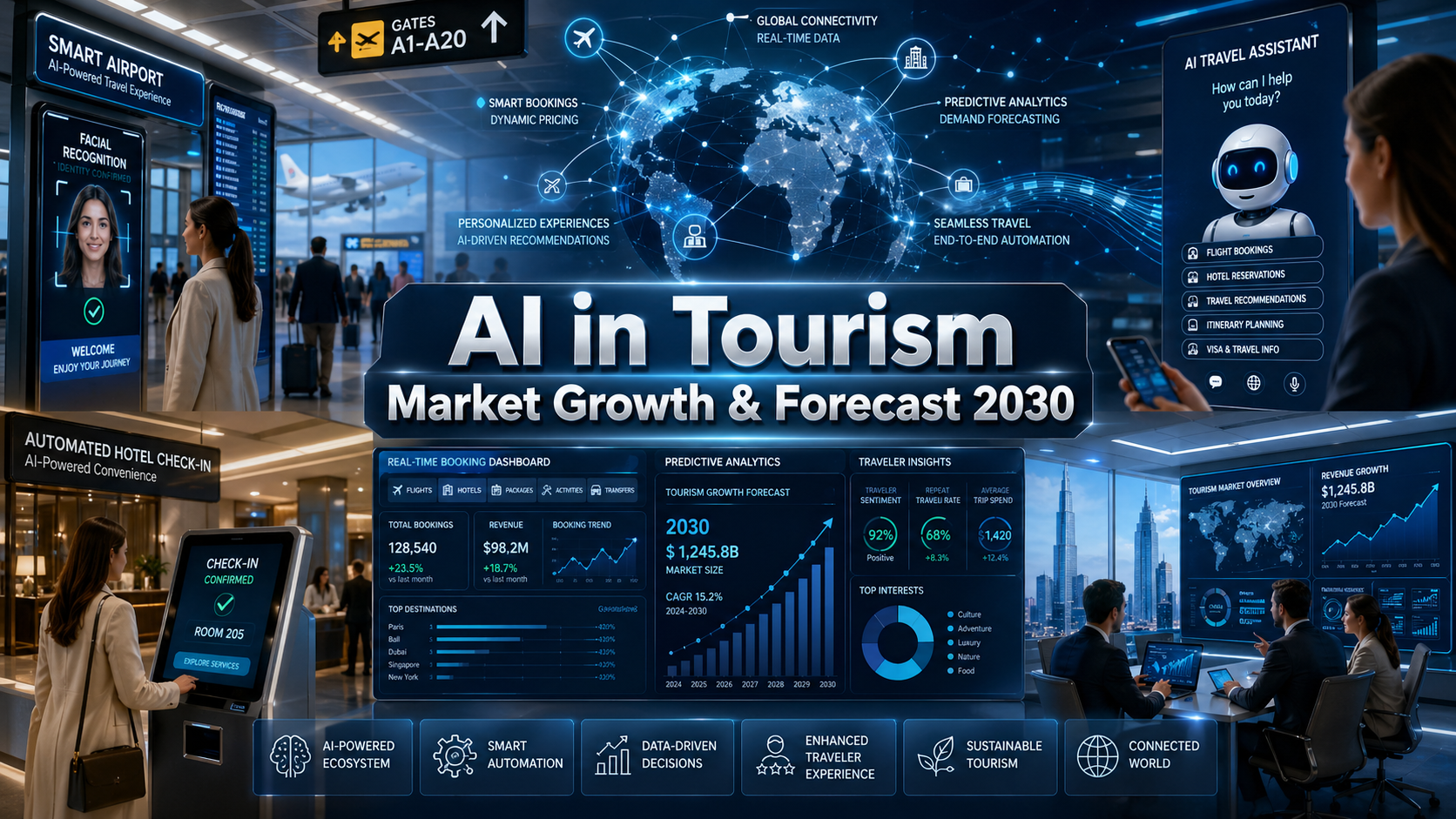
AI in Tourism growth
According to a research report “Artificial Intelligence in Tourism Market by Solution (Virtual Assistant & Chatbots, Pricing & Revenue Management, Booking Management System), End Users (Maritime Travel, Aviation, Cruise Line Operators, Resorts & Theme Parks) – Global Forecast to 2030″ published by MarketsandMarkets, the AI in Tourism market size is projected to reach USD 13.38 billion by 2030 from USD 2.95 billion in 2024, at a Compound Annual Growth Rate (CAGR) of 28.7% during the AI in Tourism forecast period (2024–2030).
AI-based security systems are emerging as critical enablers driving AI in Tourism growth by enhancing safety standards across the industry. Advanced technologies such as facial recognition, biometric authentication, and AI-driven surveillance are being deployed across airports, hotels, and travel destinations to streamline security operations while enabling real-time threat detection. Facial recognition at check-in points and border crossings accelerates identity verification, improving operational efficiency and reducing processing time. AI-powered surveillance systems enhance large-area monitoring, detect suspicious activities, and enable proactive security responses. These innovations significantly contribute to the AI in Tourism outlook, ensuring safer and more efficient travel experiences while strengthening operational performance.
Download PDF : https://www.marketsandmarkets.com/pdfdownloadNew.asp?id=114969018
“Based on type, the Other AI segment to hold the largest market size during the forecast period.”
Other AI segments encompass advanced technologies such as machine learning, natural language processing (NLP), computer vision, and predictive analytics, which are central to AI in Tourism analysis and transformation. These technologies enable businesses to process large data volumes, identify patterns, and optimize operational efficiency while delivering personalized services such as dynamic pricing and targeted promotions. NLP-powered chatbots and virtual assistants enhance customer engagement by delivering real-time responses to traveler queries. Computer vision improves airport security, enhances customer experience, and strengthens safety through automated surveillance and facial recognition systems. Predictive analytics supports data-driven decision-making by forecasting customer behavior, including booking trends and travel disruptions. Collectively, these innovations are shaping AI in Tourism trends and driving next-generation service delivery across the tourism ecosystem.
“The services segment to have highest growth during the forecast period.”
Tourism enterprises are increasingly leveraging a wide range of services to optimize AI deployment and infrastructure capabilities, supporting overall AI in Tourism share expansion. Professional services, including consulting and training, enable seamless AI integration with existing systems while enhancing capabilities such as personalized marketing and customer engagement. Support and maintenance services ensure continuous performance optimization and scalability of AI applications. Managed services further enable organizations to outsource AI operations, including monitoring and lifecycle management, allowing businesses to focus on core competencies while improving efficiency. This service-driven approach is a key contributor to the AI in Tourism report landscape and long-term market scalability.
Sample Report : https://www.marketsandmarkets.com/requestsampleNew.asp?id=114969018
Top 10 Companies in AI in Tourism
- Snowflake (US)
- IBM (US)
- NVIDIA (US)
- Microsoft (US)
- AWS (US)
- Salesforce (US)
- Huawei (China)
- Appier (Taiwan)
- Sabre Corporation (US)
- SAS Institute (US)
“North America is expected to hold the second-largest market size during the forecast period.”
The US is accelerating the adoption of AI across industries, including tourism, through strong public funding and strategic initiatives, significantly influencing the AI in Tourism forecast trajectory. In May 2023, the National Science Foundation allocated USD 140 million to establish seven National AI Research Institutes aimed at advancing AI innovation and workforce diversity. In July 2024, Wyndham Hotels & Resorts introduced Wyndham Connect, leveraging AI and large language models to enhance guest experiences through mobile tipping and AI-driven communication while boosting revenue streams.
In April 2024, Canada announced a USD 2.07 billion investment package in its federal budget to strengthen its AI sector. Additionally, in December 2023, NVIDIA Metropolis and Inception member Sensors implemented a visual AI platform at Toronto Pearson International Airport to reduce customs wait times. Real-time wait-time insights are shared via digital dashboards and terminal displays, enabling passengers to access accurate processing timelines. These developments are key indicators shaping the regional AI in Tourism analysis, driving adoption, and reinforcing market expansion across North America.