
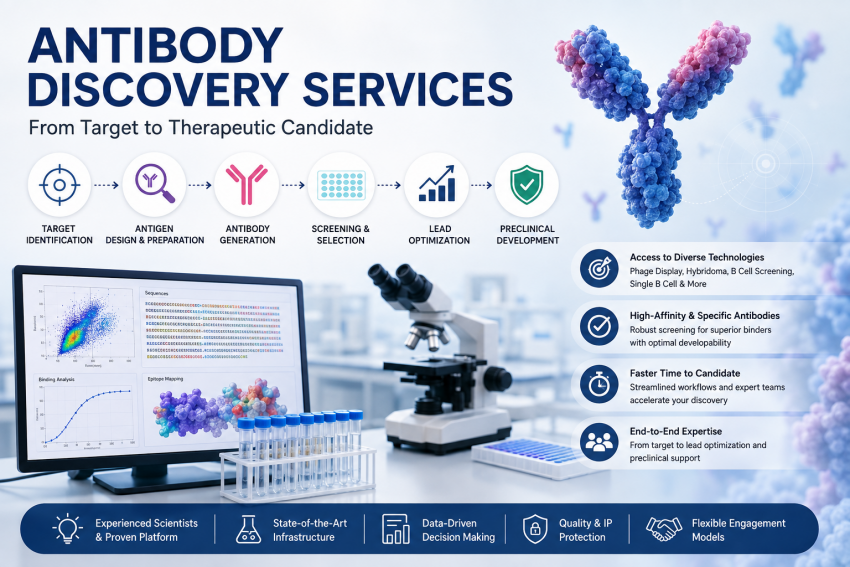
The global Antibody Discovery Services Market is witnessing remarkable growth as pharmaceutical and biotechnology companies accelerate investments in biologics, precision medicine, and advanced therapeutic antibodies. Valued at USD 1.90 billion in 2025, the market is projected to reach USD 3.54 billion by 2030, growing at a CAGR of 13.3%.
The increasing development of monoclonal antibodies, bispecific antibodies, antibody-drug conjugates (ADCs), and antibody fragments is driving demand for specialized discovery services. At the same time, advances in artificial intelligence (AI), automation, and end-to-end discovery platforms are helping organizations shorten development timelines and improve success rates.
Download PDF Brochure: https://www.marketsandmarkets.com/pdfdownloadNew.asp?id=182887795
Why the Antibody Discovery Services Market Is Expanding
Biologics continue to dominate modern drug development due to their high target specificity and strong clinical outcomes. Pharmaceutical companies are increasingly outsourcing antibody discovery activities to specialized service providers that offer expertise, advanced technologies, and scalable research capabilities.
Key factors driving market growth include:
- Growing demand for therapeutic antibodies
- Expansion of antibody-drug conjugate (ADC) pipelines
- Rising development of bispecific antibodies and antibody fragments
- Increasing venture capital investments in biotechnology
- Growing adoption of AI-powered drug discovery platforms
- Rising outsourcing to contract research organizations (CROs)
- End-to-end discovery-to-IND service offerings
Despite challenges such as high discovery costs, complex biologics development, biosimilar competition, and emerging cell and gene therapies, the market continues to expand through technological innovation and strategic collaborations.
Next-Generation Antibody Formats Are Creating New Opportunities
One of the strongest drivers of the Antibody Discovery Services Market is the rapid development of innovative antibody formats.
Unlike traditional monoclonal antibodies that recognize a single target, bispecific antibodies can bind two different targets simultaneously, enabling more effective immune system activation against cancer cells and other complex diseases.
Similarly, Fab fragments offer several advantages, including:
- Improved tissue penetration
- Enhanced targeting capabilities
- Flexible molecular engineering
- Reduced molecular size
- Applications in complex therapeutic designs
These next-generation biologics are expanding the scope of antibody discovery across oncology, immunology, infectious diseases, and rare disorders.
Artificial Intelligence Is Revolutionizing Antibody Discovery
Artificial intelligence and laboratory automation are fundamentally changing how therapeutic antibodies are discovered and optimized.
Modern AI-driven platforms can rapidly analyze biological data, predict antibody structures, identify promising candidates, and optimize antibody characteristics with unprecedented speed.
Combined with automated high-throughput screening and robotic laboratory systems, AI enables researchers to:
- Accelerate lead identification
- Improve antibody affinity and specificity
- Reduce research timelines
- Increase screening capacity
- Lower operational costs
- Improve overall discovery efficiency
As pharmaceutical companies seek faster development cycles and improved productivity, AI-powered antibody discovery services are becoming an essential competitive advantage.
Antibody Engineering and Optimization Is the Fastest-Growing Service Segment
Among all service categories, antibody engineering and optimization is expected to register the highest growth throughout the forecast period.
Following initial antibody discovery, therapeutic candidates require extensive optimization before entering clinical development. Service providers enhance antibodies through advanced engineering techniques such as:
- Affinity maturation
- Humanization
- Fc engineering
- Stability optimization
- Structure-guided design
- Computational antibody modeling
These services help improve efficacy, safety, manufacturability, and clinical success while supporting pharmaceutical companies in developing differentiated biologic therapies.
Growing demand for optimized antibodies across oncology, autoimmune diseases, inflammation, and infectious diseases continues to drive this segment.
Request Sample Pages : https://www.marketsandmarkets.com/requestsampleNew.asp?id=182887795
Monoclonal Antibodies Continue to Dominate Discovery Programs
The monoclonal antibodies segment accounted for the largest share of the Antibody Discovery Services Market and remains the industry’s primary focus.
Monoclonal antibodies have transformed treatment approaches for numerous diseases because of their exceptional target specificity, reproducible performance, and proven clinical effectiveness.
Today, they are widely used across:
- Cancer therapeutics
- Autoimmune disorders
- Chronic inflammatory diseases
- Infectious diseases
- Rare genetic disorders
As pharmaceutical pipelines increasingly prioritize biologics, demand for high-quality monoclonal antibody discovery, screening, and optimization services continues to rise.
Asia Pacific Emerges as the Fastest-Growing Regional Market
While North America and Europe remain established biologics hubs, Asia Pacific is expected to experience the highest growth during the forecast period.
Countries including China, India, Japan, and South Korea are making substantial investments in biotechnology research, antibody development infrastructure, and contract research capabilities.
Several factors are supporting regional growth:
- Expanding pharmaceutical and biotechnology industries
- Increasing government support for biologics research
- Availability of highly skilled scientific talent
- Competitive research and development costs
- Rising outsourcing from global pharmaceutical companies
- Growing incidence of chronic diseases
These advantages have positioned Asia Pacific as an attractive destination for global antibody discovery partnerships.
Competitive Landscape
The Antibody Discovery Services Market is highly competitive, with leading global service providers expanding their capabilities through innovation, partnerships, acquisitions, and technology integration.
Companies are investing in:
- AI-enabled discovery platforms
- High-throughput screening technologies
- Automation and robotics
- Integrated discovery-to-IND services
- Global laboratory expansion
- Strategic collaborations with pharmaceutical companies
These initiatives are helping service providers deliver faster, more accurate, and cost-effective antibody discovery solutions for an increasingly complex biologics landscape.
Enquire Before Buying: https://www.marketsandmarkets.com/Enquiry_Before_BuyingNew.asp?id=182887795
Future Outlook
The future of the Antibody Discovery Services Market is exceptionally promising as biologics continue to dominate pharmaceutical innovation. Increasing adoption of AI-driven discovery platforms, advances in antibody engineering, expanding ADC pipelines, and growing investments in precision medicine are expected to reshape therapeutic development over the coming years.
Organizations that leverage advanced antibody discovery technologies and integrated service models will be better positioned to accelerate drug development, reduce research costs, and bring life-changing therapies to patients more efficiently.
As demand for innovative biologics continues to rise worldwide, antibody discovery services will remain a critical pillar supporting the next generation of precision medicine and targeted therapeutics.