
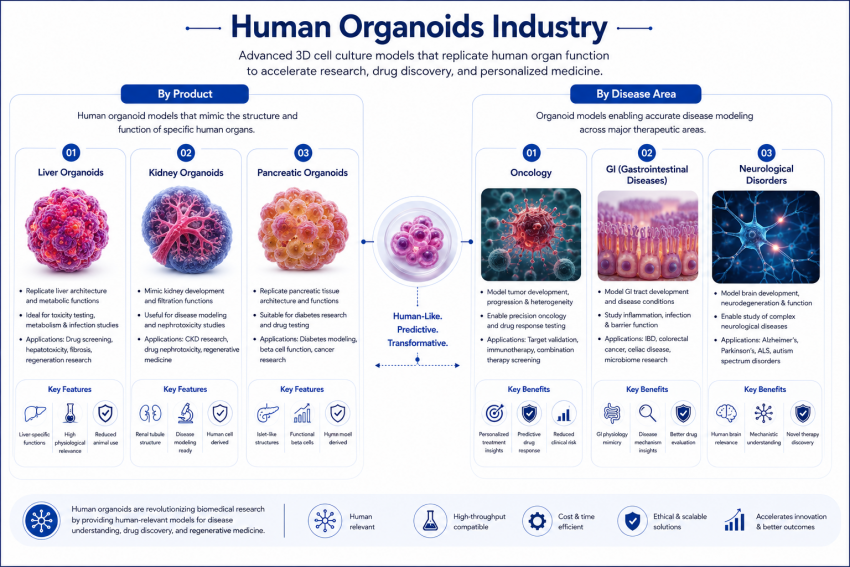
The global human organoids market is projected to grow from USD 1.19 billion in 2024 to USD 2.33 billion by 2029, at a CAGR of 14.4% during the forecast period. Market growth is driven by the increasing need for ethical alternatives to animal testing, rising demand for more predictive preclinical models, and growing investments in biomedical research.
Browse 543 market data Tables and 51 Figures spread through 426 Pages and in-depth TOC on “Human Organoids Market”.
Download PDF Brochure:- https://www.marketsandmarkets.com/pdfdownloadNew.asp?id=171046468
Organoids are emerging as highly reliable tools in drug discovery and disease modeling, offering early-stage insights that improve research efficiency and reduce costly late-stage failures. Their ability to closely mimic human organ physiology is accelerating adoption across pharmaceutical, biotechnology, and academic research settings. Additionally, increasing incidence of cancer and infectious diseases is further fueling demand for advanced research models such as organoids.
Matrigel Matrix Culture Dominates by Culture Method
By culture method, the Matrigel matrix culture segment accounted for the largest share of the human organoids market in 2023. This dominance is attributed to its unique properties that support the growth, differentiation, and structural integrity of organoids.
Matrigel is widely used due to its ease of handling, compatibility with diverse cell types, and applicability across multiple organ systems, including liver, intestine, and brain models. Its versatility and proven performance have made it a preferred choice among researchers, contributing significantly to its strong market position.
Oncology Segment Leads Disease Area
By disease area, the oncology segment held the largest share of the market in 2023. The increasing global prevalence of cancer and the growing focus on precision medicine are key factors driving this segment.
Organoids enable researchers to develop patient-specific tumor models, allowing for more accurate testing of therapeutic responses. This supports the advancement of personalized treatment strategies, improving clinical outcomes while reducing adverse effects. As a result, oncology remains a primary application area for organoid-based research.
Speak To Analyst:- https://www.marketsandmarkets.com/speaktoanalystNew.asp?id=171046468
North America Leads Global Market
North America accounted for the largest share of the human organoids market in 2023. The region’s dominance is driven by well-established healthcare infrastructure, high research and development spending, and strong presence of leading pharmaceutical and biotechnology companies.
The US and Canada are at the forefront of biomedical innovation, supported by substantial funding for life sciences research and increasing demand for advanced disease modeling tools. Additionally, the high prevalence of cancer and infectious diseases in the region further drives the adoption of organoid technologies.
Competitive Landscape
Key players operating in the human organoids market include Thermo Fisher Scientific Inc. (US), Corning Incorporated (US), Merck KGaA (Germany), BioIVT (US), HUB Organoids BV (Netherlands), BICO (Sweden), BeCytes Biotechnologies SL (Spain), InSphero (Switzerland), GBA Group (Germany), and Kirkstall Ltd. (UK), among others.
These companies are focusing on technological innovation, product development, and strategic collaborations to expand their organoid platforms and strengthen their global market presence.