
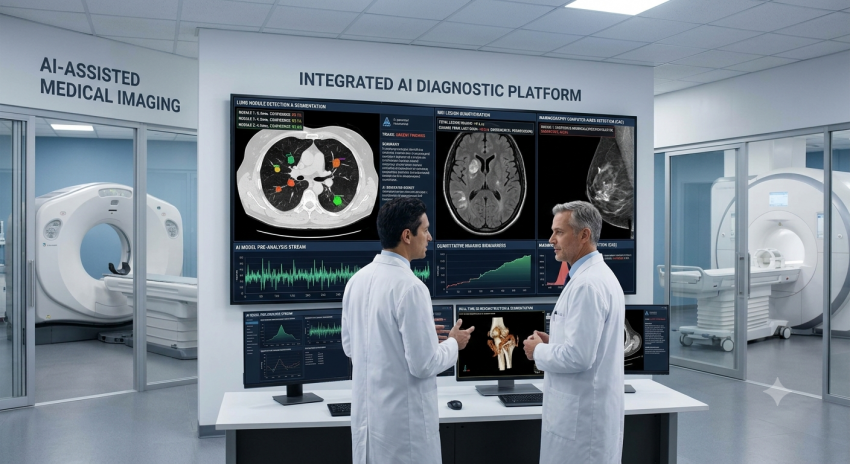
The global artificial intelligence (AI) in medical imaging market is projected to grow from USD 1.65 billion in 2024 to USD 4.54 billion by 2029, at a robust CAGR of 22.4% during the forecast period. This strong growth is fueled by increasing investments in AI-driven healthcare startups, rising cross-industry collaborations, and the growing demand for improved diagnostic accuracy and operational efficiency in healthcare systems.
Browse 523 market data Tables and 59 Figures spread through 430 Pages and in-depth TOC on “Artificial Intelligence (AI) in Medical Imaging Market”.
Download PDF Brochure:- https://www.marketsandmarkets.com/pdfdownloadNew.asp?id=21977207
AI technologies are transforming medical imaging by enhancing image interpretation, reducing diagnostic errors, and streamlining clinical workflows. However, challenges such as a shortage of skilled AI professionals and evolving regulatory frameworks may impact the pace of adoption across clinical settings.
Software Segment to Lead Market Growth
By component, the software segment is expected to dominate the AI in medical imaging market and register the highest CAGR during the forecast period. AI-powered software solutions are increasingly being adopted to address workforce shortages and rising imaging volumes.
These solutions enable healthcare providers to optimize workflows, improve resource utilization, and achieve higher diagnostic precision, providing a significant competitive advantage in clinical environments.
Radiology Segment Drives Application Demand
By application, the radiology segment is projected to hold the largest share of the market, supported by its central role in diagnostic imaging. With billions of imaging procedures conducted annually, radiology represents a key area for AI integration.
AI applications in radiology enhance accuracy, reduce diagnostic errors, and automate tasks such as lesion detection and image analysis. Meanwhile, the oncology segment is expected to witness the highest growth rate, driven by increasing demand for early cancer detection, personalized treatment planning, and precise diagnostics.
Hospitals Segment Dominates End User Market
By end user, hospitals are expected to account for the largest share of the AI in medical imaging market. The growing adoption of advanced imaging technologies and minimally invasive procedures is driving hospitals to integrate AI-powered solutions into their workflows.
AI tools support faster clinical decision-making, improve diagnostic accuracy, and reduce the burden on healthcare professionals, ultimately enhancing patient care and operational efficiency.
Speak To Analyst:- https://www.marketsandmarkets.com/speaktoanalystNew.asp?id=21977207
North America Leads Global Market; Asia Pacific Shows Highest Growth
North America is expected to hold the largest market share, driven by advanced healthcare infrastructure, early adoption of AI technologies, and strong investments in digital health innovation.
In contrast, the Asia Pacific region is projected to register the highest CAGR during the forecast period. Factors such as increasing cancer prevalence, rising healthcare expenditure, and expanding presence of global market players are driving adoption in the region. Growing demand for early diagnosis and personalized treatment is further accelerating market growth.
Competitive Landscape
Key players in the AI in medical imaging market include Siemens Healthineers (Germany), GE Healthcare (US), Philips (Netherlands), NVIDIA Corporation (US), Aidoc (US), Lunit, Inc. (South Korea), Qure.ai (India), Viz.ai, Inc. (US), Zebra Medical Vision (Israel), Arterys (US), Therapixel (France), Enlitic, Inc. (US), Brainomix (UK), and Microsoft (US).
These companies are focusing on AI innovation, strategic partnerships, and product development to strengthen their market positions and address the evolving needs of healthcare providers.