
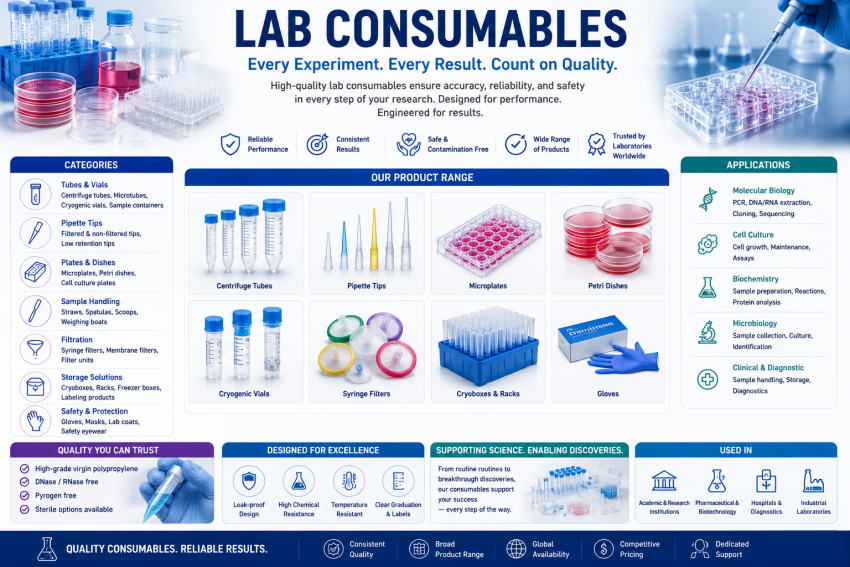
The global Lab Consumables Market is projected to grow from USD 14.41 billion in 2024 to USD 20.51 billion by 2029, registering a CAGR of 7.3% during the forecast period. Market expansion is being driven by increasing R&D investments, growing demand for drug discovery and development, and rapid adoption of lab automation and digital technologies
Download PDF Brochure:- https://www.marketsandmarkets.com/pdfdownloadNew.asp?id=184125947
Market Drivers: Innovation, Automation, and Sustainability
Laboratories worldwide are undergoing a transformation with the integration of automation, digital workflows, and high-throughput systems. This shift is significantly increasing demand for consumables such as pipettes, tubes, filters, and microplates.
Key growth drivers include:
- Rising adoption of molecular diagnostics
- Increasing number of clinical and research activities
- Growing focus on eco-friendly and sustainable lab consumables
- Expanding pharmaceutical and biotechnology industries
Additionally, competitive pressures among manufacturers are encouraging innovation, quality improvements, and brand differentiation.
Product Insights: Containers & Vials Segment Shows Strong Growth
The containers and vials segment is expected to register significant growth during the forecast period. This growth is supported by:
- Increasing use in clinical diagnostics and sample storage
- Availability of diverse product formats for varied lab applications
- Rising demand in emerging markets with expanding healthcare infrastructure
Their critical role in sample handling, storage, and transport makes them indispensable across laboratory workflows.
Application Insights: Industrial Manufacturing Leads Market
By application, the industrial manufacturing segment is expected to hold the largest market share during the forecast period.
This dominance is driven by:
- High demand for pharmaceutical and biopharmaceutical production
- Expansion of biotechnology manufacturing facilities
- Increased quality control and testing requirements
The need for consistent, high-quality consumables in large-scale production environments continues to drive segment growth.
Regional Insights: Asia Pacific Emerges as Fastest-Growing Region
The Asia Pacific region is projected to register the highest CAGR through 2029. Growth in this region is fueled by:
- Increasing number of clinical trials and research activities
- Expansion of academic and research institutions
- Rapid growth in pharmaceutical and biotech industries
Countries such as China, India, South Korea, and Singapore are becoming key hubs for laboratory research and manufacturing, creating strong demand for consumables.
Competitive Landscape: Focus on Innovation and Global Expansion
Leading players in the lab consumables market are focusing on expanding product portfolios, improving quality standards, and strengthening global distribution networks. Key companies include: Merck KGaA (Germany), Danaher Corporation (US), Corning Incorporated (US), Greiner Bio-One International GmbH (Austria), Thermo Fisher Scientific, Inc. (US), Eppendorf SE (Germany), Abbott Laboratories (US), Danaher Corporation (US), Bio-Rad Laboratories Inc. (US), Agilent Technologies Inc. (US), Qiagen (Germany), Waters Corporation (US), Bruker Corporation (US) and Sysmex Corporation (Japan), among others.
These companies are investing in automation-compatible consumables, sustainable materials, and high-performance lab products to meet evolving industry needs.
Sepak To Analyst:- https://www.marketsandmarkets.com/speaktoanalystNew.asp?id=184125947
Strategic Outlook: Backbone of Modern Laboratory Operations
Lab consumables remain a critical foundation of scientific research, diagnostics, and manufacturing workflows. As laboratories become more automated and data-driven, the demand for reliable, high-quality consumables will continue to grow.
Future market growth will be supported by:
- Increasing adoption of automated and smart laboratories
- Expansion of precision medicine and molecular diagnostics
- Rising emphasis on sustainability and waste reduction