
The permanent magnet motor market is projected to reach USD 93.75 billion by 2030 from an estimated USD 58.68 billion in 2025, at a CAGR of 9.8%.
The permanent magnet motor market is experiencing significant global growth due to the increasing demand for high-performance and energy-efficient motors across various applications. Permanent magnet motors utilize permanent magnets to create the magnetic field, making them more efficient, offering superior torque profiles, and allowing for a more compact design than conventional motors. As energy savings and performance become more critical in automotive, industrial automation, HVAC, aerospace, and consumer electronics, these motors have emerged as the preferred choice. A key factor driving this market growth is the rise in the adoption of electric vehicles (EVs). Permanent magnet motors are particularly popular in EV drivetrains because of their high power density and efficiency. Additionally, advancements in magnet technology, decreasing prices of rare-earth materials, and supportive government policies aimed at energy conservation further propel market growth. The Asia Pacific region is emerging as the fastest-growing area, supported by rapid industrialization, increasing EV production, and strong government backing in countries such as China, Japan, and India. The permanent magnet motor market is expected to grow steadily in the coming years, as companies continue to invest in production capacity and innovation. These motors’ high efficiency, compact size, and improved torque control enable their use in electric vehicles, industrial automation, HVAC systems, and household appliances. Furthermore, the global shift toward a more sustainable future and stricter energy policies are stimulating the replacement of older motors with permanent magnet alternatives. Continuous technological advancements and decreasing costs of rare-earth materials make these motors more affordable and accessible.
Download PDF Brochure @ https://www.marketsandmarkets.com/pdfdownloadNew.asp?id=218887711
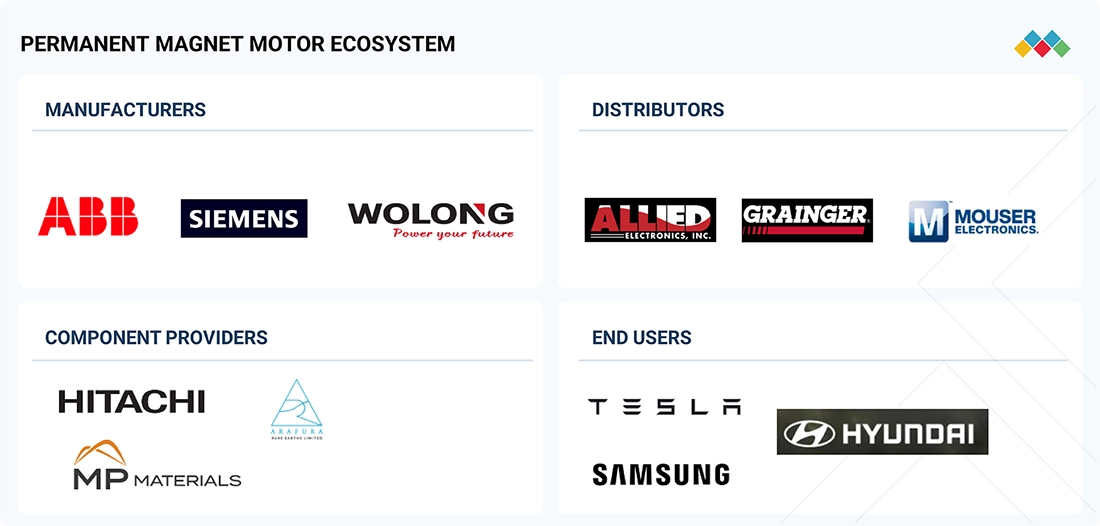
Key Market Players
- ABB (Switzerland)
- Wolong (China)
- Siemens (Germany)
- Toshiba (Japan)
- NIDEC CORPORATION (Japan)
Driver: Increasing demand for energy-efficient and low-cost maintenance motors across different industries
Permanent magnet synchronous motors (PMSMs) are notably more efficient and power-dense than induction motors, making them the preferred option for various applications. Growing demand for higher operational efficiency across multiple industries boosts the adoption of PMSMs in electronics, textiles, and pulp and paper manufacturing. These motors are used in advanced washing machines, fans, and solar-powered water pumps, improving performance even in low-light conditions. The residential and commercial sectors are rapidly adopting permanent magnet motors, especially in HVAC systems, to enhance energy savings and system reliability. PMSMs lead the electric vehicle (EV) market, with roughly 80% of future EVs expected to use these motors due to their high efficiency and compact design. Additionally, appliances powered by permanent magnet motors consume 22 to 42% less energy and are more reliable, which is particularly valuable in off-grid or rural areas. These benefits satisfy consumers and motivate them to invest in energy-efficient technologies with higher performance.
Market adoption is widespread across power ratings, with lower power segments (up to 25 kW) leading in residential, commercial, and consumer applications—such as home appliances, small pumps, or electronics—due to their compactness and efficiency. The 25–100 kW and 100–300 kW segments experience strong demand for industrial automation, large-scale manufacturing systems, and commercial building operations, especially where higher torque and continuous operation are necessary. Motors over 300 kW are mainly used in heavy industry, electric transportation, and utility-scale renewable energy (wind turbines, rail), reflecting global trends in industrialization, electrification, and decarbonization. OEMs constantly develop new efficiency standards for each rating to meet increasing global regulations and application-specific needs.
The industrial segment is likely to have the highest CAGR and largest market share, driven by automation adoption, energy-saving regulations, and the growth of advanced manufacturing worldwide. Applications include process automation, robotics, conveyors, compressors, and EV supply chains. Commercial use is led by HVAC, building automation, and pumps, indicating investment in sustainable infrastructure. Residential demand is fueled by smart appliances, low-noise systems, and consumer electronics, which increasingly use PM motors for efficiency and precision control. Emerging segments include renewable energy projects, transportation, and aerospace, where PM motor features are vital to next-generation products.
Ask sample pages @ https://www.marketsandmarkets.com/Enquiry_Before_BuyingNew.asp?id=218887711
REGION
Asia Pacific will be the fastest-growing region in the global permanent magnet motor market during the forecast period.
The widespread growth of electric vehicles, smart manufacturing, and renewable energy initiatives in leading economies such as China, Japan, and South Korea is significantly increasing the demand for high-efficiency permanent magnet motors (PMMs). Government policies aimed at achieving carbon neutrality and optimizing energy use are further incentivizing the integration of PMMs in sectors including industrial automation, HVAC systems, and electric mobility.