
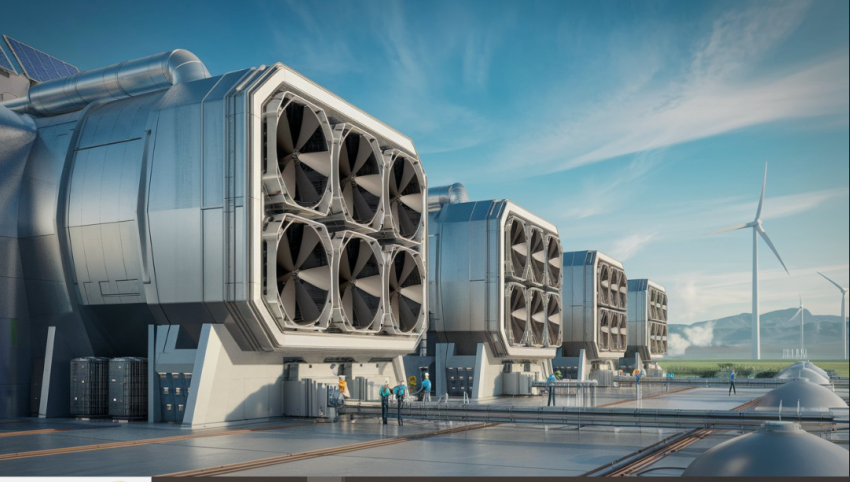
The global Direct Air Capture Market size is projected to reach USD 1,727 million by 2030, from USD 62 million in 2023, at a CAGR of 60.9% according to a new report by MarketsandMarkets™. Direct Air Capture provides a pathway to offset emissions that cannot be entirely eliminated. Direct air capture technology is known for its unique technology which directly captures CO2 from the ambient air, which is poised to play a pivotal role in the carbon removal process. Countries across the globe are putting efforts to reduce their carbon emission to meet the net-zero emission goals. Direct Air Capture (DAC) systems exhibit adaptability in their deployment, capable of being implemented across diverse scales and geographical locations. This inherent flexibility contributes to the versatility of DAC technology, allowing for customization to suit the specific magnitude of emissions and regional needs.
Moreover, Direct Air Capture (DAC) can play a vital role in mitigating historical or legacy emissions by actively extracting carbon dioxide that has accumulated in the atmosphere over an extended period. This proactive approach aids in reversing the environmental impacts associated with past emissions. However, the risks associated with higher cost and significant energy inputs of the direct air capture technology have hindered the growth of the market in recent years and are expected to restrain the market’s growth during the forecast period.
Download PDF Brochure: https://www.marketsandmarkets.com/pdfdownloadNew.asp?id=239519839
List of Key Players in Direct Air Capture Market:
- Climeworks (Switzerland),
- Carbon Engineering ULC. (Canada),
- Global thermostat (US),
- Heirloom Carbon Technologies (US),
- Skytree (Netherlands) among others.
Several factors driving the direct air capture market are more stringent government regulations and increased interest in synthetic fuels for environmental benefits in carbon reduction. Globally, governments are making strides to achieve a net-zero emission target. Over 140 major carbon-polluting countries, including China, US, and India, have promised to reach net-zero emissions by mid-century in 2050. The increased focus on net-zero emissions allows for an earlier investment opportunity for the developers of DAC solutions.
Carbon Capture, Utilization, and Storage (CCUS) is expected to be the largest segment.
By application, the direct air capture market has been split into two types: carbon capture, and storage (CCS) and carbon capture, utilization, and storage. The carbon capture, and storage (CCS) segment is expected to hold the largest market share during the forecast period. Carbon mineralization involves the enduring removal of carbon dioxide by converting it into a solid mineral form, typically a carbonate, through a chemical reaction with specific rocks. A notable advantage of carbon mineralization lies in its capacity to securely sequester carbon, effectively preventing its re-release into the atmosphere.
Request Sample Pages: https://www.marketsandmarkets.com/requestsampleNew.asp?id=239519839
North America region holds the largest direct air capture market share
North America is poised to be the largest region of the direct air capture market size forecast (2023-2030), followed by Europe. North America’s primary role is firmly bolstered by clear policies and market-driven activities. The role of US Department of Energy support, particularly in regards to programs such as the The Regional Direct Air Capture (DAC) Hubs program, serves a firm basis for North America’s market leader position. Under this program, US will develop four regional direct air capture hubs. Furthermore, policy frameworks have been put in place to encourage the deployment of DAC such as 45 Q tax credit and California low Carbon Fuel Standard.The regional market is experiencing growth due to the presence of leading solution providers like Global Thermostat (US), Carbon Engineering ULC. (Canada) and Heirloom Carbon Technologies (US).