
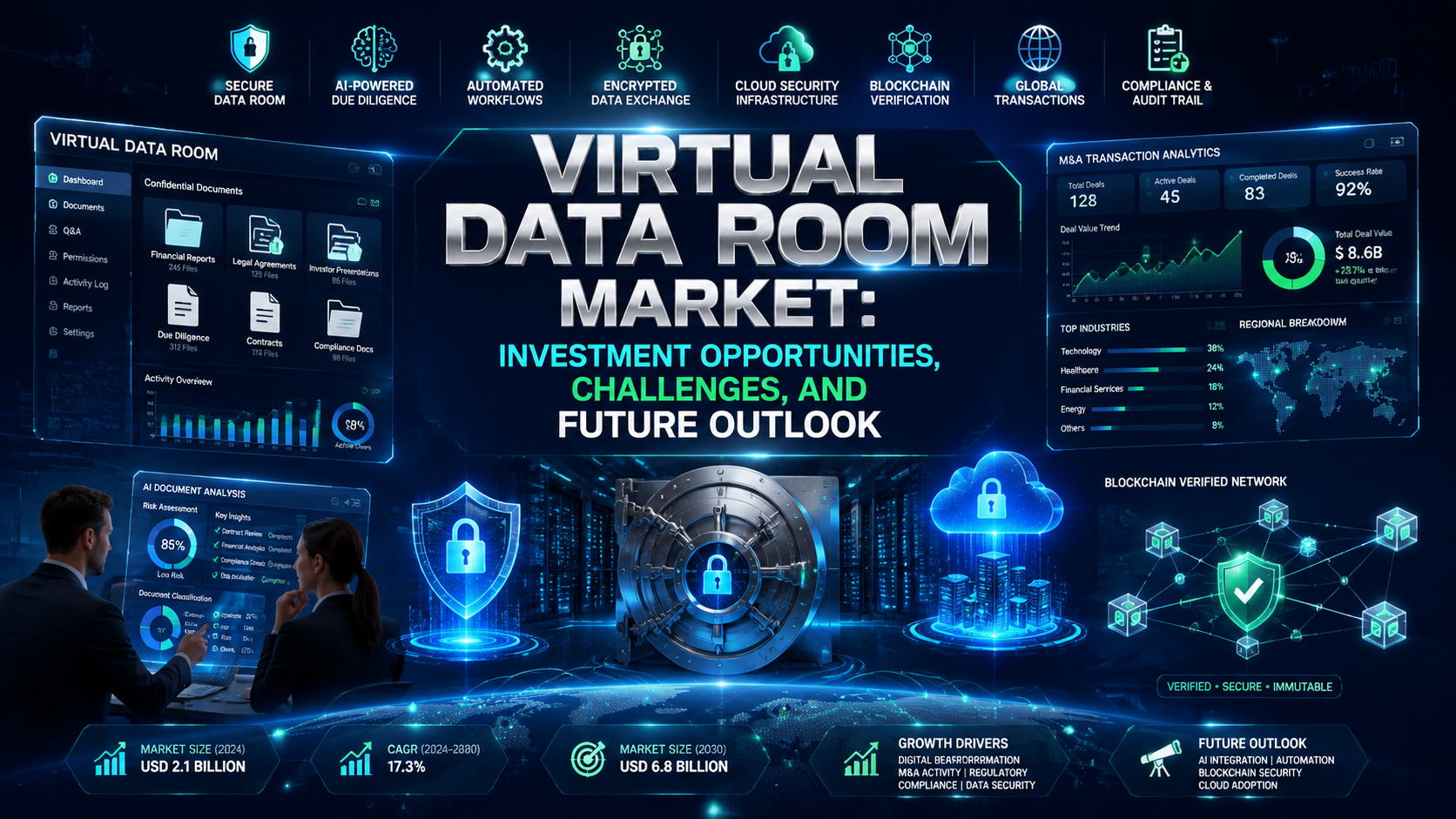
The Virtual Data Room Market has transformed from a specialized solution for mergers and acquisitions into a critical platform supporting enterprise collaboration, regulatory compliance, and digital transformation. As organizations manage larger volumes of confidential information across distributed teams, secure cloud-native platforms have become essential for protecting sensitive documents while enabling efficient collaboration.
Cloud computing, Artificial Intelligence (AI), workflow automation, and Zero Trust security are redefining enterprise document management. Rather than relying on traditional on-premises repositories, businesses are adopting scalable virtual data rooms that provide encrypted storage, intelligent search, automated workflows, real-time accessibility, and comprehensive audit trails.
The continued rise in mergers and acquisitions, private equity investments, regulatory obligations, and hybrid work environments is accelerating the Virtual Data Room Market. Financial institutions, healthcare organizations, legal firms, real estate companies, and multinational enterprises increasingly require secure digital workspaces that safeguard confidential information while improving operational efficiency.
Industry research shows that enterprise cloud adoption now exceeds 90% among large organizations, while cybersecurity remains one of the fastest-growing areas of IT investment. These developments reinforce the long-term outlook for the Virtual Data Room Market, as enterprises prioritize secure collaboration and cloud-native infrastructure to support modern business operations.
This article explores the Virtual Data Room Market, highlighting its evolution, cloud-native architecture, emerging technologies, business applications, investment opportunities, market challenges, and future direction.
What Is the Virtual Data Room Market?
The Virtual Data Room Market consists of secure cloud-based platforms designed to store, organize, manage, and share confidential business documents throughout high-value corporate transactions. Although originally developed for mergers and acquisitions, virtual data rooms now support fundraising, legal compliance, audits, board communications, intellectual property management, strategic partnerships, and enterprise governance.
Unlike conventional file-sharing systems, modern virtual data rooms deliver enterprise-grade security through end-to-end encryption, granular access controls, multi-factor authentication, digital watermarking, AI-powered document management, and comprehensive audit trails. These features enable organizations to protect sensitive information while allowing authorized employees, investors, advisors, regulators, and business partners to collaborate securely.
Cloud-native architecture also provides on-demand scalability, continuous software updates, automated backups, and disaster recovery capabilities, enabling enterprises to strengthen operational resilience while reducing infrastructure costs.
Market research indicates strong trends Download the PDF to uncover business insights.
Why Cloud-Native Platforms Are Reshaping the Virtual Data Room Market
Cloud-native architecture has become one of the strongest growth drivers of the Virtual Data Room Market, enabling organizations to modernize document management while improving security, scalability, and operational agility. Unlike traditional on-premises systems that demand significant infrastructure investments and ongoing maintenance, cloud-native virtual data rooms deliver secure, always-available environments that support enterprise collaboration across multiple regions.
Organizations managing mergers and acquisitions, fundraising initiatives, regulatory audits, legal proceedings, and strategic partnerships often handle thousands of confidential documents. Cloud-native platforms simplify these complex processes by centralizing information within secure repositories that authorized users can access from virtually any location.
How Artificial Intelligence Is Transforming Enterprise Collaboration
Artificial Intelligence continues to redefine the Virtual Data Room Market by automating document-intensive processes and improving operational efficiency. AI-powered virtual data rooms can intelligently classify files, organize documents, automate indexing, identify duplicate content, and support semantic search, allowing users to locate critical information quickly without manually reviewing extensive document libraries.
This Sample Report is designed to fuel your business growth download it today.
Enterprise Security and Integration Drive Market Growth
Security remains the foundation of enterprise adoption across the Virtual Data Room Market. Leading platforms implement Zero Trust security models, multi-factor authentication, end-to-end encryption, role-based access controls, dynamic watermarking, digital rights management, continuous threat monitoring, and immutable audit logs. These security measures protect confidential financial records, legal documents, intellectual property, and strategic business information while supporting compliance with evolving regulatory requirements.
Modern virtual data rooms also integrate seamlessly with enterprise applications, including enterprise resource planning (ERP), customer relationship management (CRM), identity and access management solutions, productivity platforms, compliance software, and e-signature tools.
As organizations continue embracing hybrid work and cloud-first strategies, cloud-native virtual data rooms are becoming long-term digital infrastructure that supports governance, compliance, and secure enterprise collaboration. Their combination of scalability, AI-driven automation, enterprise-grade cybersecurity, and seamless interoperability continues strengthening the long-term outlook for the Virtual Data Room Market.
Investment Opportunities, Market Challenges, and Future Outlook
The Virtual Data Room Market is creating significant opportunities as organizations accelerate digital transformation, strengthen cybersecurity, and adopt cloud-first collaboration strategies. Rising demand across mergers and acquisitions (M&A), private equity, banking, healthcare, legal services, corporate governance, and real estate is encouraging enterprises to invest in secure digital environments that simplify document management while improving compliance and operational efficiency.
Where Are the Biggest Investment Opportunities?
One of the strongest investment opportunities within the Virtual Data Room Market lies in Artificial Intelligence (AI) and automation. Enterprises increasingly seek platforms capable of intelligent document classification, semantic search, contract analysis, compliance monitoring, workflow automation, and due diligence support.
Organizations are replacing legacy file-sharing systems with scalable subscription-based platforms that provide secure access, enterprise-grade encryption, and real-time collaboration without maintaining costly on-premises infrastructure.
Cybersecurity remains equally important. Features such as multi-factor authentication, digital rights management, granular access controls, detailed audit trails, and advanced encryption have become essential for organizations managing confidential information.
What Challenges Could Affect Market Growth?
Despite strong momentum, several factors may influence the adoption of the Virtual Data Room Market. Advanced enterprise platforms often require significant investment, making implementation more challenging for small and medium-sized businesses seeking highly customized solutions.
Data security concerns also remain a priority. Although virtual data rooms are designed to protect sensitive information, organizations continue evaluating cybersecurity risks before migrating confidential documents to cloud-based environments.
In addition, some organizations continue relying on conventional cloud storage or standard file-sharing solutions for basic collaboration, limiting awareness of the specialized governance, compliance, and security advantages offered by dedicated virtual data rooms.
Future Outlook
The long-term outlook for the Virtual Data Room Market remains highly positive. Continued innovation in Artificial Intelligence, cloud computing, workflow automation, blockchain-inspired security, and advanced analytics is expected to redefine secure enterprise collaboration. As organizations increasingly prioritize regulatory compliance, operational resilience, and intelligent information management, virtual data rooms will continue evolving from secure document repositories into strategic digital collaboration platforms that support business growth, governance, and high-value corporate transactions across global industries.
Competitive Landscape and Strategic Business Applications
The Virtual Data Room Market has evolved into a highly competitive technology landscape where innovation, enterprise security, and intelligent automation determine long-term success. As organizations continue modernizing confidential document management, solution providers are investing in Artificial Intelligence (AI), cloud-native infrastructure, advanced cybersecurity, and seamless enterprise integration to strengthen their market position.
Which Industries Benefit Most from the Virtual Data Room Market?
The Virtual Data Room Market serves a wide range of industries that require secure document sharing and regulatory compliance. While mergers and acquisitions (M&A) remain the largest application area, enterprise adoption now extends across investment banking, private equity, legal services, healthcare, manufacturing, real estate, and government.
Investment banks and private equity firms rely on virtual data rooms to manage fundraising, acquisitions, divestitures, and strategic investments through secure collaboration and controlled document access. Legal organizations use these platforms for litigation support, contract negotiations, intellectual property management, and corporate governance, ensuring sensitive information remains protected throughout every stage of the legal process.
Healthcare providers, pharmaceutical companies, and life sciences organizations leverage secure virtual data rooms to manage clinical research documentation, licensing agreements, regulatory submissions, and research collaborations while maintaining compliance with strict privacy requirements.
Real estate organizations use centralized digital repositories to simplify property transactions, lease management, financing documentation, and infrastructure projects, while government agencies increasingly deploy secure virtual data rooms to support procurement, policy documentation, compliance reviews, and public-sector collaboration.
Competitive Landscape
Competition within the Virtual Data Room Market continues to intensify as enterprises demand intelligent, scalable, and highly secure collaboration platforms. Leading vendors differentiate themselves through AI-powered document management, advanced encryption, customizable workflows, analytics dashboards, cloud scalability, and seamless integration with enterprise applications.
Market participants are also expanding industry-specific capabilities to address the unique compliance requirements of financial services, healthcare, legal, government, and multinational enterprises.
According to the latest Virtual Data Room Market report, organizations increasingly prefer platforms that combine enterprise-grade cybersecurity, AI-driven automation, cloud-native scalability, and regulatory compliance within a unified environment. As secure digital collaboration becomes a strategic business priority, technology providers capable of delivering intelligent, integrated, and future-ready solutions are expected to capture a larger share of the Virtual Data Room Market while supporting the next generation of enterprise information management.
Strategic Recommendations and the Future of the Virtual Data Room Market
The Virtual Data Room Market is entering a new phase of enterprise adoption as organizations place greater emphasis on secure collaboration, regulatory compliance, and intelligent information management. Virtual data rooms are no longer viewed solely as transaction support tools; they have become strategic digital platforms that enable organizations to protect sensitive information while improving operational efficiency across multiple business functions.
What Should Enterprises Prioritize?
Organizations investing in the Virtual Data Room Market should prioritize platforms that combine cloud-native scalability, Artificial Intelligence (AI), advanced cybersecurity, workflow automation, and seamless integration with existing enterprise applications. Solutions that deliver intelligent document management, real-time collaboration, detailed audit trails, and compliance-ready reporting help enterprises simplify governance while accelerating business processes.
Security should remain at the center of every deployment strategy. Enterprise-grade encryption, multi-factor authentication, role-based access controls, digital watermarking, and Zero Trust security frameworks enable organizations to protect confidential financial records, legal documentation, intellectual property, and strategic business information.
How Will the Virtual Data Room Market Evolve?
The future of the Virtual Data Room Market will be shaped by continued investment in AI-powered automation, cloud computing, advanced cybersecurity, and intelligent analytics. Organizations increasingly require secure collaboration platforms capable of supporting remote work, cross-border transactions, regulatory compliance, and digital governance without compromising performance or data protection.
Future innovation is expected to focus on intelligent document processing, predictive analytics, automated compliance monitoring, confidential computing, and enhanced security architectures.
The competitive landscape will also continue evolving as technology providers expand cloud capabilities, improve interoperability with enterprise ecosystems, and develop industry-specific solutions tailored to finance, healthcare, legal services, manufacturing, real estate, and government sectors.
The long-term outlook for the Virtual Data Room Market remains highly promising. Rising enterprise cloud adoption, growing cybersecurity investments, expanding regulatory requirements, and increasing demand for secure digital collaboration continue creating favorable conditions for sustained market growth. Organizations that invest in intelligent, cloud-native virtual data room platforms today will be better positioned to improve governance, accelerate high-value transactions, strengthen compliance, and support future digital transformation initiatives.
As secure enterprise collaboration becomes a strategic business priority, the Virtual Data Room Market is expected to remain a foundational component of modern digital infrastructure, enabling organizations worldwide to exchange confidential information with greater confidence, efficiency, and transparency.