

The global specialty fertilizers market is gaining significant momentum as agriculture increasingly shifts toward precision nutrient management, sustainable crop production, and higher fertilizer-use efficiency. Specialty fertilizers are designed to deliver nutrients more precisely and efficiently than conventional fertilizers, helping growers improve crop productivity, quality, and nutrient uptake while minimizing nutrient losses.
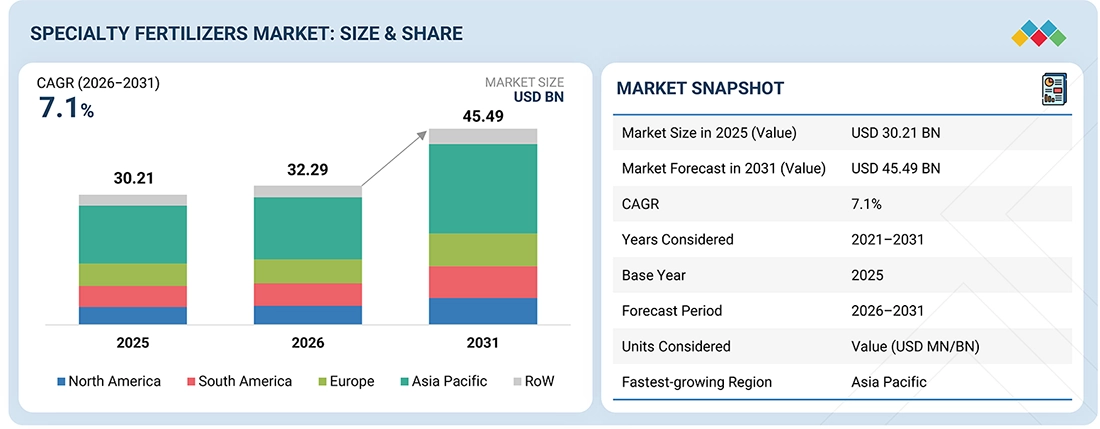
According to MarketsandMarkets, the global specialty fertilizers market is estimated to reach USD 32.29 billion in 2026 and is projected to reach USD 45.49 billion by 2031, registering a CAGR of 7.1% during 2026–2031.
What Are Specialty Fertilizers?
Specialty fertilizers are advanced nutrient products formulated to address specific crop, soil, and application requirements. They include technologies such as controlled-release fertilizers, water-soluble fertilizers, micronutrients, and other specialized formulations.
Unlike conventional fertilizers, specialty fertilizers can provide more targeted nutrient delivery. Their use is closely associated with fertigation, foliar application, precision agriculture, greenhouse cultivation, and other modern farming practices.
The growing focus on improving nutrient-use efficiency has made specialty fertilizers an increasingly important component of modern agricultural production.
Specialty Fertilizers Market Size and Forecast
The specialty fertilizers market is experiencing steady expansion as farmers and commercial growers seek solutions that can improve productivity while optimizing fertilizer application.
According to MarketsandMarkets:
- Market size in 2026: USD 32.29 billion
- Projected market size by 2031: USD 45.49 billion
- CAGR (2026–2031): 7.1%
- Base year: 2025
- Forecast period: 2026–2031
The market is analyzed across technology, form, application method, type, crop type, and region.
Key Factors Driving the Specialty Fertilizers Market
- Growing Adoption of Precision Agriculture: Precision agriculture is changing how farmers manage nutrients, irrigation, and crop inputs. Technologies such as soil sensors, GPS-based farm management, variable-rate application, and data-driven crop monitoring enable growers to apply nutrients according to specific crop and field requirements. Specialty fertilizers complement these technologies by providing formulations suitable for precise and targeted nutrient delivery.
- Increasing Focus on Nutrient-Use Efficiency: Rising input costs and concerns about nutrient losses are encouraging growers to improve fertilizer-use efficiency. Specialty fertilizers can help deliver nutrients at appropriate rates and stages of crop development. Controlled-release fertilizers, water-soluble fertilizers, and micronutrient formulations are particularly relevant to efficient nutrient management.
- Expansion of Fertigation: Fertigation—the application of fertilizers through irrigation systems—is becoming increasingly important in intensive agricultural production. Water-soluble fertilizers are well suited to fertigation because nutrients can be delivered directly to the crop root zone through irrigation systems. The increasing adoption of drip irrigation, greenhouse farming, and protected cultivation is therefore creating additional opportunities for specialty fertilizer manufacturers.
- Rising Demand for High-Value Crops: Fruits, vegetables, horticultural crops, and other high-value crops require careful nutrient management to achieve desirable yield and quality characteristics. Specialty fertilizers can help growers address specific nutrient deficiencies and support crop characteristics such as fruit size, color, quality, and overall productivity. MarketsandMarkets identifies the fruits and vegetables segment as an important area of growth within the market.
Download PDF Brochure: https://www.marketsandmarkets.com/pdfdownloadNew.asp?id=57479139
Micronutrients Gain Importance
Micronutrients represent a significant technology segment within the specialty fertilizers market. Essential nutrients such as zinc, iron, boron, manganese, copper, and molybdenum play important roles in plant growth, enzyme activity, photosynthesis, and nutrient metabolism.
Intensive cultivation and repeated cropping can contribute to depletion of certain soil nutrients. As awareness of balanced plant nutrition increases, growers are increasingly incorporating micronutrient fertilizers into crop nutrition programs.
Advancements in chelated micronutrient formulations are also improving nutrient availability and application efficiency. Foliar sprays and fertigation provide additional pathways for delivering micronutrients to crops.
Water-Soluble and Controlled-Release Fertilizers
Water-soluble fertilizers are increasingly used in fertigation and precision irrigation systems because they can be dissolved and delivered through irrigation water.
Controlled-release fertilizers, meanwhile, are designed to release nutrients gradually over a defined period. This approach can help synchronize nutrient availability with crop requirements and potentially reduce nutrient losses.
The adoption of these technologies is being supported by the growing emphasis on sustainable agriculture, resource efficiency, and precision nutrient management.
Request Sample Pages: https://www.marketsandmarkets.com/requestsampleNew.asp?id=57479139
Regional Outlook
Asia Pacific represents a major market for specialty fertilizers, supported by agricultural modernization, expanding commercial farming, increasing awareness of balanced crop nutrition, and growing adoption of advanced irrigation and cultivation technologies.
North America and Europe are also important markets, with demand supported by precision agriculture, sustainable farming practices, high-value crop cultivation, and advanced agricultural technologies. MarketsandMarkets reports strong adoption across Asia Pacific, North America, and Europe.
Emerging Opportunities in the Specialty Fertilizers Market
The transition toward more efficient and sustainable agricultural systems is creating several opportunities for market participants.
One important opportunity lies in customized nutrient formulations. As growers increasingly use soil testing, crop diagnostics, and precision agriculture technologies, demand is growing for fertilizer solutions tailored to specific soil and crop requirements.
Another opportunity is the expansion of protected cultivation and greenhouse farming. These production systems require accurate nutrient management, creating demand for water-soluble fertilizers, micronutrients, and fertigation-compatible products.
The development of environmentally focused fertilizer technologies also provides opportunities for manufacturers to differentiate their products through improved nutrient-use efficiency and reduced nutrient losses.
Future Outlook
The future of the specialty fertilizers market is closely connected to the broader transformation of agriculture toward precision, sustainability, and resource efficiency.
As farmers seek to produce more from limited arable land while optimizing water and nutrient use, demand for advanced fertilizer technologies is expected to increase. Integration with precision agriculture, fertigation, smart irrigation, protected cultivation, and data-driven crop management is likely to create new growth opportunities.
With the global specialty fertilizers market projected to reach USD 45.49 billion by 2031, the industry is positioned for continued expansion.