
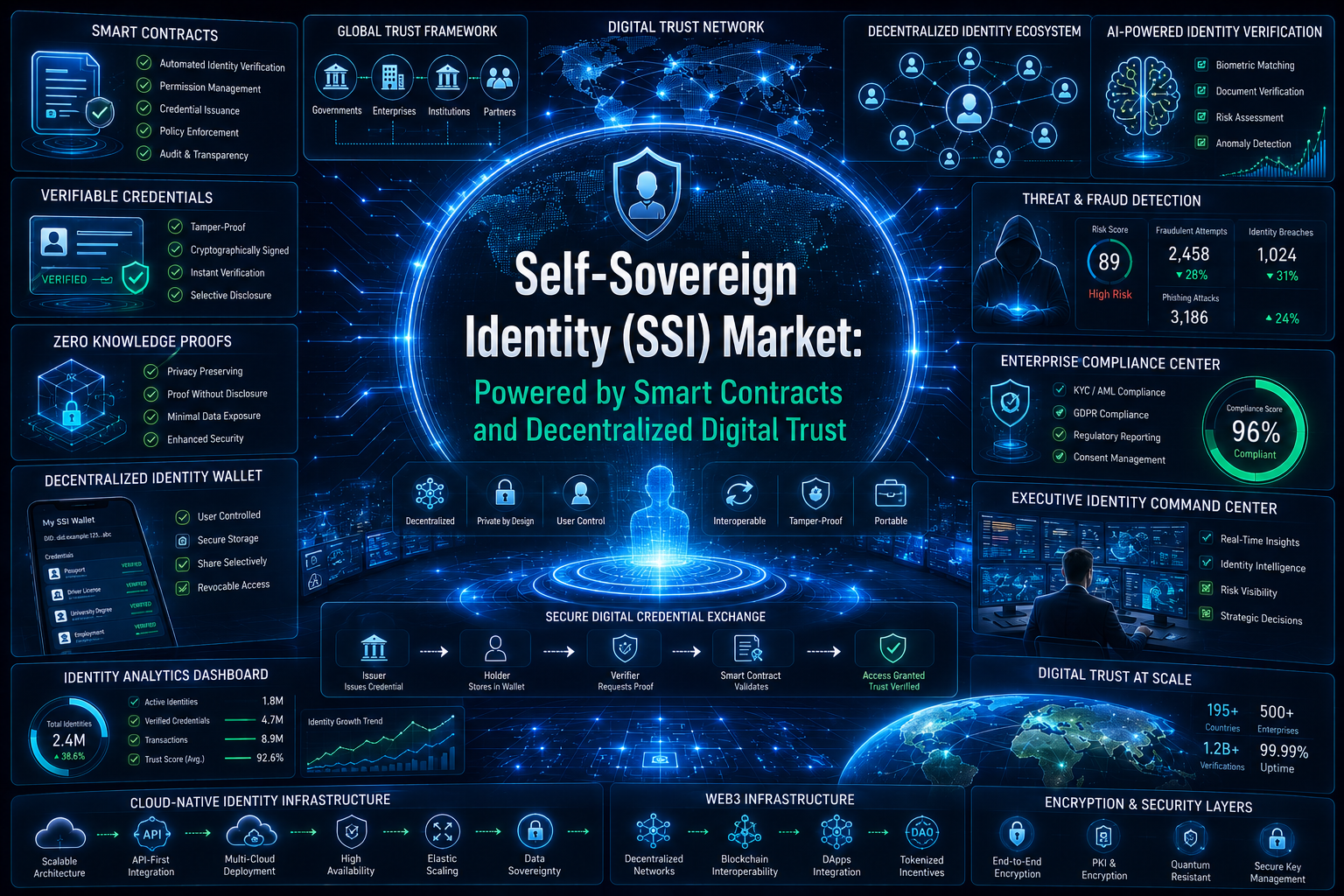
The Convergence of Trust and Technology
The Self-Sovereign Identity (SSI) Market is rapidly establishing itself as a cornerstone of modern digital identity management, cybersecurity innovation, blockchain adoption, and enterprise digital transformation strategies. As organizations expand operations across decentralized networks, cloud-based environments, digital commerce platforms, and interconnected global ecosystems, the ability to establish, verify, and maintain trusted digital relationships has become a critical business imperative.
At the heart of this evolution are Smart Contracts—blockchain-enabled, self-executing digital agreements that automatically enforce predefined rules, permissions, and transactional conditions without the need for intermediaries. When integrated with Self-Sovereign Identity (SSI) frameworks, Smart Contracts create a secure, transparent, and verifiable identity infrastructure that enables trusted interactions across digital ecosystems.
The convergence of blockchain technology, decentralized identity architectures, artificial intelligence, cryptographic verification mechanisms, and Smart Contracts is accelerating innovation across industries while creating significant opportunities within the Self-Sovereign Identity (SSI) Market. Together, these technologies are laying the foundation for a more secure, privacy-centric, and digitally trusted future.
Accelerating the Digital Trust Revolution
The modern digital economy is increasingly dependent on trusted identity verification, secure data exchange, and transparent governance frameworks. As organizations embrace digital transformation, the importance of establishing confidence in digital interactions continues to grow.
Today’s enterprises face a range of identity-related challenges, including:
- Identity fraud and impersonation threats
- Data breaches and unauthorized access
- Complex regulatory compliance requirements
- Inefficient verification and authentication processes
- Customer onboarding delays
- Cross-border identity validation challenges
In response, Smart Contracts are emerging as a strategic technology enabler that addresses these challenges by automating trust-based processes, reducing operational friction, and enhancing overall digital trust.
Market research indicates strong trends Download the PDF to uncover business insights.
Why Smart Contracts Are Transforming Modern Enterprises
Smart Contracts introduce a new level of automation, transparency, and accountability by executing contractual obligations through programmable logic embedded within blockchain networks.
Their enterprise value extends across several key functions:
- Automated transaction execution
- Identity verification and authentication
- Access governance and permissions management
- Fraud prevention and risk mitigation
- Compliance monitoring and reporting
- Digital credential validation
- Secure transaction processing
- Decentralized governance frameworks
By minimizing manual intervention and eliminating reliance on intermediaries, Smart Contracts enhance operational efficiency, improve transparency, and strengthen trust across business processes.
Unlock insights that drive business success—download the Sample Report now.
Understanding the Self-Sovereign Identity (SSI) Market
The Self-Sovereign Identity (SSI) Market represents a significant shift from traditional identity management models. Unlike centralized systems where organizations control user identities, SSI enables individuals and enterprises to securely own, manage, and selectively share verifiable digital credentials.
Key components of SSI ecosystems include:
- Decentralized Identifiers (DIDs)
- Verifiable Credentials
- Blockchain-Based Infrastructure
- Digital Identity Wallets
- Cryptographic Authentication Mechanisms
- Smart Contract Frameworks
Growing adoption across financial services, healthcare, government, and enterprise sectors continues to expand the overall Self-Sovereign Identity (SSI) Market size, reflecting increasing demand for privacy-first identity solutions.
Market Context and Growth Dynamics
Several macroeconomic and technological factors are accelerating momentum across the SSI landscape.
Key Technology Drivers
- Rapid blockchain adoption
- Expansion of decentralized finance (DeFi)
- Growth of Web3 ecosystems
- Increased implementation of Zero Trust security frameworks
- Enterprise identity modernization initiatives
- Government-led digital identity programs
Competitive Market Environment
Technology providers, financial institutions, healthcare organizations, public-sector agencies, and enterprise software vendors are making substantial investments in decentralized identity and Smart Contract capabilities.
Current Self-Sovereign Identity (SSI) Market analysis highlights a growing preference for privacy-preserving identity solutions that balance security, compliance, and user control while supporting enterprise-scale digital transformation.
Enterprise Challenges Fueling Adoption
Despite significant advancements in digital technologies, organizations continue to encounter operational and security challenges that hinder efficiency and growth.
Operational Inefficiencies
Manual verification processes consume resources, increase administrative complexity, and delay critical business transactions.
Rising Compliance and Security Costs
Identity fraud, regulatory obligations, and customer verification requirements continue to increase operational expenditures.
Customer Acquisition and Experience Barriers
Lengthy onboarding processes often lead to customer abandonment and reduced conversion rates.
Regulatory Complexity
Organizations must navigate evolving global privacy regulations while ensuring secure identity verification.
Security Vulnerabilities
Centralized identity repositories remain high-value targets for cybercriminals, increasing exposure to data breaches and fraud.
These challenges are driving strong demand for decentralized identity ecosystems powered by Smart Contracts and advanced verification technologies.
Smart Contracts as a Strategic Business Enabler
Smart Contracts provide a scalable and efficient framework for automating trust-based interactions across digital ecosystems.
Accelerating Digital Transformation
Organizations can streamline identity verification, credential management, and authentication workflows while reducing operational complexity.
Enhancing Automation Through AI Integration
Automated validation processes improve speed, consistency, and accuracy while reducing dependency on manual review.
Enabling New Business Models
Decentralized identity frameworks create opportunities for innovative digital trust services, secure credential exchanges, and next-generation digital ecosystems.
Strengthening Strategic Collaboration
SSI-powered infrastructures enable trusted interactions among customers, partners, suppliers, regulators, and stakeholders.
These capabilities continue to contribute significantly to Self-Sovereign Identity (SSI) Market growth worldwide.
The Convergence of AI, Blockchain, and Identity Automation
The next generation of digital identity platforms is being shaped by the integration of multiple advanced technologies.
Artificial Intelligence
AI enhances fraud detection, behavioral analytics, identity verification, and risk assessment capabilities.
Blockchain Infrastructure
Distributed ledger technology delivers transparency, immutability, and trust across digital transactions.
Smart Contracts
Automated execution of predefined rules improves governance and operational efficiency.
Advanced Cryptography
Sophisticated cryptographic methods ensure privacy, security, and data integrity.
Together, these technologies are creating highly resilient, scalable, and secure identity ecosystems capable of supporting global digital transformation initiatives.
Data-Driven Industry Insights
Enterprise adoption of decentralized identity technologies continues to accelerate across multiple sectors.
Key industry trends include:
- Increased investment in blockchain infrastructure
- Growing demand for digital identity solutions
- Enhanced regulatory focus on privacy and user consent
- Expansion of decentralized applications and Web3 ecosystems
Organizations implementing automated identity verification solutions consistently report:
- Faster customer onboarding cycles
- Reduced fraud and security incidents
- Lower compliance and operational costs
- Enhanced customer experiences and satisfaction
Recent Self-Sovereign Identity (SSI) Market report findings consistently identify Smart Contracts as a key driver of innovation and enterprise adoption.
Industry Applications and Real-World Impact
Financial Services
Historically, customer onboarding required extensive documentation and manual verification procedures.
Through Smart Contract-enabled identity validation, financial institutions can significantly reduce onboarding timelines while improving compliance effectiveness and fraud prevention.
Healthcare
Traditional healthcare systems often struggle with fragmented patient records and interoperability challenges.
SSI-based digital credentials provide secure, verifiable access to patient information while maintaining privacy and regulatory compliance.
Supply Chain and Logistics
Organizations frequently encounter challenges related to document verification and authenticity.
Smart Contracts automate credential validation, enhancing transparency, reducing fraud, and improving operational efficiency across complex supply chains.
Business Impact and Return on Investment
Organizations implementing Smart Contract-enabled identity solutions can realize measurable business value.
Revenue Growth
Enhanced customer experiences support faster acquisition and improved retention rates.
Cost Optimization
Automation reduces administrative overhead, compliance expenses, and operational inefficiencies.
Improved Trust and Transparency
Secure and verifiable digital interactions strengthen stakeholder confidence.
Competitive Differentiation
Organizations gain a strategic advantage through innovative, secure, and privacy-focused digital experiences.
Scalability and Global Expansion
Automated identity ecosystems support cross-border growth initiatives and digital business expansion.
These benefits continue contributing to increasing Self-Sovereign Identity (SSI) Market share across industries worldwide.
Challenges and Risk Considerations
While the market outlook remains highly favorable, organizations must carefully address several implementation challenges.
Regulatory Evolution
Digital identity regulations continue to evolve across jurisdictions, creating compliance complexities.
Legacy System Integration
Modern SSI frameworks must coexist with existing enterprise infrastructure.
Interoperability Requirements
Ensuring compatibility across platforms, networks, and ecosystems remains a critical success factor.
User Adoption and Education
Stakeholder awareness and trust are essential for widespread implementation.
Governance and Standards
Clear governance models and industry standards are necessary to maintain transparency and accountability.
Competitive Advantage and Future Outlook
The long-term Self-Sovereign Identity (SSI) Market outlook remains exceptionally strong as organizations prioritize privacy, trust, and digital security.
Several transformative developments are expected to shape future growth:
Decentralized Identity Ecosystems
Broader enterprise adoption of SSI-based trust frameworks.
Zero-Knowledge Proofs (ZKPs)
Privacy-preserving verification technologies becoming mainstream.
AI-Powered Identity Intelligence
Advanced analytics driving enhanced fraud prevention and compliance monitoring.
Web3 Expansion
Growing demand for decentralized identity solutions across digital ecosystems.
Autonomous Smart Contracts
AI-enhanced Smart Contracts capable of managing increasingly sophisticated business workflows.
The overall Self-Sovereign Identity (SSI) Market forecast suggests sustained expansion driven by technological innovation, enterprise adoption, and increasing demand for secure digital trust frameworks.
Executive Recommendations
To maximize value and maintain competitive relevance, organizations should consider the following strategic priorities:
- Invest in enterprise-grade Smart Contract infrastructure.
- Develop comprehensive SSI adoption roadmaps.
- Strengthen digital trust and identity governance frameworks.
- Enhance privacy, security, and compliance capabilities.
- Leverage AI-powered identity intelligence solutions.
- Establish blockchain governance and risk management strategies.
- Foster strategic partnerships across digital ecosystems.
The convergence of Smart Contracts and the Self-Sovereign Identity (SSI) Market is fundamentally transforming how organizations establish trust, verify identities, and manage digital interactions. As digital transformation initiatives continue to accelerate, decentralized identity frameworks will play an increasingly important role in strengthening security, enhancing customer experiences, and improving operational efficiency.
Organizations that invest in Smart Contracts, decentralized identity technologies, and trusted digital ecosystems today will be better positioned to drive sustainable growth, strengthen resilience, and lead the next phase of digital innovation.
The future of enterprise technology extends beyond digital transformation—it is increasingly defined by trusted, automated, decentralized, and intelligently connected ecosystems that enable secure interactions at global scale.