
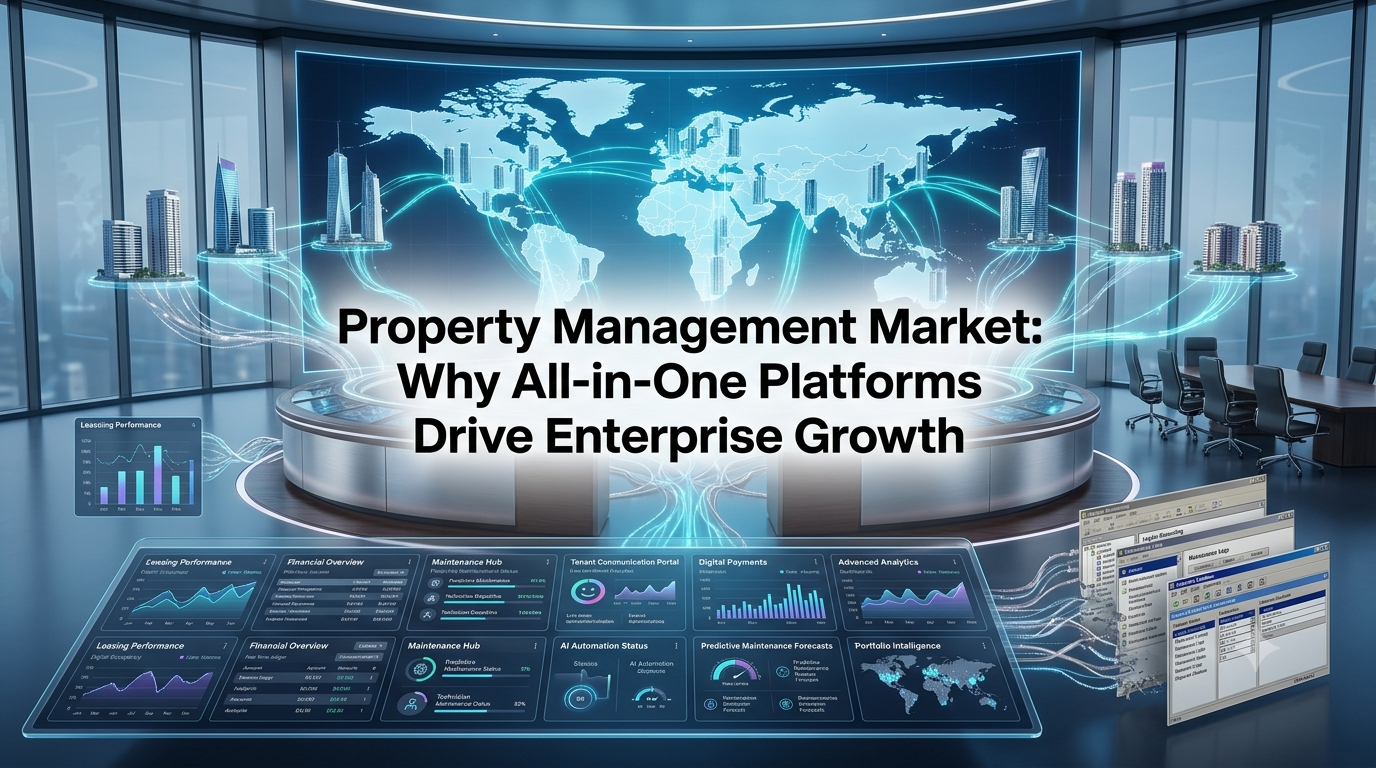
Property management once depended on specialized systems: leasing in one application, accounting in another, maintenance elsewhere, and tenant communication across email, spreadsheets, portals, and phone calls. That model worked when portfolios were smaller and decisions moved slowly. In 2026, the Property Management Market faces a tougher reality. Owners and operators need connected data, faster execution, automated workflows, and one operational view. The move toward all-in-one platforms is no longer simply a software upgrade. It is becoming a strategic response to complexity, cost pressure, and scalable growth.
The Software Stack Is Becoming a Hidden Business Risk
- Fragmented systems create operational friction.
- Manual data movement increases error risk.
- Disconnected applications weaken visibility.
Property technology stacks rarely become fragmented overnight. They expand one decision at a time. A team adds accounting software, then leasing, maintenance, CRM, payments, and reporting tools. Each product may solve a legitimate problem, but the connections between them can become the bigger problem.
Employees may spend hours exporting records, updating spreadsheets, reconciling information, and moving data between applications. As portfolios expand, those tasks multiply. What looks like a technology issue becomes a business-performance issue.
For enterprise operators, fragmentation can create duplicate records, inconsistent reporting, slower approvals, communication gaps, and limited portfolio visibility. The critical question is no longer which application has the longest feature list. It is whether technology can operate as one business.
Download the PDF for business opportunities as outlined in the latest market research findings.
Why Fragmentation Can Block Property Management Growth
- Software silos make scaling harder.
- Manual handoffs slow decisions.
- Portfolio expansion increases disconnected-workflow costs.
Consider an organization managing thousands of units across several markets. A maintenance request may sit in one system, lease information in another, payment history elsewhere, and vendor performance in a separate database. Managers can assemble the picture, but the process consumes time and introduces inconsistency.
Every disconnected workflow becomes a potential bottleneck, particularly when teams coordinate across regions, properties, vendors, and departments.
The All-in-One Platform Shift
- Unified platforms connect core property workflows.
- One operational context improves visibility.
- Consolidation is increasingly about performance.
An all-in-one platform brings leasing, accounting, maintenance, payments, reporting, communication, documents, vendor coordination, and automation into a connected environment.
The objective is not merely reducing subscriptions. It is creating one operational context.
When a tenant submits a maintenance request, a connected platform can associate it with the property, lease, tenant profile, service history, vendor, and communication record. Employees no longer need to reconstruct the story across multiple applications.
Software therefore evolves from a digital filing cabinet into an operating layer. Enterprise value comes from connected processes, not simply accumulating applications.
For your business growth, be sure to download the Sample Report today.
AI Makes Integration More Valuable
- AI performs better with relevant business context.
- Connected data strengthens automation.
- Embedded AI can improve decision-making.
Artificial intelligence makes integration more important, not less.
A leasing assistant becomes more capable when it can access availability, pricing, property information, applicant details, appointments, and communication history. Predictive maintenance becomes stronger when asset histories, work orders, sensors, and contractor performance can be analyzed together.
Portfolio analytics also becomes more powerful when financial, occupancy, leasing, maintenance, and tenant information are connected.
The stronger formula is AI plus integrated data plus workflow automation.
From Data Silos to Property Intelligence
- Unified data strengthens decisions.
- Cross-property visibility reveals patterns.
- Connected information increases data value.
Organizations accumulate information about rents, vacancies, tenants, maintenance, vendors, properties, expenses, and transactions. Yet information loses strategic value when trapped across incompatible systems.
A unified environment can create a common intelligence layer. Executives can ask better questions: Which properties require intervention? Where are maintenance expenses rising? Which units remain vacant too long? Which vendors meet service expectations? Where are operating costs exceeding targets? Which properties deserve additional investment?
Where Unified Platforms Create Enterprise Value
- Leasing automation accelerates prospect engagement.
- Maintenance technology supports proactive operations.
- Financial integration improves visibility.
- Digital tenant services reduce friction.
The Property Management Market serves diverse portfolios, but several applications consistently create business value.
Leasing tools can automate lead responses, digital applications, appointments, property discovery, and follow-up communication. Maintenance platforms can centralize work orders, vendors, asset histories, preventive schedules, and service communications. Buildium reports that 56% of surveyed owners said maintenance support was the main reason they hired a property manager, highlighting its importance.
Financial management can connect rent collection, accounting, invoices, reporting, and reconciliation. Tenant experience tools can combine digital payments, service requests, mobile communication, documents, and renewals. Portfolio intelligence can move leadership from individual reports toward cross-portfolio analysis and capital allocation.
What Enterprises Gain Beyond Software Savings
- Unified technology increases organizational leverage.
- Connected workflows support larger portfolios.
- Better information improves executive decisions.
The strongest business case for an all-in-one platform is not necessarily lower software spending. It is organizational leverage.
A connected system can help teams manage greater complexity without increasing administrative effort at the same rate. Buildium reports that 50% of surveyed property managers identified adopting new tools or making better use of existing tools as their most common cost-cutting approach.
All-in-One vs Best-of-Breed: The Critical Choice
- All-in-one does not automatically mean better.
- Specialized systems may remain essential.
- Architecture should follow business outcomes.
Consolidation should not mean eliminating every specialized application.
Commercial real estate can involve sophisticated lease structures, CAM reconciliation, percentage rent, multi-entity ownership, and specialized financial requirements. A generic platform may not address every enterprise need.
The smarter strategy is to eliminate unnecessary fragmentation while preserving essential specialization. The objective is a coherent architecture, not a simplistic software count.
The 2026 Enterprise Technology Playbook
- Start with workflows, not product features.
- Map data dependencies before selecting technology.
- Identify automation and governance requirements.
Organizations evaluating property technology should begin with how work moves through the business.
First, identify where employees repeatedly transfer information. Second, map the data sets that must interact. Third, identify repetitive processes suitable for automation. Fourth, determine where AI can deliver measurable value. Finally, establish governance for security, permissions, data quality, integrations, and human oversight.
What Comes Next for Property Management
- AI is moving toward workflow execution.
- Predictive analytics will influence operations.
- Mobile and self-service capabilities will expand.
The Property Management Market outlook increasingly points toward intelligent, connected operations.
AI is moving beyond content generation toward workflow execution. Predictive analytics can influence maintenance and portfolio planning. Mobile-first platforms can support distributed teams. Digital payments and self-service experiences can make everyday interactions faster.
Consolidation Is Becoming a Growth Strategy
- Connected operations can create the next competitive advantage.
- Technology consolidation can strengthen scalability.
- Leaders should prioritize measurable outcomes.
The next phase of the Property Management Market will not be defined simply by how many applications managers use. It will be defined by how effectively those applications work together.
Property operations are interconnected. Leasing influences occupancy. Occupancy affects revenue. Maintenance influences tenant satisfaction and operating costs. Payments affect cash flow. Communication influences retention. Portfolio analytics informs investment decisions.
When these activities remain disconnected, organizations lose speed, context, and visibility. When they operate through a connected environment, each workflow can support a broader business objective.
That is why all-in-one platforms are becoming strategically important in 2026.
The winning organizations will not necessarily have the most technology. They will connect the right technology to the right workflows—and turn operational complexity into competitive advantage. Globally.