
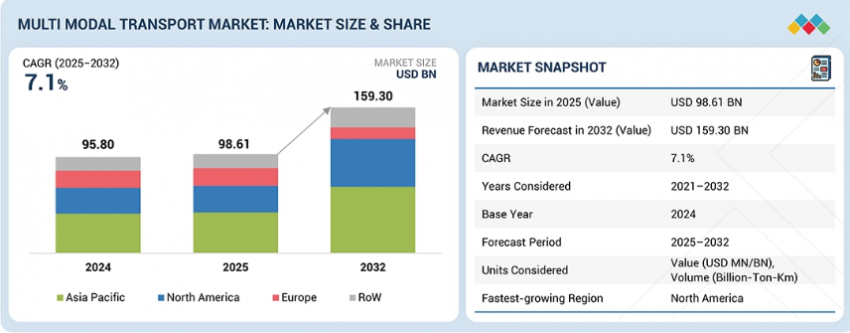
The global multimodal transport market is experiencing significant growth due to increasing demand for integrated logistics solutions, rising international trade volumes, growing e-commerce activities, and the need for resilient supply chain networks. Businesses are increasingly adopting multimodal transportation systems that combine road, rail, sea, and air transport to improve operational efficiency, reduce logistics costs, and enhance cargo visibility across global supply chains.
The multimodal transport market size is projected to grow from USD 98.61 billion in 2025 to USD 159.30 billion by 2032, at a CAGR of 7.1%. Growing investments in logistics infrastructure, digital freight management platforms, and supply chain optimization technologies are expected to accelerate multimodal transport industry growth during the forecast period.
Multimodal Transport Industry Overview
Multimodal transport refers to the movement of goods using multiple transportation modes under a single logistics framework. These solutions typically integrate road, rail, sea, and air transportation to create seamless freight movement across domestic and international supply chains.
Modern multimodal transportation networks help organizations improve cargo handling efficiency, reduce transit delays, optimize transportation costs, and enhance supply chain flexibility. Industries including retail, manufacturing, food & beverages, chemicals, pharmaceuticals, and healthcare increasingly rely on multimodal logistics to support growing distribution requirements and global sourcing strategies.
The increasing complexity of international supply chains is expected to continue driving demand for multimodal transport solutions worldwide.
Supply Chain Optimization Driving Multimodal Transport Market Growth
Supply chain optimization is becoming one of the strongest growth drivers within the multimodal transport market. Companies increasingly seek transportation models capable of improving transit reliability, reducing freight costs, and minimizing disruptions across global trade routes.
Multimodal transport enables businesses to balance capacity across different transportation modes while improving route flexibility and shipment visibility. As organizations focus on building resilient supply chains capable of responding to market volatility, multimodal logistics has become an essential strategy for efficient freight management.
Growing investments in logistics parks, inland container depots, and transportation infrastructure are further supporting multimodal transport market growth globally.
Download PDF Brochure @ https://www.marketsandmarkets.com/pdfdownloadNew.asp?id=145586443
Digital Freight Platforms Transforming Multimodal Logistics
Digitalization is transforming the multimodal logistics market through advanced freight management technologies and real-time visibility platforms. Logistics providers increasingly deploy digital freight platforms, automated documentation systems, cloud-based logistics software, and cargo tracking solutions to improve operational transparency.
Real-time shipment monitoring, predictive analytics, electronic documentation, and automated workflow management help reduce delays, improve customer service, and optimize transportation planning. These technologies also enhance coordination between carriers operating across different transportation modes.
The increasing adoption of digital logistics solutions is expected to remain a major trend within the multimodal transport market.
E-Commerce Expansion Increasing Demand for Multimodal Transportation
The rapid growth of e-commerce and omnichannel retail is significantly increasing demand for multimodal transportation services worldwide. Retailers increasingly require efficient transportation networks capable of supporting high shipment volumes, cross-border trade, and faster delivery expectations.
Multimodal transportation allows businesses to combine cost-effective sea and rail freight with faster road and air transport options, helping optimize delivery performance while controlling logistics costs. The expansion of quick-commerce, direct-to-consumer distribution models, and international retail trade is expected to further strengthen market demand.
The retail industry is projected to be the fastest-growing end-use segment within the multimodal transport market during the forecast period.
Three-Mode Transport Networks Supporting Efficient Freight Movement
Three-mode transportation configurations are emerging as a key trend within the multimodal transport market. These solutions typically combine road, rail, and sea transport or road, air, and sea transport to provide greater flexibility and efficiency across complex logistics networks.
Three-mode systems help organizations improve cargo routing, reduce handling complexity, optimize capacity utilization, and enhance supply chain resilience. Industries such as aerospace, pharmaceuticals, electronics, and industrial manufacturing increasingly utilize these transportation models to support global operations.
As supply chains become more geographically dispersed, three-mode transportation networks are expected to play an increasingly important role in freight transportation strategies.
Asia Pacific Emerging as a Major Multimodal Transport Market
Asia Pacific represents one of the most significant growth regions for the multimodal transport market due to rapid industrialization, expanding manufacturing activities, increasing cross-border trade, and substantial investments in logistics infrastructure.
China continues to strengthen its position through extensive port infrastructure, rail connectivity projects, and international trade corridors. India is investing heavily in freight corridors, multimodal logistics parks, and transportation modernization initiatives, while Southeast Asian economies continue expanding regional connectivity and logistics capabilities
The growing importance of Asia Pacific in global manufacturing and trade is expected to continue driving multimodal transport market growth throughout the forecast period.
Request Free Sample Report @ https://www.marketsandmarkets.com/requestsampleNew.asp?id=145586443