

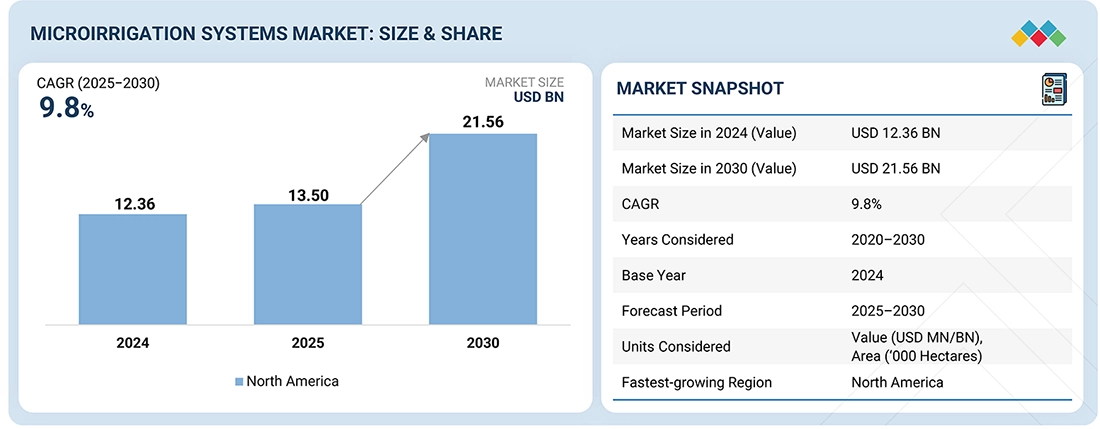
The global microirrigation systems market is entering a strong growth phase, projected to expand from USD 13.50 billion in 2025 to USD 21.56 billion by 2030, at a CAGR of 9.8%. This upward trajectory reflects a broader transformation in agriculture toward precision farming, resource optimization, and sustainable water management.
The Rise of Smart Irrigation Technologies
A major factor fueling the growth of the microirrigation systems market is the rapid advancement of irrigation hardware, software, and integrated services. Today’s systems go far beyond traditional water delivery by incorporating automation and intelligent control technologies.
These modern solutions enable precise irrigation scheduling, real-time flow regulation, and uniform water distribution. Farmers can optimize when and how much they irrigate, significantly reducing water wastage, energy consumption, and labor dependency while improving overall farm efficiency.
Download PDF Brochure: https://www.marketsandmarkets.com/pdfdownloadNew.asp?id=566
From Reactive to Data-Driven Farming
Technological innovations in sensors, remote monitoring, and data analytics are transforming irrigation into a proactive, data-driven process. Within the microirrigation systems market, these capabilities are becoming standard features.
By monitoring soil moisture, weather patterns, evaporation rates, and crop-specific water needs in real time, farmers can dynamically adjust irrigation strategies. This leads to improved crop health, consistent yields, and stronger resilience to climate variability and water scarcity.
Fertigation and Digital Integration Enhancing Efficiency
Another critical trend shaping the microirrigation systems market is the integration of fertigation systems with digital platforms. This allows nutrients to be delivered precisely along with water, improving fertilizer efficiency while minimizing runoff and environmental impact.
Cloud-based platforms, mobile applications, and IoT-enabled systems further simplify operations by offering real-time insights, alerts, and performance tracking. These tools not only enhance usability but also improve decision-making and return on investment for farmers.
Segment Spotlight: Micro Sprinklers Leading Growth
By type, the sprinkler irrigation segment is witnessing rapid expansion, with micro sprinklers emerging as the fastest-growing sub-segment in the microirrigation systems market. Their ability to balance precision, coverage, and operational efficiency makes them highly attractive.
Micro sprinklers ensure uniform water distribution across orchards, vineyards, nurseries, and plantation crops. Their targeted application reduces both under- and over-irrigation, supporting healthier crop growth. Additionally, their low-pressure operation significantly reduces energy consumption and operating costs, while their adaptability to uneven terrain enhances their versatility.
Request Sample Pages: https://www.marketsandmarkets.com/requestsampleNew.asp?id=566
Industrial Adoption Accelerating Demand
From an end-user perspective, industrial users are expected to drive significant growth in the microirrigation systems market. Large agribusinesses, plantations, and institutional growers are increasingly adopting these systems to meet sustainability goals and improve operational efficiency.
These systems help reduce water usage, limit fertilizer and pesticide runoff, and optimize resource utilization. Moreover, IoT-enabled platforms allow remote monitoring and control via mobile apps and dashboards, making it easier to manage large-scale or geographically dispersed operations while reducing labor requirements.
Asia Pacific: A High-Growth Regional Hub
The Asia Pacific region is projected to be the fastest-growing market, driven by challenges such as erratic rainfall, droughts, and rising temperatures. The microirrigation systems market in this region is gaining traction as farmers seek efficient solutions to manage water scarcity.
Microirrigation systems deliver water directly to the root zone in controlled quantities, reducing crop stress and improving resilience to extreme weather. They also enable precise irrigation scheduling based on crop type, soil conditions, and growth stages.
Additionally, integrated filtration and purification systems address water quality concerns by removing contaminants such as salts and heavy metals. This ensures better crop health, improved yields, and long-term soil sustainability.
Leading Microirrigation Systems Companies:
The microirrigation systems market is highly competitive, with several global and regional players driving innovation and expansion. Key companies include Jain Irrigation Systems Ltd. (India), The Toro Company (US), Netafim (Israel), Nelson Irrigation (US), Rain Bird Corporation (US), Finolex Plasson (India), Mahindra EPC Irrigation Limited (India), T-L Irrigation (US), Hunter Industries (US), Rivulis (Israel), Chinadrip irrigation Equipment co., Ltd. (China), Elgo Irrigation Ltd. (Israel), Antelco (Australia), Microjet (South Africa), and Irritec S.p.A (Italy), among others.