
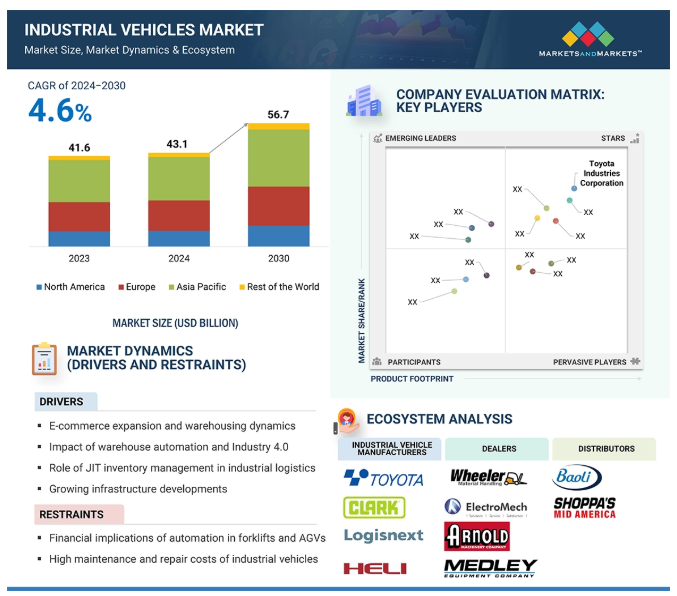
The global industrial vehicle market is witnessing strong growth due to increasing adoption of warehouse automation technologies, rising demand for efficient material handling equipment, and rapid expansion of e-commerce and smart logistics infrastructure worldwide. Industrial vehicles are becoming essential components of modern warehouses, manufacturing facilities, fulfillment centers, ports, and industrial supply chains due to their ability to improve operational efficiency, reduce labor dependency, and optimize material movement.
The industrial vehicle industry is also benefiting from advancements in electric propulsion systems, autonomous navigation technologies, telematics platforms, AI-enabled fleet management, and Industry 4.0 integration. Increasing investments in smart factories, automated warehouses, sustainable logistics infrastructure, and intelligent material handling systems are expected to significantly accelerate long-term market growth globally. The industrial vehicle market size is projected to expand steadily as industries increasingly adopt connected and automated industrial mobility solutions.
Industrial Vehicle Industry Overview
The industrial vehicle industry includes forklifts, tow tractors, pallet trucks, automated guided vehicles (AGVs), reach trucks, container handlers, and other material handling equipment used across warehouses, factories, ports, distribution centers, and logistics hubs. These vehicles are critical for improving operational productivity, warehouse efficiency, inventory movement, and industrial transportation.
Modern industrial vehicles increasingly integrate advanced telematics systems, IoT sensors, AI-based fleet analytics, lithium-ion battery technologies, autonomous navigation systems, and connected warehouse management platforms to improve safety, operational visibility, and energy efficiency. Manufacturers are focusing heavily on automation-ready industrial vehicles capable of supporting smart logistics and digital warehouse operations.
The industrial vehicle market share is growing rapidly due to increasing e-commerce activity, expansion of fulfillment centers, rising investments in industrial automation, and growing demand for efficient intralogistics systems. Smart factories and connected logistics ecosystems are further accelerating adoption of intelligent industrial mobility solutions globally.
Key Trends in the Industrial Vehicle Market
One of the most significant industrial vehicle industry trends is the rapid transition toward electric industrial vehicles. Electric forklifts, battery-powered pallet trucks, and zero-emission warehouse vehicles are becoming increasingly popular due to lower operating costs, reduced emissions, quieter operation, and improved energy efficiency.
Lithium-ion battery technologies are significantly improving charging performance, operational uptime, and fleet productivity within warehouses and logistics centers. Many manufacturers and warehouse operators are transitioning away from internal combustion industrial vehicles toward fully electric fleets to support sustainability goals and regulatory compliance.
Another major industrial vehicle market trend is the increasing adoption of warehouse automation and autonomous material handling systems. Automated guided vehicles (AGVs), autonomous mobile robots (AMRs), and AI-powered warehouse navigation systems are becoming critical components of modern smart logistics infrastructure.
Connected fleet management systems equipped with telematics, predictive maintenance capabilities, and real-time analytics are also reshaping industrial vehicle operations. These technologies help operators optimize fleet utilization, monitor vehicle health, improve worker safety, and reduce operational downtime.
Download PDF Brochure @ https://www.marketsandmarkets.com/pdfdownloadNew.asp?id=164686137
Electric Industrial Vehicles Transforming Material Handling Operations
Electric industrial vehicles are becoming one of the fastest-growing segments within the global industrial vehicle market. Electric forklifts and battery-powered warehouse vehicles provide several advantages compared to conventional internal combustion systems, including lower maintenance requirements, improved indoor air quality, reduced operating noise, and enhanced energy efficiency.
Advancements in lithium-ion batteries, fast-charging systems, and energy management technologies are enabling industrial operators to improve fleet uptime and warehouse productivity. Electric industrial vehicles are particularly important for indoor logistics operations, automated warehouses, and sustainability-focused manufacturing facilities.
Government regulations focused on industrial emissions reduction and corporate sustainability initiatives are expected to further accelerate adoption of electric material handling equipment globally.
Warehouse Automation Accelerating Industrial Vehicle Demand
Warehouse automation is becoming one of the strongest growth drivers within the industrial vehicle market. Rapid growth in e-commerce, omni-channel retail, and fulfillment center expansion is increasing demand for highly efficient material handling systems capable of supporting high-volume logistics operations.
Automated warehouses increasingly rely on industrial vehicles integrated with robotics, warehouse management software, AI-driven inventory systems, and real-time analytics platforms to improve operational efficiency and order fulfillment speed. Smart logistics facilities deploy connected forklifts, AGVs, and automated pallet systems to optimize warehouse throughput and reduce labor dependency.
The increasing shift toward digital warehouses and smart intralogistics ecosystems is expected to significantly strengthen long-term demand for industrial vehicles worldwide.
Industry 4.0 and Smart Factory Technologies Supporting Market Growth
Industry 4.0 technologies are significantly transforming the industrial vehicle industry. Connected factories and smart warehouses increasingly require intelligent material handling systems capable of real-time communication, predictive maintenance, digital tracking, and fleet optimization.
Industrial vehicles equipped with IoT connectivity and telematics platforms allow operators to monitor battery performance, vehicle utilization, maintenance schedules, and operational productivity in real time. Predictive maintenance systems help reduce downtime and improve overall fleet efficiency.
Integration with warehouse management systems, digital twins, AI analytics, and cloud-based logistics platforms is further improving the operational capabilities of next-generation industrial vehicles.
E-Commerce Expansion Increasing Demand for Industrial Vehicles
The rapid expansion of e-commerce and online retail is creating strong demand for industrial vehicles across fulfillment centers, distribution hubs, and warehouse operations. Increasing order volumes and faster delivery expectations are driving investments in automated logistics infrastructure and advanced material handling systems.
Warehouse operators are increasingly deploying electric forklifts, AGVs, automated pallet systems, and connected industrial vehicles to improve inventory movement, reduce order processing times, and optimize warehouse throughput.
Growing investments in logistics automation and smart fulfillment infrastructure are expected to continue supporting industrial vehicle market growth during the forecast period.
Regional Analysis of the Industrial Vehicle Market
Asia Pacific dominates the global industrial vehicle market share due to strong manufacturing activity, rapid industrialization, expansion of warehouse infrastructure, and increasing adoption of automation technologies across China, Japan, South Korea, and India.
North America is witnessing significant growth in warehouse automation and smart logistics investments driven by rapid e-commerce expansion and increasing deployment of automated fulfillment centers. The United States remains a major market for electric forklifts, AGVs, and connected warehouse systems.
Europe is experiencing growing adoption of electric industrial vehicles and sustainable logistics technologies due to strict environmental regulations and increasing focus on green industrial mobility solutions.
Future Outlook of the Industrial Vehicle Market
The future of the industrial vehicle market will be strongly influenced by warehouse automation, electric mobility, autonomous logistics systems, and Industry 4.0 technologies. Connected industrial vehicles integrated with AI analytics, robotics, and digital warehouse platforms are expected to become increasingly important within future smart logistics ecosystems.
Advancements in lithium-ion batteries, autonomous navigation systems, predictive maintenance technologies, and cloud-connected fleet management platforms are expected to significantly improve warehouse productivity, energy efficiency, and operational intelligence.
As e-commerce, industrial automation, and smart logistics infrastructure continue expanding globally, the industrial vehicle market is expected to remain a critical segment within the future intelligent material handling and warehouse automation industry.
Request Free Sample Report @ https://www.marketsandmarkets.com/requestsampleNew.asp?id=164686137