
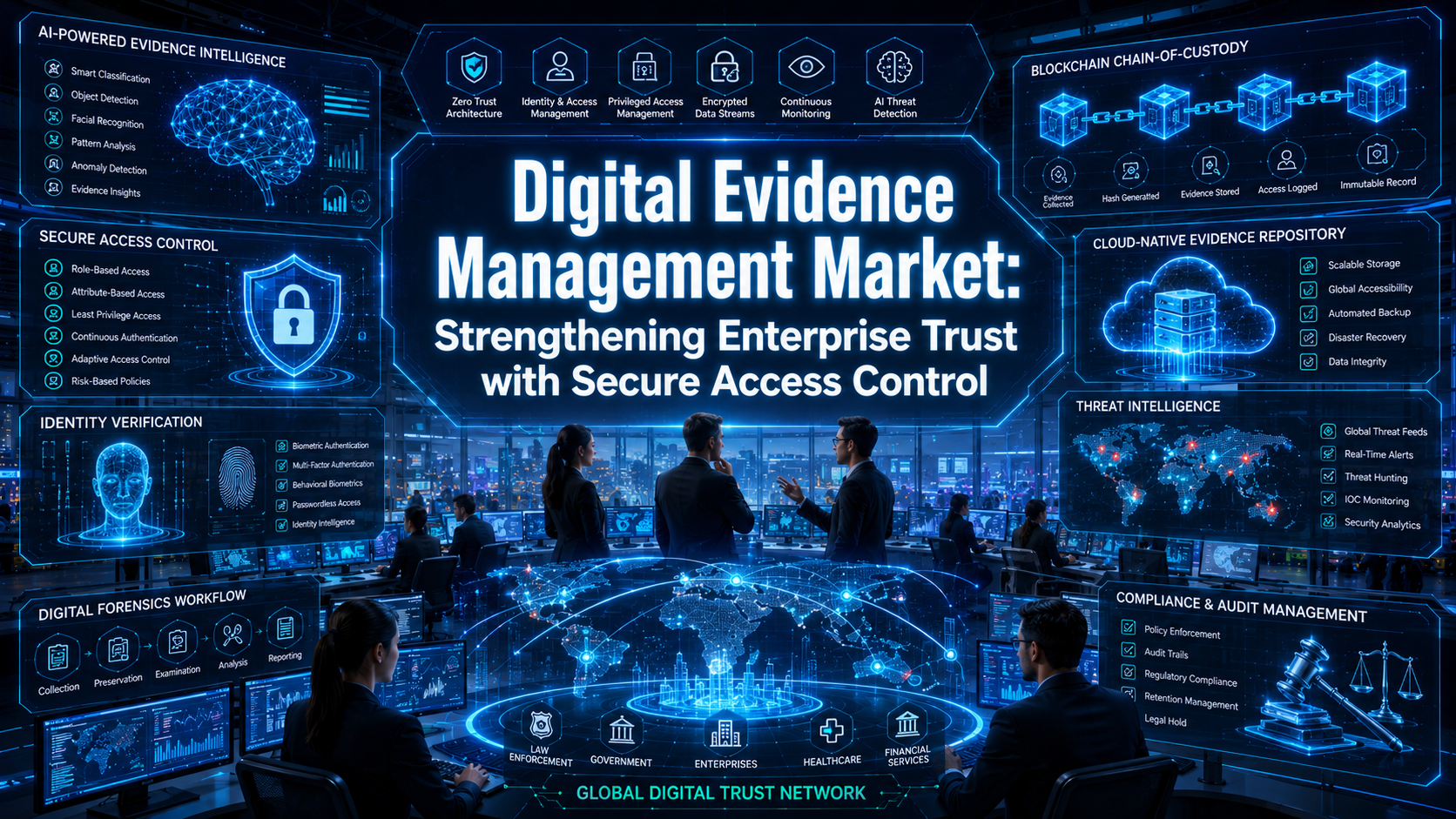
The market for digital evidence management is emerging as a key component of digital governance, regulatory compliance, and enterprise cybersecurity. Protecting digital evidence has become crucial for upholding trust, operational resilience, and legal accountability as businesses embrace cloud computing, remote labor, AI-driven business processes, and connected digital ecosystems.
Secure Access Control, which guarantees that only authorized people may access, manage, alter, or distribute sensitive digital evidence, is at the core of this change. When combined, Digital Evidence Management and Secure Access Control Market help businesses to enhance business continuity, bolster compliance programs, protect sensitive data, and expedite investigations.
Through surveillance systems, mobile devices, cloud platforms, IoT sensors, workplace apps, and cybersecurity solutions, modern organizations produce enormous volumes of digital evidence. Securely managing this data is now a strategic business imperative that promotes organizational expansion, risk mitigation, and consumer trust rather than just an IT necessity.
Why Secure Access Control Has Become a Strategic Enterprise Investment
The digital enterprise works in global business ecosystems, distributed workforces, linked devices, and hybrid cloud infrastructures. The attack surface has grown as a result of this change, and protecting sensitive data throughout its lifecycle is now more crucial.
Perimeter defense-based traditional security methods are no longer able to offer sufficient protection. Businesses today need intelligent access management, which continuously confirms identities, keeps an eye on user activity, and modifies security rules in response to current threats.
By integrating identity management, authentication, authorization, and ongoing monitoring into a single security architecture, Secure Access Control tackles these issues.
Key Drivers Behind Enterprise Adoption
- Hybrid and remote workforce expansion
- Growing cyber threats
- Increasing ransomware attacks
- Zero Trust adoption
- Cloud-first business strategies
- Regulatory compliance requirements
- Digital transformation initiatives
- Rising insider threats
- Increasing volumes of digital evidence
- AI-powered security operations
Organizations implementing Secure Access Control improve operational resilience while protecting critical business assets and maintaining regulatory compliance.
According to market research, you can Download the PDF to explore detailed business opportunities.
Understanding the Strategic Rise of the Digital Evidence Management Market
The market for digital evidence management has advanced significantly beyond conventional technologies for storing evidence. To build intelligent digital evidence ecosystems, contemporary solutions combine artificial intelligence, cloud computing, identity management, advanced analytics, blockchain verification, and automated chain-of-custody capabilities.
Businesses today need solutions that can handle evidence from a variety of sources, such as body-worn devices, mobile phones, cloud apps, endpoint security platforms, IoT devices, surveillance cameras, and business collaboration tools.
Modern Digital Evidence Management platforms enable organizations to:
Protect Sensitive Information
Valuable digital assets are protected by sophisticated access controls, encryption, and secure storage.
Strengthen Regulatory Compliance
Compliance with industry requirements is made easier by policy-driven governance, automated audit trails, and unchangeable evidence records.
Accelerate Investigations
Intelligent analytics, metadata indexing, and AI-powered search capabilities speed up investigations and enhance decision-making.
Improve Collaboration
While keeping thorough chain-of-custody records, authorized stakeholders can safely access evidence across departments.
Support Enterprise Risk Management
Organizations may find security flaws, spot anomalous activity, and enhance governance throughout digital operations with the use of integrated analytics.
Latest Technology Trends Driving Intelligent Digital Evidence Management
A number of cutting-edge technologies are boosting innovation in the digital evidence management market and changing enterprise security.
AI-Powered Evidence Intelligence
Artificial intelligence uses clever analytics to automatically categorize digital evidence, spot abnormalities, spot patterns, and expedite forensic investigations.
Zero Trust Security
In order to drastically lower insider threats and illegal access, organizations are increasingly verifying each user, device, and application before allowing access.
Cloud-Native Evidence Platforms
Without sacrificing security, cloud-based architectures offer scalable storage, worldwide accessibility, disaster recovery, automated updates, and enhanced collaboration.
Blockchain-Based Chain of Custody
By producing tamper-resistant audit trails that increase legal defensibility and regulatory confidence, blockchain technology enhance evidence integrity.
Identity-Centric Security
The new security perimeter is identity. Adaptive authentication, behavioral analytics, advanced IAM, and PAM guarantee ongoing security throughout organizational ecosystems.
Intelligent Compliance Automation
Contemporary technologies save human labor while increasing compliance accuracy by automating governance procedures, audit reporting, evidence preservation regulations, and regulatory documentation.
AI-Assisted Threat Detection
Machine learning continuously examines system activity, user behavior, and access patterns to spot possible risks before they become security problems.
Mobile and Cloud Evidence Integration
Evidence produced by smartphones, cloud services, IoT devices, remote work locations, and collaboration platforms is increasingly managed by organizations inside a single, cohesive ecosystem.
This Sample Report is designed to fuel your business growth—download it today.
Why Traditional Digital Evidence Systems Can No Longer Support Modern Enterprises
Evidence quantities were generally small and security requirements were simpler in isolated locations, where legacy evidence management systems were built. Today’s businesses produce massive amounts of digital evidence, both organized and unstructured, on a daily basis, rendering conventional methods less and less useful.
Manual procedures, dispersed storage repositories, disjointed workflows, and restricted search capabilities are common features of conventional systems. These restrictions lengthen investigations, raise compliance issues, and lower operational effectiveness.
These issues are resolved by combining cutting-edge Digital Evidence Management systems with contemporary Secure Access Control, which enables:
- Centralized evidence repositories
- Automated chain-of-custody management
- AI-powered search and analytics
- Real-time identity verification
- Policy-driven access governance
- Secure cloud collaboration
- Continuous compliance monitoring
- Enterprise-wide visibility across digital assets
Organizations embracing these capabilities gain stronger cybersecurity, improved legal defensibility, faster investigations, and enhanced business resilience.
Secure Access Control and Digital Evidence Management: A Strategic Enterprise Framework
Organizations are building a safe, legal, and intelligence-driven digital ecosystem with the aid of Secure Access Control and the Digital Evidence Management Market. Businesses are realizing more and more that digital evidence is a strategic business resource that supports cybersecurity, governance, operational resilience, and customer trust rather than just a legal or investigative asset.
Identity management systems, cloud security frameworks, SIEM solutions, endpoint detection tools, surveillance infrastructure, and compliance platforms are all integrated with contemporary digital evidence management platforms. Organizations may securely manage evidence throughout its lifecycle with full visibility and responsibility thanks to this integration.
Enterprise Advantages of an Integrated Framework
- Centralized evidence governance
- Secure cloud-based evidence storage
- Automated chain-of-custody management
- Real-time access monitoring
- AI-assisted evidence analysis
- Faster incident response
- Improved compliance readiness
- Enhanced enterprise security posture
By aligning Secure Access Control with Digital Evidence Management, organizations create a foundation for secure digital transformation and sustainable business growth.
Enterprise Applications Across Industries
Government and Public Safety
Large amounts of digital evidence from surveillance systems, investigations, emergency response operations, and public safety initiatives are managed by government organizations.
Business Benefits
- Faster case management
- Improved evidence integrity
- Enhanced transparency
- Reduced investigation timelines
- Stronger public trust
Financial Services
Digital Evidence Management platforms are used by banks and other financial institutions to support risk management programs, cybersecurity operations, fraud investigations, and regulatory compliance.
Business Benefits
- Improved fraud detection
- Faster compliance audits
- Enhanced data protection
- Better risk management
- Stronger customer confidence
Healthcare
Through patient records, telemedicine systems, linked medical devices, and cybersecurity monitoring platforms, healthcare providers create digital evidence.
Business Benefits
- Improved data security
- Enhanced compliance management
- Better patient privacy protection
- Faster incident investigations
- Reduced regulatory risks
Retail and E-Commerce
Digital Evidence Management solutions are used by retail enterprises to monitor transactions, secure consumer data, look into fraud, and safeguard digital assets.
Business Benefits
- Reduced financial losses
- Enhanced transaction security
- Improved customer trust
- Better fraud prevention
- Faster operational investigations
Manufacturing
In order to support supply chain security, cybersecurity investigations, quality management, and operational compliance, manufacturers are depending more and more on digital evidence.
Business Benefits
- Enhanced operational visibility
- Stronger cyber resilience
- Improved compliance management
- Better supplier accountability
- Reduced operational risks
Telecommunications
Digital Evidence Management systems are used by telecom companies to protect consumer data, look into occurrences, keep an eye on network activities, and comply with legal obligations.
Business Benefits
- Improved network security
- Faster incident response
- Better customer protection
- Enhanced compliance readiness
- Reduced operational disruptions
Business Benefits Every Enterprise Leader Should Understand
Businesses making investments in digital evidence management and secure access control Measurable business benefits for the market that go well beyond security operations.
Operational Benefits
- Automated evidence workflows
- Centralized digital asset management
- Improved investigation efficiency
- Faster evidence retrieval
- Enhanced collaboration across teams
Financial Benefits
- Reduced operational costs
- Lower compliance expenses
- Decreased investigation timelines
- Improved resource utilization
- Higher return on security investments
Strategic Benefits
- Stronger digital trust
- Enhanced brand reputation
- Better governance and accountability
- Improved cybersecurity maturity
- Sustainable competitive advantage
As enterprises continue to digitize operations, Digital Evidence Management is becoming a critical enabler of business continuity and enterprise resilience.
Digital Evidence Management Market Share, Size, Analysis, Trends, Outlook, Report, Growth, and Forecast
Digital Evidence Management Market Share
Providers that offer cloud-native architectures, AI-powered analytics, secure access controls, enhanced encryption, and automated compliance management are having an increasing impact on the market share for digital evidence management. Platforms that can support enterprise-scale digital transformation while upholding strict security standards are preferred by organizations.
Digital Evidence Management Market Size
The Management of Digital Evidence As businesses engage in cloud infrastructure, cybersecurity upgrades, regulatory compliance programs, and intelligent evidence management systems, the market’s size is growing. The need for scalable evidence platforms is rising due to the increasing amount of digital data produced in various business settings.
Digital Evidence Management Market Analysis
Complete Management of Digital Evidence Digital transformation, remote work, the rise in cybercrime, cloud use, and more stringent compliance regulations are all driving market expansion, according to market analysis. Centralized solutions that can securely manage evidence while enhancing operational effectiveness and governance are becoming more and more necessary for organizations.
Digital Evidence Management Market Trends
Leading Digital Evidence Management Market trends include:
- AI-powered evidence analytics
- Zero Trust security frameworks
- Cloud-native evidence repositories
- Blockchain-based chain of custody
- Identity-centric security models
- Automated compliance workflows
- Behavioral analytics
- Secure remote access management
- Digital forensics integration
- Enterprise-wide evidence intelligence
These trends are reshaping how organizations protect, manage, and utilize digital evidence as a strategic asset.
Digital Evidence Management Market Outlook
As businesses prioritize digital trust, cybersecurity resilience, cloud security, and regulatory compliance, the future for the digital evidence management market is still quite bright. Businesses are using integrated evidence management systems more frequently to promote long-term growth and operational excellence.
Digital Evidence Management Market Report
Business executives may assess technological advancements, competitive dynamics, customer adoption trends, investment prospects, and future growth strategies with the help of a thorough Digital Evidence Management Market analysis. In an increasingly complicated digital environment, these insights aid in making well-informed decisions.
Digital Evidence Management Market Growth
Effective Management of Digital Evidence As businesses continue to invest in cloud-native architectures, AI-powered analytics, digital governance frameworks, and intelligent security solutions, market expansion is anticipated. Market adoption across industries is accelerating due to the growing significance of digital trust.
Digital Evidence Management Market Forecast
The Management of Digital Evidence The market projection shows continued growth in the upcoming years as businesses use cloud-based security ecosystems, automated compliance, AI-driven evidence intelligence, and Secure Access Control. Companies will be in a better position to control risk, improve governance, and foster corporate innovation if they update their evidence management skills.
Future Outlook: The Evolution of Enterprise Digital Trust
Beyond storage and retrieval, digital evidence management has a bright future. Artificial intelligence, machine learning, blockchain, digital identity verification, and predictive analytics are examples of emerging technologies that will change how businesses handle evidence, evaluate risk, and make decisions.
Future enterprise platforms will increasingly deliver:
- Autonomous evidence classification
- Real-time threat correlation
- Predictive risk intelligence
- Intelligent compliance monitoring
- Self-service evidence analytics
- Continuous identity verification
- Advanced chain-of-custody automation
- Enterprise-wide digital trust frameworks
Organizations that invest early in these capabilities will gain stronger security, greater agility, and improved competitive positioning.
For contemporary businesses looking to safeguard confidential data, improve governance, and foster digital trust, secure access control has emerged as a fundamental necessity. Simultaneously, the market for digital evidence management is developing into a vital technology sector that helps businesses manage digital assets safely while enhancing operational effectiveness and regulatory compliance.
Businesses must implement intelligent evidence management solutions that incorporate cybersecurity, compliance, identity governance, and advanced analytics as digital ecosystems continue to grow. Successfully aligning these competencies can help organizations lower risk, increase resilience, speed up investigations, and provide long-term commercial value.
Businesses that view digital evidence as a strategic asset that fosters innovation, trust, and sustainable growth rather than as a compliance need will win the future.