
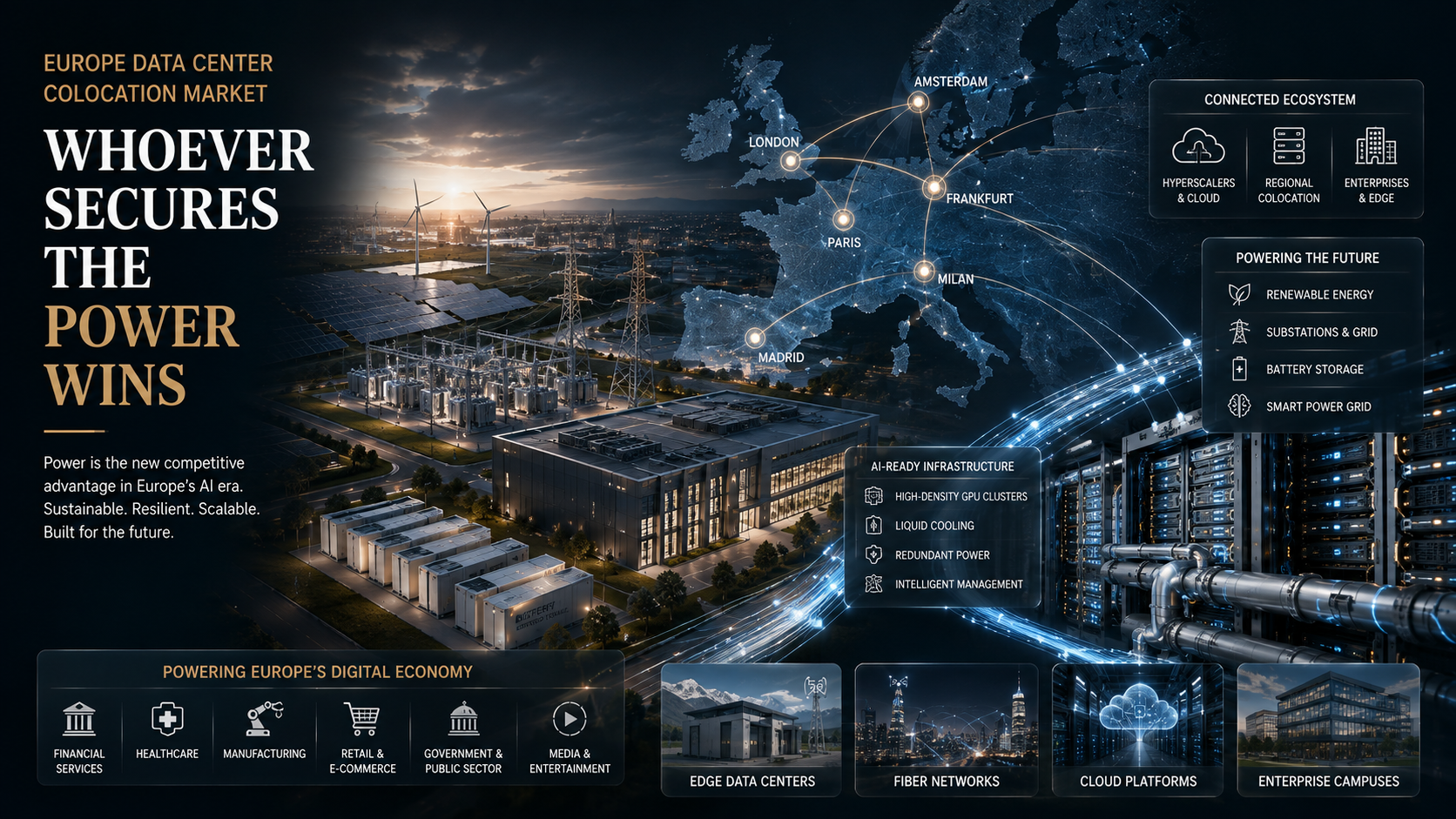
The Europe Data Center Colocation Market is entering a decisive new phase. Electricity availability is becoming more valuable than land, buildings, and, in some locations, even fiber connectivity. AI, high-performance computing (HPC), cloud platforms, and digital services are turning data centers into strategic infrastructure for economic growth.
For decades, location, connectivity, and customer proximity defined the competitive equation. Now the question is changing: who can secure reliable power, renewable energy, grid capacity, and efficient cooling at scale? That shift is becoming central to Europe Data Center Colocation Market growth.
As enterprises accelerate AI adoption, demand for GPU clusters, high-density racks, and low-latency computing continues to rise. Operators capable of securing long-term energy capacity could gain a decisive advantage.
Strategic Introduction: Why Power Is Europe’s New Digital Currency
Power is becoming a critical competitive asset because AI and high-density computing require reliable, scalable, and increasingly sustainable electricity.
Artificial intelligence is creating a structural increase in compute demand. Training large language models, supporting AI inference, running digital twins, processing industrial IoT data, and delivering cloud-native applications all require significant electrical capacity.
The Europe Data Center Colocation Market size opportunity is therefore moving beyond square footage and rack counts. Operators increasingly need:
- Grid availability and expansion capacity
- Renewable energy sourcing and power purchase agreements
- Battery storage and backup resilience
- Advanced cooling efficiency
- Utility and infrastructure partnerships
The winning strategy is no longer simply building a facility. It is securing the energy ecosystem that allows that facility to scale.
Market research indicates strong trends Download the PDF to uncover business insights.
Market Context & Growth Narrative: AI Changes the Equation
AI is reshaping European colocation by increasing power density, accelerating demand for specialized facilities, and expanding investment beyond traditional data center hubs.
The rapid growth of AI workloads is transforming Europe’s digital infrastructure landscape. Hyperscalers, enterprises, governments, and cloud providers increasingly require facilities designed for high-density computing rather than conventional enterprise workloads.
Key Europe Data Center Colocation Market trends include:
- Growing demand for GPU infrastructure
- Expansion beyond established FLAP markets
- Increasing regional and edge colocation
- Greater investment in renewable-powered facilities
- Adoption of liquid and direct-to-chip cooling
- Rising interest in sovereign cloud infrastructure
The Europe Data Center Colocation Market forecast points toward sustained expansion as digital transformation and AI adoption accelerate. Traditional workloads remain important, but AI is creating an entirely new infrastructure category with different power, cooling, and connectivity requirements.
This Sample Report is designed to fuel your business growth—download it today.
Europe Data Center Colocation Market Analysis: Where the Opportunity Lies
The market opportunity is being shaped by the intersection of AI demand, hyperscaler expansion, energy access, sustainability, connectivity, and digital sovereignty.
A meaningful Europe Data Center Colocation Market analysis must examine three interconnected forces.
Supply drivers
- AI infrastructure investment
- Hyperscaler expansion
- Enterprise cloud migration
- Digital sovereignty initiatives
Demand drivers
- Machine learning
- HPC workloads
- Edge computing
- 5G applications
- Industrial IoT
Competitive drivers
- Secure power access
- Renewable energy credentials
- Cooling innovation
- Carrier and cloud ecosystems
- Rapid capacity expansion
As these factors become more important, Europe Data Center Colocation Market share could increasingly favor operators that combine energy security with scalable, AI-ready infrastructure.
Business Value Proposition: Why Colocation Is Winning
Colocation provides faster access to scalable infrastructure while reducing the complexity and capital burden of building and operating private data centers.
Colocation has become strategically important because organizations can deploy critical infrastructure without owning every component of a facility.
Its core advantages include:
- Faster deployment and market entry
- Lower capital requirements
- Access to carrier and cloud ecosystems
- AI-ready power and cooling
- Sustainability support
- Geographic flexibility
For enterprises, colocation can accelerate cloud and AI expansion. For hyperscalers, it can provide faster access to strategic markets. For governments, it can strengthen digital resilience and regional capacity.
That is why the Europe Data Center Colocation Market report landscape increasingly positions colocation as a core digital infrastructure model rather than simply a real estate alternative.
Industry Use Cases: Where Demand Is Accelerating
Financial services, healthcare, manufacturing, retail, and telecommunications are expanding colocation demand through AI, analytics, edge computing, and connected digital services.
Financial institutions need low-latency infrastructure for transactions, fraud detection, AI analytics, and compliance. Healthcare organizations require secure computing for patient data, diagnostics, research, and digital services.
Manufacturers are deploying industrial AI, robotics, digital twins, and IoT platforms that benefit from localized computing. Retailers need edge infrastructure for personalization, inventory optimization, and omnichannel commerce.
Telecommunications companies are expanding regional infrastructure to support 5G and edge applications.
These use cases demonstrate why the Europe Data Center Colocation Market growth opportunity extends well beyond traditional enterprise workloads.
Technology Architecture: Building AI-Ready Colocation
AI-ready colocation requires coordinated power, compute, cooling, connectivity, and energy-management systems rather than conventional rack space alone.
Modern facilities increasingly combine:
- Compute: GPUs, HPC clusters, and AI accelerators
- Power: Grid connections, renewables, batteries, and microgrids
- Cooling: Liquid, direct-to-chip, and heat-reuse systems
- Connectivity: Carrier-neutral networks, cloud on-ramps, and edge links
The architecture must be designed for density and flexibility. Operators capable of increasing power availability without completely redesigning facilities will be better positioned to capture future AI workloads.
Regulatory & Sustainability Landscape: Efficiency Becomes Strategy
European data center competitiveness increasingly depends on energy efficiency, carbon reduction, renewable sourcing, data sovereignty, and transparent sustainability practices.
Europe’s regulatory environment is influencing infrastructure decisions. Operators face growing expectations around energy performance, emissions, renewable energy, reporting, and digital sovereignty.
Facilities that integrate efficient cooling, renewable power, energy storage, and waste-heat recovery can strengthen both environmental performance and commercial positioning.
The Europe Data Center Colocation Market outlook is therefore becoming closely linked to sustainability. Energy efficiency is moving from a compliance consideration toward a board-level infrastructure strategy.
Implementation Roadmap: Turning Demand Into Capacity
Enterprises can reduce infrastructure risk by evaluating workloads, power availability, location, connectivity, sustainability, and scalability before selecting a colocation strategy.
A practical roadmap includes:
- Assess AI, cloud, and digital workload requirements.
- Evaluate available power and future grid capacity.
- Compare locations, connectivity, regulations, and latency.
- Design hybrid architectures across cloud, colocation, and edge.
- Establish sustainability and energy-management targets.
- Continuously optimize capacity, cooling, and utilization.
The objective is not simply to secure today’s capacity. It is to create an infrastructure path capable of supporting tomorrow’s workloads.
Challenges & Risk Considerations: The Constraints Behind Growth
Grid constraints, connection delays, construction costs, cooling complexity, land limitations, and skilled-labor shortages can slow European data center expansion.
The biggest challenge may be securing power when and where demand is rising fastest. Utility connection timelines can extend project schedules, while high-density AI environments introduce greater cooling and operational complexity.
Key risks include:
- Limited grid capacity
- Long utility connection timelines
- Rising construction costs
- Advanced cooling requirements
- Land and permitting constraints
- Shortages of specialized talent
These pressures are encouraging investment in secondary cities and emerging locations where power availability may offer a stronger expansion pathway.
Competitive Advantage & Future Outlook: The Power-First Era
Future market leaders will compete on energy access, AI readiness, sustainability, cooling, connectivity, and the ability to scale capacity quickly.
The next generation of colocation leaders will not compete on buildings alone. Their advantage will come from integrating:
- Reliable power and renewable energy
- High-density AI infrastructure
- Advanced cooling
- Edge capabilities
- Carrier and cloud ecosystems
- Resilient operations
Europe Data Center Colocation Market growth will increasingly depend on energy strategy. Operators that secure power early, invest in efficient cooling, and prepare for AI workloads can create stronger long-term positions.
The Winners May Control Energy, Not Land
The Europe Data Center Colocation Market is evolving from a space-driven business into an energy-driven digital infrastructure industry. AI, cloud, sustainability, and digital transformation are converging around one increasingly scarce resource: reliable electricity.
The strategic lesson is clear. The companies that win the next infrastructure cycle will not simply build more data centers. They will secure power, optimize efficiency, integrate renewable energy, support high-density AI, and create resilient digital ecosystems.
The Europe Data Center Colocation Market outlook therefore points toward a more competitive and energy-conscious future. Land will still matter. Connectivity will still matter. But power may ultimately determine how quickly a facility can scale and whether a project captures the next wave of demand.