

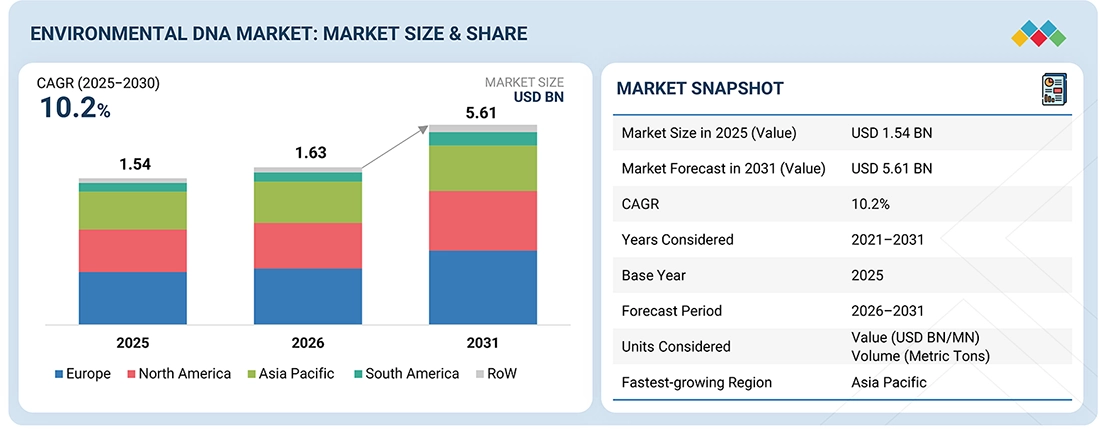
The global Environmental DNA (eDNA) industry is experiencing rapid expansion as governments, research institutions, and environmental organizations increasingly adopt molecular-based monitoring solutions for ecosystem analysis and species detection. The environmental DNA market is projected to grow from USD 1.63 billion in 2026 to USD 5.61 billion by 2031, registering a CAGR of 10.2% during the forecast period.
Environmental DNA technology has emerged as a transformative approach in environmental monitoring because it provides faster, more accurate, and non-invasive species identification compared to conventional survey methods. By analyzing small traces of DNA collected from water, soil, air, or sediment samples, researchers can detect organisms without physically capturing or observing them. This capability is significantly improving biodiversity assessments, invasive species management, conservation programs, water quality testing, and climate-related ecological studies.
Download PDF Brochure: https://www.marketsandmarkets.com/pdfdownloadNew.asp?id=87204702
Rising Adoption of eDNA Technologies Across Environmental Monitoring Applications
The growing demand for efficient ecosystem monitoring solutions is one of the primary factors driving the environmental DNA market. Traditional biological monitoring techniques often require extensive field surveys, skilled personnel, and longer processing times. In contrast, eDNA analysis enables large-scale environmental assessments with improved speed, precision, and lower ecological disturbance.
Environmental agencies and conservation organizations are increasingly utilizing eDNA technologies for:
- Biodiversity monitoring
- Rare and endangered species detection
- Invasive species surveillance
- Freshwater and marine ecosystem assessments
- Ecological restoration projects
- Environmental impact assessments
- Climate change research
The ability of eDNA to detect multiple species from minimal biological material is making it an essential tool for modern ecological studies. As global concerns around biodiversity loss and habitat degradation continue to rise, the demand for scalable environmental monitoring technologies is expected to accelerate further.
Technological Advancements Supporting Environmental DNA Market Growth
Continuous improvements in molecular biology and sequencing technologies are significantly strengthening the capabilities of the environmental DNA industry. Advanced Polymerase Chain Reaction (PCR) methods, next-generation sequencing (NGS), and bioinformatics platforms are enhancing the accuracy, efficiency, and scalability of eDNA workflows.
Innovations in automated data analysis and cloud-based interpretation tools are also simplifying the process for end users. These developments are helping researchers and environmental service providers generate reliable ecological insights more quickly and cost-effectively.
At the same time, standardized protocols and validated testing workflows are improving consistency across studies. This standardization is becoming increasingly important as environmental regulations become stricter and governments demand more scientifically reliable ecological assessments.
Request Sample Pages: https://www.marketsandmarkets.com/requestsampleNew.asp?id=87204702
Services Segment Holds a Significant Share of the Environmental DNA Market
Based on solution type, the services segment accounts for a substantial share of the environmental DNA market. The increasing preference for outsourced environmental testing and analysis services is driving strong demand across the segment.
Environmental DNA service providers offer complete end-to-end solutions that typically include:
- Field sample collection
- Laboratory testing
- DNA extraction
- Sequencing services
- Bioinformatics analysis
- Data interpretation
- Reporting and project management
Many environmental agencies, academic institutions, and private organizations prefer outsourcing these services because establishing in-house molecular laboratories requires significant investments in infrastructure, technical expertise, and specialized equipment.
Comprehensive service offerings simplify complex biodiversity monitoring projects and help clients achieve faster and more reliable outcomes. Service providers also ensure standardized methodologies and regulatory compliance, which are essential for environmental impact studies and conservation programs.
As demand for large-scale ecological monitoring grows worldwide, the services segment is expected to maintain strong momentum throughout the forecast period.
Metabarcoding Segment Expected to Witness Strong Growth
By detection method, the metabarcoding segment is projected to experience substantial growth in the coming years. Metabarcoding has become increasingly popular because it enables simultaneous identification of multiple species from a single environmental sample.
Unlike targeted detection methods such as quantitative PCR (qPCR), which focus on individual species, metabarcoding uses high-throughput sequencing technologies to analyze mixed DNA samples and identify diverse biological communities in one workflow.
This approach is particularly valuable for:
- Broad biodiversity assessments
- Aquatic ecosystem monitoring
- Soil biodiversity studies
- Marine ecological surveys
- Environmental impact assessments
- Conservation biology research
Metabarcoding provides a more comprehensive understanding of ecosystem composition by detecting fish, plants, fungi, microorganisms, and other taxa within the same analysis. Ongoing reductions in sequencing costs and improvements in reference databases are further supporting adoption across research and environmental management applications.
Additionally, advancements in computational biology and data interpretation software are improving the reliability and reproducibility of metabarcoding studies, making the technology more accessible for routine environmental monitoring.
Europe Maintains a Strong Position in the Environmental DNA Industry
Europe holds a significant share of the global environmental DNA market due to stringent environmental regulations and long-term biodiversity monitoring initiatives. Regulatory frameworks such as the EU Water Framework Directive and the EU Biodiversity Strategy are encouraging the widespread adoption of eDNA-based monitoring systems across the region.
Countries including the UK, Germany, France, and several Nordic nations are actively integrating environmental DNA technologies into:
- River and lake monitoring programs
- Invasive species detection systems
- Ecosystem health assessments
- Marine conservation projects
- Habitat restoration initiatives
The region benefits from strong collaboration between academic institutions, environmental agencies, and private service providers. Consistent research funding and well-established laboratory networks are also contributing to the expansion of eDNA applications throughout Europe.
Furthermore, ongoing efforts to standardize testing methodologies and improve cross-border environmental monitoring programs are enhancing the reliability and scalability of eDNA studies across the European environmental sector.
Leading Environmental DNA Companies
The environmental DNA market features the presence of several global biotechnology, sequencing, and environmental testing companies focused on expanding their molecular diagnostics and ecological monitoring capabilities. Key players are investing in advanced sequencing platforms, bioinformatics tools, and integrated service solutions to strengthen their market position.
Major companies operating in the environmental DNA industry include:
- Thermo Fisher Scientific
- QIAGEN
- Illumina
- Eurofins Scientific
- SGS Société Générale de Surveillance SA
- NatureMetrics
- EnviroDNA
- EDNAtec
- SPYGEN
- ID-GENE ecodiagnostics Ltd.
- Takara Bio Inc.
- Stantec
- Applied Genomics
- AllGenetics
- Jonah Ventures
Future Outlook
The future of the environmental DNA market appears highly promising as environmental sustainability, biodiversity conservation, and climate resilience become global priorities. Growing investments in ecological monitoring programs, combined with technological advancements in sequencing and molecular diagnostics, are expected to create significant growth opportunities across the industry.
As environmental regulations become more stringent and organizations seek faster, data-driven ecological insights, eDNA technologies are likely to become a standard tool for environmental assessment and biodiversity management worldwide.