
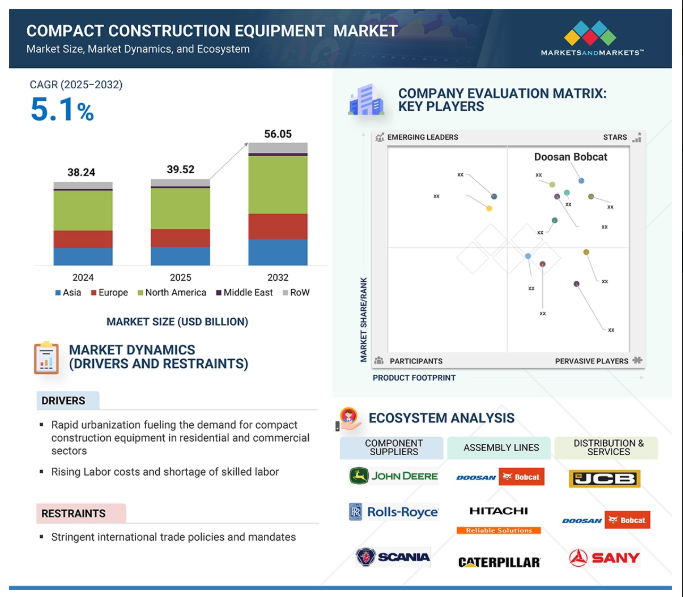
The compact construction equipment market size is projected to grow from USD 39.62 billion in 2025 to USD 56.21 billion by 2032, registering a CAGR of 5.1% during the forecast period. Increasing investments in infrastructure development, construction equipment rental, electrification, and intelligent machine technologies are expected to drive long-term market growth.
The global compact construction equipment market is experiencing steady growth as contractors increasingly adopt versatile, fuel-efficient, and space-saving machinery for residential, commercial, and infrastructure projects. Rapid urbanization, smart city initiatives, and the need to operate efficiently in confined job sites are driving demand for compact machines that deliver high productivity with lower operating costs.
Compact Construction Equipment Industry Overview
Compact construction equipment includes a wide range of machines such as mini excavators, skid steer loaders, compact track loaders, compact wheel loaders, telehandlers, and compactors. These machines are specifically designed for projects where maneuverability, lower ground impact, and operational flexibility are essential.
Compared with heavy construction equipment, compact machines offer lower transportation costs, reduced fuel consumption, easier maintenance, and greater versatility through interchangeable attachments. They are widely used across residential construction, landscaping, road maintenance, utilities, agriculture, and municipal infrastructure projects.
Manufacturers are increasingly integrating telematics, automation, electric drivetrains, and advanced hydraulic systems to improve equipment efficiency and operator productivity.
Urban Infrastructure Development Driving Compact Construction Equipment Market Growth
Urban redevelopment and infrastructure modernization are among the primary growth drivers of the compact construction equipment market. Expanding residential construction, road upgrades, utility installations, and smart city projects require machines capable of operating in space-constrained environments.
Compact equipment enables contractors to complete excavation, grading, lifting, loading, and material handling tasks efficiently while minimizing disruption in densely populated areas. Their ability to access confined workspaces makes them indispensable for modern urban construction projects.
As governments continue investing in infrastructure development, demand for compact construction equipment is expected to remain strong throughout the forecast period.
Mini Excavators Leading the Compact Construction Equipment Market
Mini excavators are expected to account for the largest share of the compact construction equipment market due to their versatility, compact dimensions, and ability to perform a wide variety of excavation tasks.
These machines are increasingly used for trenching, landscaping, demolition, utility installation, and residential construction. Improved hydraulic performance, reduced fuel consumption, and enhanced operator comfort have further strengthened their popularity among contractors.
Manufacturers continue introducing advanced mini excavators equipped with intelligent machine control, telematics, and fuel-efficient engines to improve productivity and reduce ownership costs.
Download PDF Brochure @ https://www.marketsandmarkets.com/pdfdownloadNew.asp?id=89115103
Electric Compact Construction Equipment Transforming the Industry
Electrification is emerging as one of the most important trends within the compact construction equipment market. Electric mini excavators, compact loaders, compactors, and telehandlers are gaining popularity as contractors seek lower emissions, quieter operation, and reduced maintenance costs.
Battery-powered construction equipment is particularly suitable for indoor projects, urban construction, and environmentally sensitive worksites where diesel emissions and noise restrictions are becoming increasingly stringent.
Advancements in lithium-ion battery technology, charging infrastructure, and electric powertrains are expected to accelerate adoption of electric compact construction equipment over the coming years.
Smart Technologies Enhancing Equipment Productivity
Digital technologies are transforming compact construction equipment through the integration of telematics, GPS fleet management, automation, remote diagnostics, and predictive maintenance systems.
Connected machines allow fleet managers to monitor equipment utilization, fuel consumption, maintenance schedules, and machine health in real time. Automation features such as grade control, machine guidance, and semi-autonomous operation also improve accuracy and productivity while reducing operator fatigue.
As construction companies continue embracing digital transformation, smart compact equipment is expected to become increasingly common across global job sites.
Equipment Rental Fueling Market Expansion
The growing popularity of equipment rental services is creating significant opportunities for the compact construction equipment market. Small and medium-sized contractors increasingly prefer renting equipment instead of purchasing machinery outright, allowing them to reduce capital expenditure while accessing the latest technologies.
Compact equipment’s lower transportation costs, versatility, and compatibility with multiple attachments make it especially attractive for rental companies. Rental fleets are also adopting connected technologies that improve fleet utilization and maintenance efficiency.
The continued expansion of rental business models is expected to support sustained market growth worldwide.
North America Leading the Compact Construction Equipment Market Share
North America is expected to hold the largest share of the compact construction equipment market due to strong residential construction activity, infrastructure investments, and widespread adoption of advanced construction technologies.
The United States remains the largest regional market, supported by increasing housing development, road construction, and government infrastructure programs. The presence of major manufacturers such as Caterpillar, Deere & Company, JCB, Kubota, and CNH Industrial further strengthens regional market growth.
Growing investment in automation, electrification, and smart fleet management is expected to reinforce North America’s leadership position during the forecast period.
Future Outlook for the Compact Construction Equipment Market
The future of the compact construction equipment market will be shaped by electrification, automation, intelligent fleet management, sustainable construction practices, and digital connectivity. As contractors increasingly prioritize productivity, lower operating costs, and environmentally friendly equipment, compact machines will play an increasingly important role across construction, landscaping, utility, and infrastructure projects.
Growing investments in electric construction equipment, autonomous machine technologies, telematics, and smart city development will continue creating opportunities for OEMs, rental providers, and technology companies. As a result, the compact construction equipment market is expected to witness steady innovation, expanding market share, and sustainable global growth through 2032.
Request Free Sample Report @ https://www.marketsandmarkets.com/requestsampleNew.asp?id=89115103