
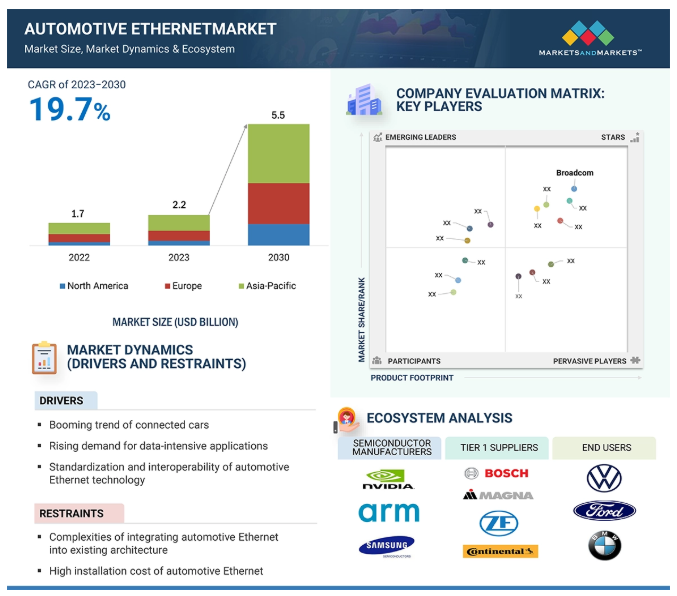
The Automotive Ethernet Market size is projected to grow from USD 2.2 billion in 2023 to USD 5.5 billion by 2028, registering a CAGR of 19.7% during the forecast period. Increasing demand for faster in-vehicle networking and continuous innovation in connected-car features are among the key factors driving Automotive Ethernet Market growth.
The global Automotive Ethernet Market is experiencing strong growth as automakers increasingly adopt high-speed in-vehicle networking technologies to support connected cars, advanced driver assistance systems (ADAS), infotainment, autonomous driving, and other data-intensive automotive applications. As vehicle electronic architectures become more complex, conventional communication technologies are increasingly being complemented by Ethernet-based networks capable of handling significantly higher data volumes.
Automotive Ethernet Market Overview
Automotive Ethernet is a high-speed communication technology designed to enable reliable data transmission between electronic control units (ECUs), sensors, cameras, displays, processors, and other components within vehicles. The technology is increasingly becoming important as modern vehicles generate and process large volumes of data.
The market is segmented by type into Automotive Ethernet Network and Automotive Ethernet Testing, while other market segments include component type, bandwidth, application, vehicle type, and region. The increasing integration of connected and autonomous vehicle technologies is creating strong demand for scalable and high-bandwidth vehicle networking solutions.
Faster In-Vehicle Networking Driving Automotive Ethernet Market Growth
The increasing complexity of vehicle electronics is one of the primary factors driving the Automotive Ethernet Market. Modern vehicles incorporate multiple cameras, radar sensors, infotainment systems, displays, ADAS functions, and electronic control units that require fast and reliable communication.
Automotive Ethernet provides higher bandwidth and scalability compared with traditional in-vehicle networking technologies. Its ability to support large volumes of data makes it suitable for next-generation vehicle architectures and increasingly sophisticated automotive applications.
Automotive Ethernet Network Segment Leading Market Share
The Automotive Ethernet Network segment is expected to hold the largest share of the Automotive Ethernet Market during the forecast period. The network segment is expanding as vehicles evolve toward greater connectivity, intelligent features, and autonomous driving capabilities.
High-bandwidth connectivity is increasingly required for applications such as ADAS and infotainment, while the scalability and cost-effectiveness of Ethernet compared with older CAN-based systems are further supporting adoption.
Automotive Ethernet also provides the networking foundation required for technologies such as V2X communication, helping manufacturers develop increasingly connected and sophisticated vehicle architectures.
Download PDF Brochure @ https://www.marketsandmarkets.com/pdfdownloadNew.asp?id=103704247
2.5/5/10 Gbps Bandwidth Segment Driving Market Demand
The 2.5/5/10 Gbps bandwidth segment is estimated to exhibit the fastest growth in the global Automotive Ethernet Market. These high-speed bandwidths support data-intensive applications requiring rapid and reliable communication within vehicles.
The technology is particularly relevant to autonomous driving, high-definition multimedia, real-time sensor fusion, V2V communication, and V2I communication. The ability to transmit high-resolution video and large volumes of sensor data makes high-speed Ethernet increasingly important for advanced vehicle systems.
The 2.5/5/10 Gbps automotive Ethernet technologies are based on IEEE 802.3ch, using technologies including PAM4 encoding, full-duplex transmission, and point-to-point topology.
Connected and Autonomous Vehicles Accelerating Automotive Ethernet Adoption
The rise of connected and autonomous vehicles is creating substantial demand for Automotive Ethernet networking solutions. Connected vehicles continuously exchange data between sensors, ECUs, infotainment systems, cloud platforms, and other connected infrastructure.
Autonomous driving further increases networking requirements because cameras, sensors, processors, and actuators must exchange large quantities of information with minimal latency. Automotive Ethernet provides the high-speed communication infrastructure required to support these increasingly complex vehicle systems.
ADAS and Infotainment Increasing Demand for High-Speed Vehicle Networks
ADAS and infotainment systems are major applications driving Automotive Ethernet demand. Advanced driver assistance functions rely on data from cameras, radar, and other sensors, while modern infotainment systems require high-speed communication for video, audio, displays, and connectivity features.
The increasing adoption of high-resolution displays, driver monitoring systems, advanced cockpit technologies, and autonomous driving functions is expected to further increase the need for high-bandwidth in-vehicle networking.
Automotive Ethernet Testing Supporting Next-Generation Vehicle Development
Automotive Ethernet Testing is another important component of the market ecosystem. As Ethernet networks become increasingly integrated into vehicles, manufacturers and suppliers require testing solutions to verify communication performance, reliability, interoperability, and compliance.
Testing is particularly important for high-speed Ethernet applications where uninterrupted communication is essential for safety-critical and data-intensive vehicle functions.
The growing complexity of automotive electronic architectures is therefore expected to create continued demand for Automotive Ethernet testing solutions.
Germany Leading the Automotive Ethernet Market in Europe
Germany is expected to be the largest Automotive Ethernet Market in Europe during the forecast period. The country’s strong position in the global automotive industry, advanced vehicle manufacturing capabilities, and continued investment in automotive technology support the adoption of high-speed networking solutions.
German automotive and technology companies are actively investing in technologies such as driver monitoring, OTA software updates, and high-speed networking. Government support for research and innovation, stringent safety requirements, and consumer demand for advanced vehicle features are also contributing to market growth.
The country has a significant presence of Automotive Ethernet technology providers, including Rohde & Schwarz, Ruetz System Solutions, Infineon Technologies, and TSN Systems.
Future Outlook for the Automotive Ethernet Market
The future of the Automotive Ethernet Market will be shaped by connected vehicles, autonomous driving, ADAS, software-defined vehicle architectures, high-resolution sensing, advanced infotainment, and increasingly data-intensive electronic systems.
As vehicle architectures transition toward higher levels of connectivity and centralized computing, the requirement for high-speed, scalable, and reliable in-vehicle networking will continue to increase. The growing adoption of 2.5/5/10 Gbps Ethernet, Ethernet switches, PHYs, and automotive networking solutions will create opportunities for semiconductor companies, network technology providers, automotive OEMs, and Tier 1 suppliers.
With the market projected to reach USD 5.5 billion by 2028 from USD 2.2 billion in 2023 at a CAGR of 19.7%, the Automotive Ethernet Market is positioned for strong growth as high-speed networking becomes increasingly fundamental to next-generation connected and autonomous vehicles.
Request Free Sample Report @ https://www.marketsandmarkets.com/requestsampleNew.asp?id=103704247