

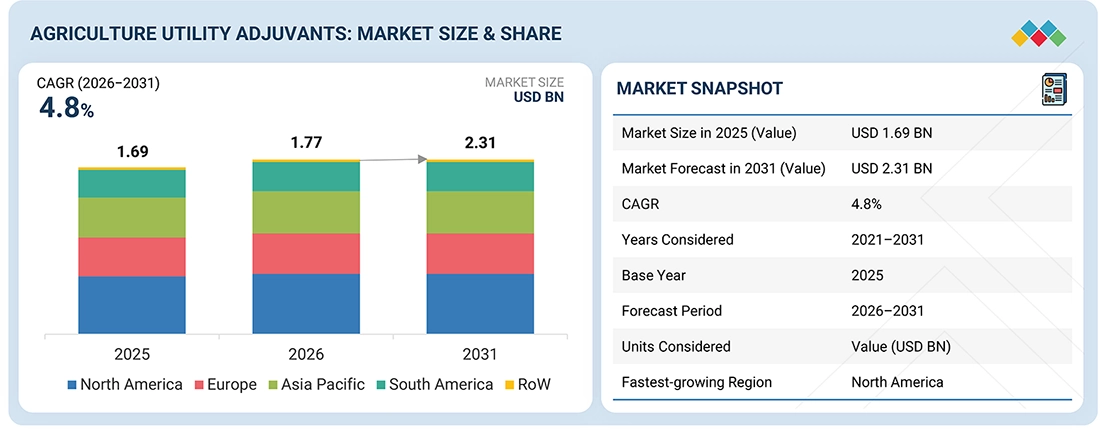
The global agriculture utility adjuvants market is on a steady growth trajectory, projected to rise from USD 1.77 billion in 2026 to USD 2.31 billion by 2031, registering a CAGR of 4.8%. This expansion reflects a broader shift in modern agriculture toward efficiency, precision, and sustainability. As farmers increasingly focus on improving spray performance and reducing input waste, utility adjuvants are becoming an essential component of crop protection strategies.
Rising Demand Driven by Precision Agriculture
One of the primary growth drivers for the agriculture utility adjuvants market is the increasing emphasis on optimizing spray applications. Farmers are paying closer attention to spray water quality, tank mix compatibility, and the overall performance of crop protection products. Utility adjuvants—such as water conditioners, buffering agents, anti-foaming agents, and compatibility enhancers—play a critical role in ensuring that agrochemical formulations perform as intended.
These additives help neutralize hard water minerals, stabilize pH levels, reduce foam formation, and ensure that multiple agrochemicals can be effectively mixed in a single spray tank. As a result, they enhance both the physical and chemical stability of spray solutions, improving application efficiency and preserving the efficacy of active ingredients.
Additionally, stricter government regulations around pesticide usage, environmental protection, and spray drift management are accelerating the adoption of utility adjuvants. With compliance becoming more complex, farmers are relying on these solutions to meet regulatory standards while maintaining productivity.
Download PDF Brochure: https://www.marketsandmarkets.com/pdfdownloadNew.asp?id=131568926
Emulsifiable Concentrates Lead the Formulation Segment
Among various formulation types, emulsifiable concentrates (EC) hold a significant share in the agriculture utility adjuvants market. Their dominance is largely attributed to their high compatibility with a wide range of crop protection products.
Emulsifiable concentrates allow oil-based functional ingredients to be effectively mixed with water, forming stable emulsions in spray tanks. This ensures uniform distribution of both active and performance-enhancing components. Their ability to maintain stability under varying water qualities and environmental conditions makes them particularly suitable for large-scale agricultural operations.
Moreover, EC formulations improve the functional efficiency of utility adjuvants by preventing phase separation, enhancing mixing quality, and simplifying spray application. Their versatility across herbicides, fungicides, and insecticides further strengthens their market position. The growing demand for ready-to-use liquid formulations that perform consistently across diverse climatic conditions continues to reinforce the leadership of this segment.
Herbicides Segment Witnesses Fastest Growth
In terms of application, the herbicides segment is emerging as the fastest-growing category within the agriculture utility adjuvants market. This growth is closely tied to the increasing challenge of weed resistance and the widespread adoption of conservation tillage practices.
Utility adjuvants significantly enhance herbicide performance by improving spray coverage, droplet retention, cuticle penetration, and rainfastness. These benefits translate into better absorption and effectiveness of active ingredients, enabling farmers to achieve optimal weed control with lower chemical usage.
Furthermore, the rise of precision spraying technologies and tank-mix applications has intensified the need for reliable adjuvant solutions. Regulatory pressures to reduce environmental impact and improve pesticide efficiency are also encouraging farmers to adopt adjuvants that support sustainable weed management practices.
Request Sample Pages: https://www.marketsandmarkets.com/requestsampleNew.asp?id=131568926
Europe: A Key Regional Market
Europe holds a prominent share in the global agriculture utility adjuvants market, driven by its stringent regulatory framework and strong commitment to sustainable agriculture. Policies focused on pesticide reduction, environmental safety, water conservation, and spray drift control have significantly increased the demand for high-performance utility adjuvants.
The region’s advanced adoption of precision agriculture technologies—such as variable-rate sprayers and digital monitoring systems—further supports market growth. These technologies require stable and well-conditioned spray solutions, making utility adjuvants indispensable.
Countries like France, Germany, Spain, and Italy, with their extensive agricultural landscapes, are at the forefront of adopting advanced crop protection practices. The increasing preference for bio-based and environmentally friendly products, combined with strong R&D capabilities in agrochemical formulation, positions Europe as a leader in this market.
Government initiatives promoting sustainable farming and innovation in specialty chemicals continue to strengthen the region’s dominance in the global utility adjuvants landscape.
Leading Agriculture Utility Adjuvants Companies:
The agriculture utility adjuvants market is highly competitive, with several global players focusing on innovation, product development, and strategic partnerships. Key companies operating in this space include BASF SE, Corteva Agriscience, Croda International Plc, Evonik Industries AG, Solvay SA, Nufarm Ltd., Dow Inc., Clariant AG, Huntsman Corporation, Helena Agri-Enterprises LLC, Wilbur-Ellis Company LLC, Stepan Company, Brandt Consolidated Inc., Akzo Nobel N.V., and Adjuvant Plus Inc.
These companies are investing in advanced formulation technologies, eco-friendly solutions, and precision agriculture compatibility to maintain their competitive edge.