
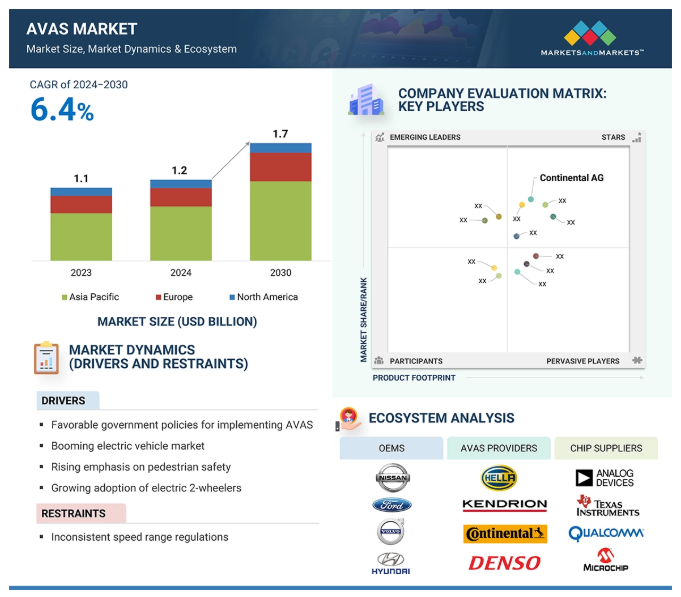
The Acoustic Vehicle Alerting System Market size is projected to grow from USD 1.2 billion in 2024 to USD 1.7 billion by 2030, registering a CAGR of 6.4% during the forecast period. Increasing production of electric vehicles, expanding pedestrian safety regulations, and growing integration of intelligent vehicle safety technologies are expected to drive sustained market growth.
The global Acoustic Vehicle Alerting System (AVAS) Market is witnessing steady growth as governments worldwide strengthen pedestrian safety regulations for electric and hybrid vehicles. Since battery electric vehicles (BEVs), plug-in hybrid electric vehicles (PHEVs), and fuel cell electric vehicles (FCEVs) operate almost silently at low speeds, AVAS has become an essential safety technology that alerts pedestrians, cyclists, and visually impaired individuals to an approaching vehicle. Rising EV adoption and mandatory safety regulations are significantly accelerating market demand.
Acoustic Vehicle Alerting System Industry Overview
An Acoustic Vehicle Alerting System (AVAS) is an electronic safety system that generates artificial sounds at low vehicle speeds to alert nearby pedestrians and cyclists of an approaching electric or hybrid vehicle. These systems automatically activate during low-speed driving and produce sounds that vary according to vehicle speed and operating conditions while complying with international regulatory standards.
Modern AVAS solutions integrate speakers, sound generators, electronic control units, vehicle speed sensors, and intelligent software to create recognizable warning sounds without contributing to unnecessary noise pollution. As global EV production continues to rise, AVAS is becoming a standard safety feature across passenger cars, commercial vehicles, and electric two-wheelers.
Electric Vehicle Adoption Driving AVAS Market Growth
The rapid growth of battery electric vehicles, plug-in hybrid vehicles, and fuel cell electric vehicles remains the primary driver of the Acoustic Vehicle Alerting System Market. As governments accelerate EV adoption through emission regulations and incentive programs, the number of nearly silent vehicles operating in urban environments continues to increase.
Unlike conventional internal combustion engine vehicles, electric vehicles generate minimal engine noise at low speeds, creating potential risks for pedestrians. AVAS addresses this challenge by providing audible alerts while maintaining the environmental benefits of electric mobility.
The continued expansion of electric vehicle production will remain one of the strongest contributors to market growth throughout the forecast period.
Pedestrian Safety Regulations Accelerating Market Demand
Government regulations are playing a critical role in accelerating AVAS adoption across global automotive markets. Regulatory standards in major regions require electric and hybrid vehicles to emit warning sounds below specified speeds to improve pedestrian safety.
Automotive manufacturers are integrating compliant AVAS technologies into new vehicle platforms to meet evolving safety requirements while enhancing consumer confidence in electric mobility. Regulatory developments across multiple countries are expected to further strengthen market demand over the coming years. Recent regulatory actions, including India’s phased AVAS requirements for new EVs, reflect the growing global emphasis on pedestrian protection.
Download PDF Brochure @ https://www.marketsandmarkets.com/pdfdownloadNew.asp?id=20863691
Integrated AVAS Systems Leading Market Adoption
Integrated AVAS systems are expected to account for the largest share of the market because they are designed directly into vehicle platforms during manufacturing. These systems offer improved reliability, seamless integration with vehicle electronics, optimized sound quality, and compliance with international safety standards.
OEMs increasingly prefer integrated AVAS solutions because they reduce installation complexity while enabling customized sound profiles that align with brand identity and regulatory requirements. Growing production of electric passenger vehicles is expected to continue driving this segment’s expansion.
AI, Sound Engineering and Smart Vehicle Safety Technologies
Artificial intelligence, digital sound synthesis, adaptive audio control, and intelligent vehicle software are transforming the next generation of AVAS technologies. Modern systems can dynamically adjust warning sounds based on vehicle speed, driving conditions, ambient noise, and surrounding traffic environments.
Automotive manufacturers are also developing customizable sound signatures that enhance pedestrian awareness while preserving brand differentiation. Integration with connected vehicle architectures and software-defined vehicle platforms is expected to further improve AVAS functionality as autonomous and intelligent mobility evolves.
Passenger Vehicles Driving AVAS Market Expansion
Passenger cars are expected to represent the largest application segment within the Acoustic Vehicle Alerting System Market, supported by rapid EV adoption and growing consumer demand for advanced vehicle safety technologies. Premium electric vehicles increasingly incorporate intelligent AVAS solutions alongside ADAS, connected vehicle platforms, and digital cockpit technologies.
Commercial electric vehicles, buses, and electric two-wheelers are also expected to witness increasing AVAS adoption as regulatory mandates expand across additional vehicle categories.
Asia Pacific Leading the Acoustic Vehicle Alerting System Market Share
Asia Pacific is expected to account for the largest Acoustic Vehicle Alerting System Market share, driven by rapid electric vehicle production, expanding government support for EV adoption, and increasing implementation of pedestrian safety regulations. China, Japan, South Korea, and India continue investing heavily in electric mobility, creating significant opportunities for AVAS manufacturers and automotive suppliers.
The region’s strong automotive manufacturing base, coupled with rising consumer awareness of vehicle safety technologies, is expected to reinforce its market leadership throughout the forecast period.
Future Outlook for the Acoustic Vehicle Alerting System Market
The future of the Acoustic Vehicle Alerting System Market will be shaped by expanding electric vehicle adoption, stricter pedestrian safety regulations, software-defined vehicles, artificial intelligence, and intelligent automotive safety technologies. As governments continue strengthening safety standards and automakers accelerate EV production, AVAS will become a standard feature across a wider range of electric vehicle platforms.
Growing investments in intelligent sound generation, connected vehicle safety systems, AI-powered audio technologies, and integrated EV safety platforms will continue creating significant opportunities for automotive OEMs, Tier-1 suppliers, electronics manufacturers, and software developers. As a result, the Acoustic Vehicle Alerting System Market is expected to witness sustained innovation, expanding market share, and steady global growth through 2030.
Request Free Sample Report @ https://www.marketsandmarkets.com/requestsampleNew.asp?id=20863691