
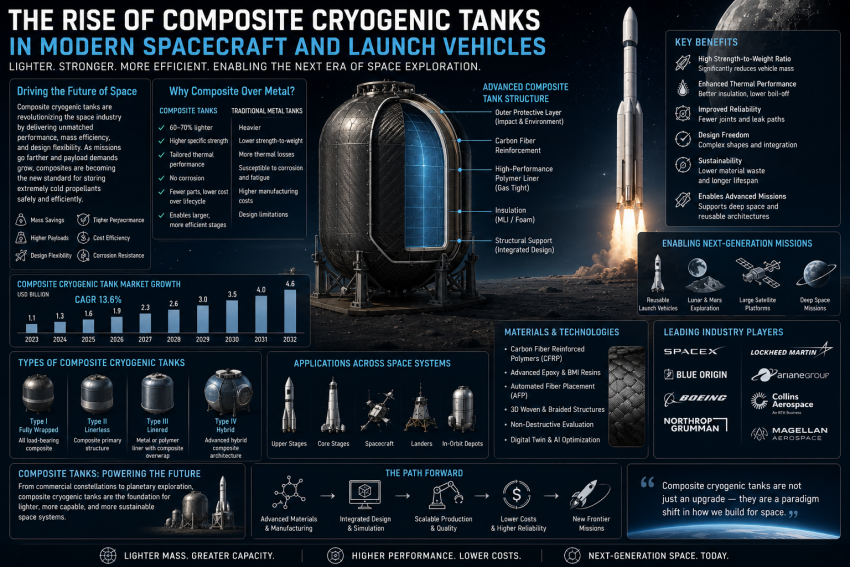
Composite cryogenic tanks, particularly those based on Carbon Fiber Reinforced Polymer (CFRP) materials, are emerging as a breakthrough solution for modern launch vehicles and spacecraft. These tanks are engineered to store extremely cold propellants such as liquid hydrogen (LH2), liquid oxygen (LOX), and liquid methane while maintaining structural integrity under harsh thermal and mechanical conditions. Space agencies and private launch providers are increasingly investing in composite cryotank technologies to improve payload efficiency, reduce launch costs, and support reusable space transportation systems.
The global space industry is entering a transformative era driven by reusable launch systems, deep-space exploration, lunar missions, and next-generation satellite deployments. At the center of this evolution lies one of the most critical aerospace technologies: cryogenic propellant storage. Traditional metallic tanks made from aluminum and stainless steel have long dominated rocket and spacecraft architecture, but increasing demands for lighter, stronger, and more thermally efficient systems are accelerating the adoption of advanced composite cryogenic tanks.
One of the biggest advantages of composite cryogenic tanks is their exceptional strength-to-weight ratio. Conventional metallic tanks contribute significantly to overall vehicle mass, limiting payload capacity and mission flexibility. Composite structures can dramatically reduce structural weight while maintaining high mechanical performance under cryogenic temperatures. Research conducted by agencies such as NASA and European Space Agency demonstrates that lightweight composite tanks can substantially improve launch vehicle efficiency and support the future development of reusable spacecraft architectures.
Download Free Sample of Report: https://www.marketsandmarkets.com/pdfdownloadNew.asp?id=195002624
The push toward reusable launch vehicles is one of the primary drivers behind the adoption of composite cryogenic tanks. Reusability requires structures capable of enduring repeated thermal cycling, mechanical loads, vibration, and extreme environmental stress. Composite materials provide the durability and fatigue resistance needed for repeated launches while minimizing inert structural mass. Advanced launch vehicle developers are now integrating linerless Type-V composite tanks and composite overwrapped pressure vessels (COPVs) into both upper-stage and in-space propulsion systems.
Hydrogen-powered launch systems particularly benefit from composite cryogenic technology. Liquid hydrogen must be stored at temperatures approaching -253°C, creating significant engineering challenges due to thermal contraction and hydrogen permeability. Earlier generations of metallic tanks required heavy insulation systems and complex support structures to handle these conditions. Modern CFRP-based cryogenic tanks are being designed with advanced resin systems, leak-resistant architectures, and linerless configurations capable of operating efficiently under ultra-low temperatures. ESA research confirmed that fully composite liquid hydrogen tanks without metallic liners are now technically feasible, marking a major milestone in aerospace engineering.
The commercial space sector is also accelerating innovation in composite cryotank manufacturing. Companies specializing in aerospace composites are developing scalable production technologies using automated fiber placement, out-of-autoclave curing, and filament winding techniques. These manufacturing approaches reduce production complexity while enabling larger and more integrated tank structures. NASA’s Composite Cryotank Technologies and Demonstration initiative focused specifically on maturing large-scale composite tanks for heavy-lift launch vehicles and future propellant depots. The program demonstrated that advanced composites could support both structural and thermal performance requirements at operational launch scales.
The rise of methane-fueled rockets is creating another major opportunity for composite cryogenic tanks. Liquid methane offers operational advantages for reusable launch systems because it is denser and easier to store than liquid hydrogen. Modern reusable launch architectures increasingly rely on methane-oxygen propulsion combinations, which require highly efficient cryogenic storage systems. Composite tanks enable mass optimization and improved thermal performance, helping launch providers maximize payload delivery while supporting rapid turnaround operations.
In addition to launch vehicles, composite cryogenic tanks are becoming increasingly important for orbital infrastructure and deep-space missions. Future lunar landers, Mars transfer vehicles, orbital fuel depots, and long-duration spacecraft will require lightweight and highly efficient propellant storage systems. Since every kilogram launched into orbit significantly impacts mission economics, reducing tank mass directly improves mission feasibility and operational flexibility. Composite tanks offer a pathway toward scalable in-space refueling systems and sustainable exploration missions beyond low Earth orbit.
Despite their advantages, composite cryogenic tanks still face several engineering challenges. Cryogenic temperatures can induce microcracking in composite matrices, potentially leading to leakage and structural degradation. Hydrogen permeation remains a complex issue because hydrogen molecules are extremely small and difficult to contain. Researchers continue developing improved resin formulations, hybrid composite architectures, and advanced manufacturing methods to address these limitations. Thermal mismatch between fibers and matrix materials also requires careful structural optimization to maintain long-term reliability.
Recent advances in smart materials and self-healing composites could further revolutionize cryogenic tank performance. Emerging aerospace research supported by ESA is exploring composite structures capable of detecting and repairing microscopic damage autonomously. These technologies combine embedded sensors, heating systems, and self-healing resins to improve durability and reduce maintenance requirements in reusable launch systems. Future spacecraft may incorporate intelligent composite tank structures capable of monitoring their own structural health during missions.
Industry momentum behind composite cryogenic tanks continues to grow globally. European launcher programs, American heavy-lift initiatives, and Asian reusable launch vehicle projects are all investing heavily in advanced cryogenic composite technologies. Research institutions and aerospace manufacturers are collaborating to create scalable solutions for next-generation launch platforms. The increasing demand for commercial launches, satellite constellations, space tourism, and interplanetary exploration is expected to further accelerate adoption over the coming decade.
The future of space transportation will depend heavily on technologies that improve efficiency, reliability, and sustainability. Composite cryogenic tanks represent one of the most important innovations enabling this transition. By reducing structural mass, improving thermal efficiency, and supporting reusable launch operations, advanced composite tanks are redefining spacecraft engineering for the next generation of space missions.
As launch providers race toward fully reusable rockets and deep-space exploration systems, composite cryogenic tanks are poised to become a foundational technology of the modern space economy. Their continued evolution will shape the future of launch vehicles, orbital infrastructure, and sustainable human expansion into space.