
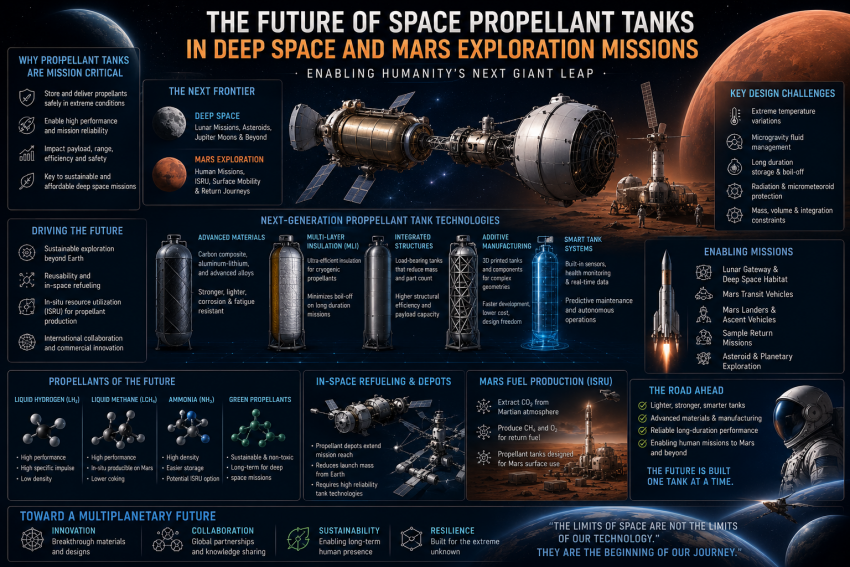
The future of deep space and Mars exploration is increasingly tied to the evolution of advanced space propellant tank technologies. As global space agencies such as NASA and private aerospace companies like SpaceX accelerate plans for lunar bases, crewed Mars missions, orbital refueling systems, and reusable launch architectures, the demand for highly efficient, lightweight, and durable propellant storage systems is growing rapidly. Space propellant tanks are no longer considered passive storage components; they are becoming mission-critical systems that directly influence spacecraft endurance, payload efficiency, operational safety, and long-duration mission success.
Deep space missions introduce conditions far more extreme than traditional low Earth orbit operations. Missions to Mars, asteroids, and deep-space stations require spacecraft to store cryogenic fuels for months or even years without significant boil-off losses. Conventional metallic tanks designed for short-term launches are increasingly inadequate for these next-generation missions. As a result, aerospace manufacturers are developing advanced cryogenic and composite propellant tanks capable of supporting long-duration storage in extreme thermal and radiation environments.
Download Free Sample of Report: https://www.marketsandmarkets.com/pdfdownloadNew.asp?id=195002624
One of the most transformative developments in the sector is the emergence of lightweight composite cryogenic tanks. Traditional aluminum-based tanks provide structural reliability, but they significantly increase launch mass. Every kilogram added to a spacecraft translates into higher launch costs and reduced payload flexibility. Composite materials, including carbon-fiber-reinforced polymers, offer dramatically lower weight while maintaining high structural integrity. These advanced materials enable spacecraft designers to maximize payload capacity and improve fuel efficiency during interplanetary travel.
For Mars exploration missions, propellant storage efficiency is especially critical. A crewed Mars mission may require massive quantities of liquid hydrogen, liquid oxygen, methane, or other advanced propellants to support propulsion, life support systems, surface operations, and return missions. Long-duration storage of cryogenic propellants presents substantial engineering challenges because these fuels naturally evaporate when exposed to heat. Even small thermal leaks can result in major fuel losses over multi-year missions.
To address this issue, aerospace engineers are integrating advanced insulation systems, multi-layer thermal barriers, and active cooling technologies into future propellant tank designs. Zero-boil-off systems are becoming a major focus area for deep-space transportation programs. These technologies use cryocoolers and thermal management systems to maintain ultra-low temperatures and minimize propellant evaporation. Such innovations are expected to become essential for future Mars transfer vehicles and orbital depots.
The increasing adoption of liquid methane propulsion is also reshaping propellant tank development. Methane-based engines are gaining momentum because methane offers a balance between storage efficiency, engine performance, and in-situ resource utilization potential on Mars. SpaceX has heavily invested in methane-fueled propulsion systems for its Starship program, which aims to support reusable interplanetary missions. Methane can potentially be produced on Mars using local resources through chemical processing methods, significantly reducing the need to transport return fuel from Earth. This capability makes methane-compatible propellant tanks strategically important for long-term human settlement initiatives.
Another major trend shaping the future of space propellant tanks is orbital refueling infrastructure. Future deep-space missions are expected to rely heavily on in-space fuel transfer operations rather than launching fully fueled spacecraft directly from Earth. Orbital fuel depots and refueling stations could dramatically reduce mission costs and increase spacecraft flexibility. However, transferring cryogenic propellants in microgravity conditions introduces highly complex fluid dynamics and thermal management challenges.
To enable orbital refueling, future tank systems must incorporate advanced sensors, autonomous pressure management technologies, and intelligent fuel distribution systems. Artificial intelligence and predictive monitoring technologies are increasingly being integrated into spacecraft tank systems to optimize propellant usage and detect anomalies before failures occur. Smart tank architectures equipped with real-time diagnostics could become standard features in future deep-space transportation networks.
Reusable launch vehicles are another driving force behind innovation in propellant tank technologies. Reusability requires tanks to endure repeated launch stresses, thermal cycling, and atmospheric reentry conditions without structural degradation. This demand has accelerated research into fatigue-resistant materials, self-healing composites, and advanced manufacturing techniques such as additive manufacturing.
3D printing is playing a growing role in the production of next-generation propellant tanks. Additive manufacturing enables engineers to produce highly complex tank geometries with fewer joints and welds, improving structural reliability while reducing production time and cost. The ability to manufacture customized tank structures rapidly could become especially valuable for future lunar and Martian infrastructure projects, where localized manufacturing capabilities may eventually be developed.
The future of space exploration also depends heavily on international collaboration and commercial participation. Organizations such as European Space Agency, ISRO, and Blue Origin are investing in advanced propulsion systems and sustainable space transportation technologies. Growing commercial competition is accelerating innovation across the space propellant tank market, encouraging the development of safer, lighter, and more scalable storage solutions.
Radiation protection is another emerging design priority for deep-space propellant tanks. Beyond Earth’s magnetosphere, spacecraft are exposed to intense cosmic radiation and solar particle events. Engineers are exploring multifunctional tank structures that not only store propellant but also contribute to spacecraft shielding systems. Some future concepts even propose using cryogenic propellants themselves as part of radiation protection strategies for crew habitats.
The rise of lunar infrastructure programs is further increasing demand for advanced tank technologies. Planned lunar bases and orbital gateways will require long-term storage and handling of cryogenic fuels for landers, transport vehicles, and power systems. These operations will serve as testing grounds for technologies eventually used in Mars exploration architectures.
As the global space economy expands, the role of space propellant tanks is evolving from simple containment systems into highly intelligent, integrated mission-enabling platforms. Future tanks must balance weight reduction, thermal efficiency, structural resilience, autonomous operation, and long-term reliability under some of the harshest conditions ever encountered by engineered systems.
Inquire Before Buying: https://www.marketsandmarkets.com/Market-Reports/satellite-propellant-tanks-market-195002624.html
The next generation of propellant tanks will be central to enabling sustainable deep-space exploration, reusable interplanetary transportation, and eventual human settlement beyond Earth. From orbital refueling stations and lunar logistics hubs to crewed Mars missions and deep-space science platforms, advanced propellant storage technologies will shape the future of humanity’s expansion into the solar system.