
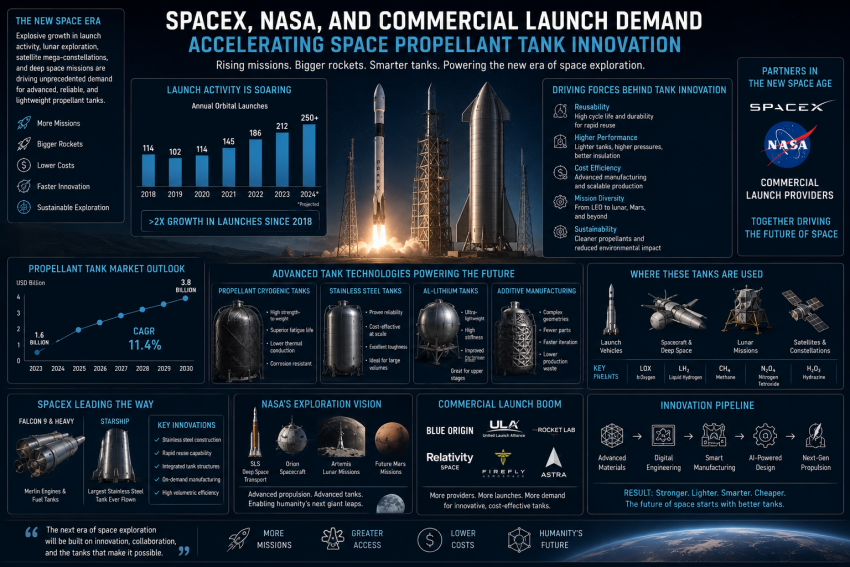
Space propellant tanks are designed to safely store and manage rocket fuels such as liquid hydrogen, liquid oxygen, methane, hydrazine, and other advanced propellants under extreme thermal and pressure conditions. These tanks directly influence launch efficiency, payload capacity, mission duration, and spacecraft reliability. With the global launch economy becoming increasingly commercialized, aerospace manufacturers are investing heavily in fuel storage systems that can reduce weight while improving structural integrity and thermal performance.
The rapid expansion of the global space industry is transforming the way spacecraft are designed, fueled, and launched. Increasing satellite deployments, lunar exploration programs, reusable launch systems, and commercial space missions are placing unprecedented demands on advanced propellant storage technologies. As launch frequency rises and mission complexity increases, space propellant tanks have become one of the most critical components in modern aerospace engineering. Organizations such as SpaceX and NASA are driving innovation in cryogenic fuel systems, lightweight composite materials, and high-pressure storage technologies to support the next generation of space transportation.
One of the primary forces accelerating innovation is the rise of reusable launch vehicles. Traditional rockets were designed for single use, but reusable systems require propellant tanks capable of enduring repeated launch, re-entry, and refurbishment cycles. SpaceX has played a major role in reshaping the industry through reusable platforms like Falcon 9 and Starship, both of which rely on advanced tank engineering to withstand repeated operational stress. Reusability has increased the importance of durable lightweight structures, driving demand for carbon composite tanks, stainless steel cryogenic systems, and improved insulation technologies.
Download PDF Brochure : https://www.marketsandmarkets.com/pdfdownloadNew.asp?id=195002624
At the same time, lunar and deep-space missions are expanding the technical requirements for space propellant storage. NASA and international space agencies are investing in Artemis-related exploration programs that require long-duration cryogenic storage and in-space refueling capabilities. Missions traveling beyond low Earth orbit need tanks that minimize propellant boil-off and maintain fuel stability over extended periods in harsh space environments. This has encouraged the development of zero-boil-off systems, multilayer insulation technologies, and smart thermal management solutions capable of improving fuel efficiency during interplanetary travel.
Commercial satellite deployment is another major growth catalyst. Thousands of communication, Earth observation, navigation, and broadband satellites are being launched annually, increasing demand for reliable propulsion systems. The expansion of mega-constellations for global internet coverage has intensified launch schedules worldwide. As private launch providers compete to reduce mission costs and increase payload efficiency, advanced propellant tanks are becoming central to spacecraft optimization strategies.
Hydrogen and methane-based propulsion systems are also reshaping tank design priorities. Liquid hydrogen offers extremely high efficiency but requires storage at ultra-low temperatures, creating major engineering challenges. Methane, increasingly used in modern rocket engines, provides a balance between performance and storage practicality. Both fuels require highly sophisticated cryogenic containment systems that can operate under severe thermal fluctuations while minimizing structural deformation. This is pushing aerospace suppliers toward next-generation composite materials and integrated sensor technologies.
Digitalization is further enhancing the evolution of propellant tank systems. Smart sensors, AI-driven monitoring platforms, and predictive maintenance technologies are improving safety and operational reliability. Modern tanks increasingly feature embedded sensing systems capable of monitoring temperature, pressure, structural stress, and fuel conditions in real time. These capabilities help launch operators identify performance anomalies early and reduce mission risks. Advanced digital twins are also being used to simulate tank behavior during launch and orbital operations, accelerating design optimization and reducing development timelines.
The growing interest in orbital refueling and space logistics is expected to create entirely new opportunities for propellant tank innovation. Future space stations, lunar gateways, and Mars exploration missions will require orbital fuel depots capable of storing cryogenic propellants for extended periods. This emerging infrastructure will depend heavily on autonomous fluid transfer technologies and highly efficient storage systems. Aerospace firms are therefore exploring modular tank architectures and scalable storage platforms that can support long-term extraterrestrial operations.
Explore In-Depth Industry Analysis: https://www.marketsandmarkets.com/Market-Reports/satellite-propellant-tanks-market-195002624.html
Defense and national security programs are contributing to market expansion as well. Military satellites, hypersonic systems, and strategic launch vehicles require highly reliable fuel storage technologies capable of operating in demanding environments. Governments worldwide are increasing investments in space-based defense infrastructure, creating additional demand for advanced aerospace-grade propellant tanks.
As global launch activity accelerates, the space propellant tank sector is moving from a supporting role to a strategic technological priority. Lightweight materials, reusable architectures, cryogenic innovation, and intelligent monitoring systems are redefining spacecraft fuel management for both commercial and government missions. With organizations like SpaceX and NASA continuing to push the boundaries of exploration and transportation, propellant tank innovation will remain at the center of the evolving space economy.