
The defense sector is undergoing a transformative shift as next-generation long-range drone communication systems become central to modern military strategy. Autonomous and semi-autonomous unmanned aerial systems (UAS) are increasingly being deployed across intelligence, surveillance, reconnaissance (ISR), combat support, electronic warfare, and precision strike missions. However, the true operational value of these platforms depends heavily on resilient, secure, and adaptive communication networks capable of sustaining connectivity across contested and geographically dispersed environments.
Download Brochure Analyst-Verified Insights: https://www.marketsandmarkets.com/pdfdownloadNew.asp?id=139489979
As military operations evolve toward distributed and multi-domain warfare, next-generation drone communication systems are emerging as a critical enabler of defense innovation. These technologies are not only extending operational reach but also redefining battlefield coordination, decision-making speed, and autonomous mission execution.
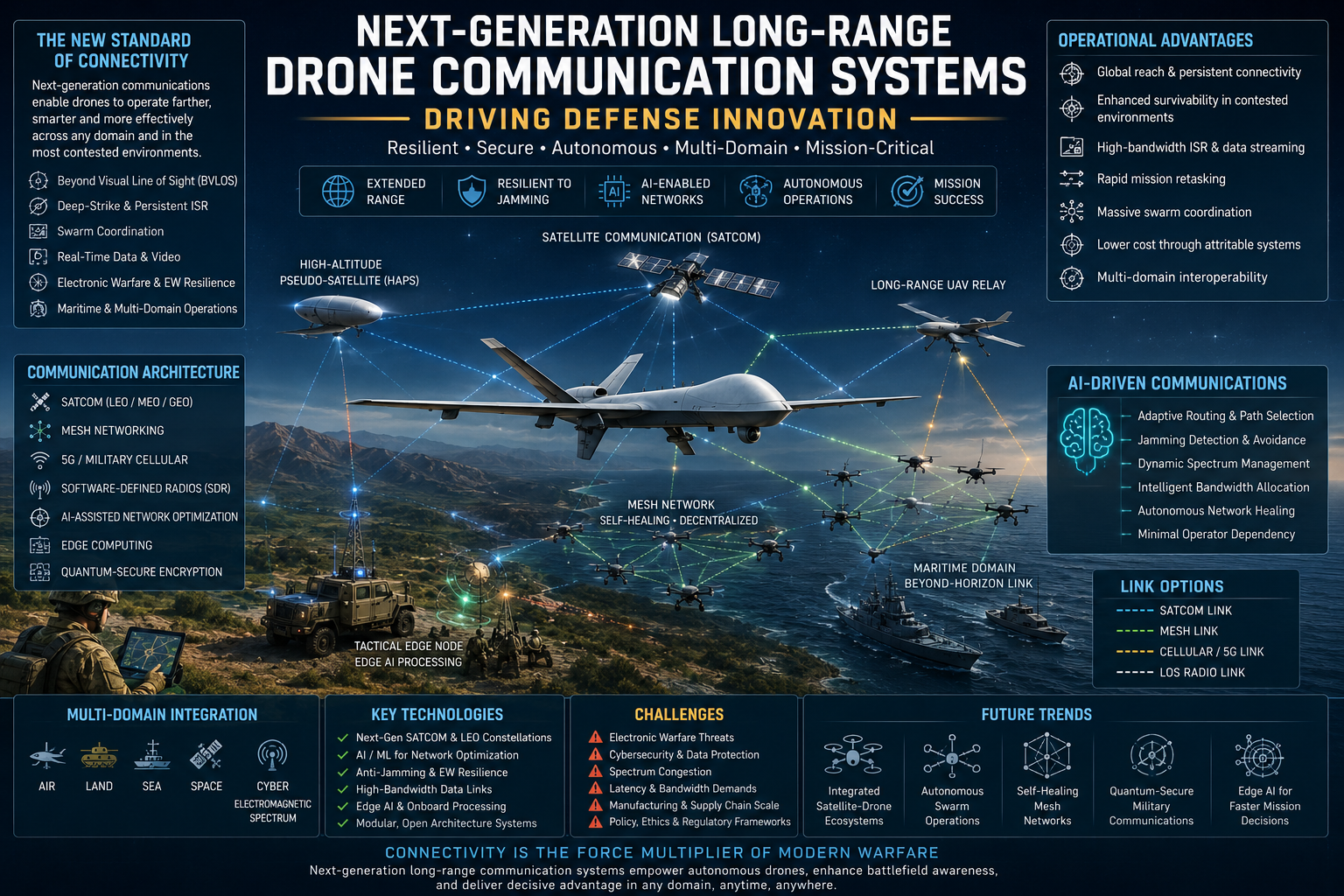
Strategic Importance of Long-Range Drone Communications
Traditional drone operations were often constrained by line-of-sight radio limitations, limited bandwidth, and vulnerability to electronic interference. Modern defense environments now require drones capable of operating far beyond conventional communication ranges while maintaining uninterrupted connectivity with command centers and allied systems.
Long-range communication technologies enable unmanned systems to conduct:
- Beyond Visual Line of Sight (BVLOS) operations
- Deep-strike reconnaissance missions
- Persistent ISR surveillance
- Autonomous swarm coordination
- Maritime surveillance and targeting
- Electronic warfare support
- Real-time battlefield data transmission
These capabilities are increasingly vital as defense agencies seek to maintain operational superiority in contested electromagnetic environments.
Evolution of Military Drone Communication Architectures
Next-generation communication systems are built upon highly resilient and layered networking architectures designed to ensure continuous operation even under hostile conditions.
Modern military drone communication ecosystems now integrate:
Satellite Communication (SATCOM)
Satellite-based connectivity allows drones to operate across vast operational theaters while maintaining secure links to command infrastructure.
Mesh Networking
Mesh communication enables multiple drones to relay information dynamically, creating decentralized and self-healing battlefield networks.
Software-Defined Radios (SDR)
SDRs provide adaptable communication frequencies and protocols that can rapidly respond to changing mission environments.
AI-Assisted Network Optimization
Artificial intelligence algorithms continuously optimize bandwidth allocation, communication routing, and interference mitigation.
5G and Cellular-Based Military Networks
Advanced cellular infrastructure is being adapted for military-grade autonomous drone operations with enhanced low-latency performance.
Edge Computing Integration
Onboard processing allows drones to analyze and prioritize data locally, reducing communication burdens and improving response times.
These technologies collectively support highly resilient communication ecosystems that can survive jamming attempts, cyberattacks, and network disruptions.
Autonomous Warfare and Communication Resilience
The rise of autonomous military operations is significantly increasing demand for intelligent communication systems. Future combat environments will require drones to make decentralized decisions with minimal human intervention while still remaining connected to broader operational networks.
AI-driven communications now enable autonomous drones to:
- Detect and avoid electronic jamming
- Automatically reroute communication pathways
- Coordinate swarm formations
- Prioritize mission-critical data traffic
- Maintain operations during partial signal loss
- Optimize energy-efficient communication protocols
This level of communication autonomy is becoming essential for large-scale drone swarm operations, where hundreds or thousands of attritable drones may operate simultaneously across dynamic battlefields.
Defense Innovation Through Attritable Drone Networks
Defense modernization programs increasingly prioritize “attritable” unmanned systems—low-cost drones designed to be expendable without sacrificing operational effectiveness. These systems are reshaping military procurement strategies by enabling scalable autonomous force structures.
Long-range communication technologies play a foundational role in enabling attritable drone ecosystems by supporting:
- Distributed battlefield intelligence
- Cooperative targeting systems
- Coordinated saturation attacks
- Persistent reconnaissance coverage
- Rapid mission re-tasking
- Multi-domain interoperability
By reducing reliance on expensive legacy platforms, attritable drone networks offer militaries greater operational flexibility and force regeneration capability.
Long-range drone communication systems are becoming a central pillar of this operational doctrine. Advanced networking capabilities now allow unmanned systems to exchange information with satellites, naval vessels, crewed aircraft, ground forces, and cyber command infrastructure in real time.
This integration significantly enhances: Situational awareness, Target acquisition speed, Battlefield coordination, Precision engagement capability, Distributed command-and-control effectiveness. The result is a more agile and data-driven military force capable of responding rapidly to emerging threats.
Electronic Warfare and Cybersecurity Challenges
Despite rapid technological advancement, several critical challenges continue to influence the development of next-generation drone communications.
Electronic Warfare Vulnerabilities
Adversaries increasingly deploy advanced jamming and spoofing systems designed to disrupt drone connectivity.
Cybersecurity Risks
Autonomous communication systems present expanding attack surfaces for cyber intrusions and data compromise.
Spectrum Congestion
Large-scale swarm deployments require efficient spectrum management to avoid communication bottlenecks.
Latency and Bandwidth Constraints
High-data ISR missions demand ultra-low-latency communication with significant bandwidth capacity.
Supply Chain and Manufacturing Limitations
Scaling autonomous drone fleets requires robust semiconductor, sensor, and communication hardware supply chains.
To address these risks, defense companies are investing heavily in encrypted communication protocols, anti-jamming technologies, quantum-resistant cybersecurity, and adaptive spectrum management systems.
AI and Machine Learning Reshaping Drone Communications
Artificial intelligence is rapidly becoming the defining technological driver of next-generation military communication systems.
AI-powered communication frameworks are enabling:
- Predictive signal optimization
- Adaptive frequency hopping
- Autonomous network healing
- Real-time threat identification
- Intelligent bandwidth allocation
- Decentralized decision-making
Machine learning algorithms can analyze battlefield communication conditions in real time and dynamically optimize network performance for maximum survivability and efficiency.
This capability is particularly valuable in contested operational environments where communication reliability directly impacts mission success.
Future Trends Shaping Defense Communication Systems
The next decade is expected to witness substantial advancement in autonomous drone communication technologies. Several major trends are likely to dominate defense innovation strategies:
Integrated Satellite-Drone Ecosystems
Closer integration between low-Earth orbit (LEO) satellites and autonomous drones will enable truly global military connectivity.
Self-Healing Mesh Networks
Future drone swarms will autonomously rebuild damaged communication pathways without human intervention.
Quantum-Secure Military Communications
Quantum-resistant encryption technologies will strengthen protection against next-generation cyber threats.
Autonomous Tactical Networking
AI-driven communication systems will manage battlefield networks independently with minimal operator oversight.
Swarm-Based Combat Operations
Large autonomous drone swarms will increasingly conduct reconnaissance, electronic warfare, and precision strike missions collaboratively.
Edge AI Integration
More processing power will shift directly onto drones, enabling faster local decision-making and reduced communication dependency.
Discover Growth Opportunities & Trends @ https://www.marketsandmarkets.com/Market-Reports/loitering-munition-market-139489979.html
Outlook for Defense Innovation
Next-generation long-range drone communication systems are fundamentally transforming modern military operations. As autonomous warfare capabilities expand, resilient communication networks will become increasingly central to battlefield effectiveness.
Defense organizations worldwide are accelerating investments in secure networking technologies, AI-enabled autonomy, and scalable unmanned ecosystems capable of operating across highly contested operational environments. The convergence of autonomous drones, resilient communications, artificial intelligence, and multi-domain integration is creating a new era of defense capability built around speed, adaptability, and distributed operational resilience.
In future conflicts, military advantage will increasingly depend not only on weapon systems themselves, but on the intelligence, survivability, and connectivity of the communication architectures that bind autonomous forces together across the modern battlespace.