
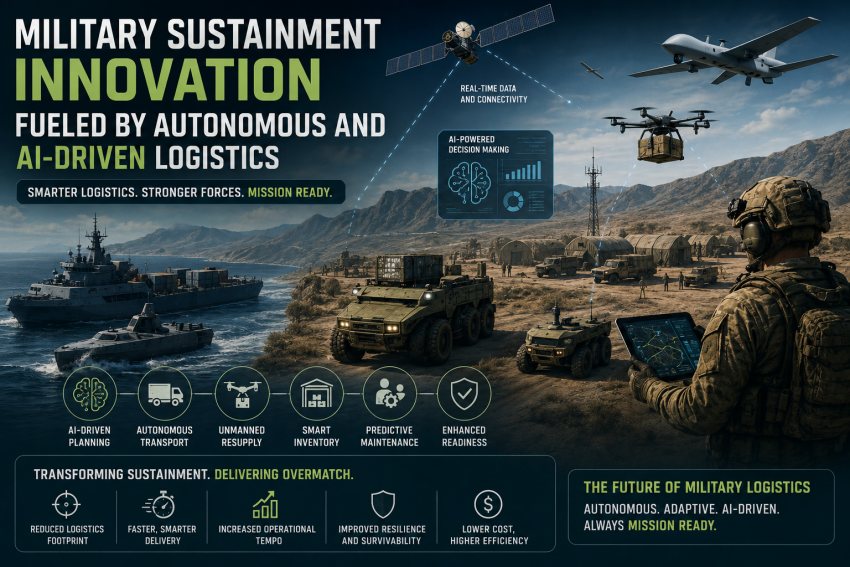
Military sustainment has become a strategic priority for defense organizations as modern warfare grows increasingly complex, fast-paced, and geographically dispersed. Success on the battlefield depends not only on advanced combat capabilities but also on the ability to deliver fuel, ammunition, medical supplies, spare parts, and equipment efficiently under demanding operational conditions. To meet these evolving requirements, armed forces around the world are embracing autonomous systems and artificial intelligence (AI) to transform military logistics and sustainment operations. These technologies are enabling faster decision-making, greater supply chain visibility, predictive maintenance, and autonomous resupply, creating a new generation of intelligent sustainment ecosystems that enhance operational readiness and mission success.
The Shift Toward Intelligent Military Sustainment
Traditional military sustainment relied heavily on manual planning, fixed supply routes, and centralized logistics hubs. While effective for conventional operations, these approaches are less suited to modern battlefields characterized by dispersed forces, contested environments, and rapidly changing mission requirements.
Today, defense organizations are adopting digital technologies that connect logistics platforms, transportation assets, maintenance systems, and command networks into integrated sustainment ecosystems. By combining real-time operational data with advanced analytics, military planners can make faster and more informed decisions, ensuring that critical resources reach deployed forces with greater speed and accuracy.
Download Brochure Analyst-Verified Insights @ https://www.marketsandmarkets.com/pdfdownloadNew.asp?id=155479010
Artificial Intelligence Enhancing Logistics Decision-Making
Artificial intelligence is transforming military logistics by enabling predictive, data-driven decision-making across the sustainment lifecycle. AI-powered systems analyze vast amounts of information from operational environments, inventory databases, transportation networks, and equipment sensors to forecast demand and optimize resource allocation.
These intelligent platforms can identify supply shortages before they occur, recommend optimal transportation routes, and prioritize deliveries based on mission urgency. Machine learning algorithms continuously improve planning accuracy by learning from historical logistics data and real-time battlefield conditions.
As military operations become increasingly dynamic, AI enables logistics commanders to respond more quickly to disruptions while improving the efficiency and resilience of supply chains.
Autonomous Logistics Redefining Battlefield Resupply
Autonomous technologies are revolutionizing the movement of supplies across military operations. Unmanned ground vehicles, autonomous cargo drones, robotic transport systems, and self-driving logistics platforms are increasingly being deployed to transport ammunition, fuel, food, medical supplies, and maintenance equipment to frontline units.
These autonomous logistics systems can operate in hazardous environments with limited human intervention, reducing personnel exposure to enemy threats while ensuring continuous resupply. Their ability to navigate complex terrain and adapt to changing operational conditions makes them particularly valuable in contested and remote environments.
As autonomy technologies mature, robotic logistics platforms are expected to become standard components of military sustainment operations.
Predictive Maintenance Improving Equipment Availability
Maintaining operational readiness requires military equipment to remain reliable throughout extended deployments. AI-enabled predictive maintenance is helping defense organizations move beyond traditional scheduled maintenance toward condition-based maintenance strategies.
Sensors embedded within military vehicles, aircraft, naval platforms, and support equipment continuously monitor system performance and transmit operational data for analysis. AI algorithms identify early signs of mechanical wear or component failure, allowing maintenance teams to perform repairs before breakdowns occur.
This proactive approach reduces equipment downtime, extends asset life, lowers maintenance costs, and improves mission readiness by ensuring that critical platforms remain available when needed.
Real-Time Supply Chain Visibility Strengthening Operational Readiness
Modern sustainment depends on complete visibility across military supply chains. Advanced digital platforms integrate information from satellite communications, GPS tracking systems, IoT-enabled sensors, and logistics management software to provide commanders with real-time awareness of inventory, transportation assets, and operational resources.
This end-to-end visibility enables logistics personnel to monitor supply movements, identify bottlenecks, and rapidly adjust distribution plans in response to changing battlefield conditions. Improved transparency enhances supply chain resilience while supporting faster and more effective operational decisions.
As military supply networks become increasingly interconnected, real-time visibility will remain essential for sustaining future combat operations.
Smart Mobility Enhancing Tactical Logistics
Smart mobility technologies are transforming tactical logistics by enabling intelligent movement of military assets across diverse operational environments. Autonomous convoy systems, AI-assisted route planning, and robotic transportation platforms improve the efficiency and safety of logistics missions while reducing reliance on manually operated vehicles.
These technologies optimize travel routes based on terrain conditions, threat intelligence, and operational priorities, ensuring that supplies reach deployed forces with minimal delays. Smart mobility also enhances operational flexibility by allowing military units to sustain dispersed operations across multiple theaters simultaneously.
The integration of intelligent transportation systems is expected to play a major role in future military sustainment strategies.
Multi-Domain Operations Driving Sustainment Innovation
Modern defense strategies increasingly emphasize coordinated operations across land, air, maritime, cyber, and space domains. Supporting these complex missions requires sustainment systems capable of integrating logistics activities across multiple operational environments.
AI-powered logistics platforms facilitate seamless coordination between transportation units, maintenance teams, operational commanders, and supply depots. Shared situational awareness enables more effective resource allocation while ensuring that sustainment operations remain aligned with evolving mission objectives.
Integrated sustainment capabilities are becoming indispensable as defense organizations prepare for future multi-domain warfare.
Digital Transformation Accelerating Defense Modernization
The digital transformation of military logistics is accelerating broader defense modernization initiatives. Cloud computing, edge computing, advanced analytics, cybersecurity, and digital twin technologies are enabling more intelligent sustainment operations while improving collaboration across defense organizations.
Digital twins allow military planners to simulate logistics operations, evaluate alternative supply strategies, and optimize deployment scenarios before executing missions. Combined with AI-powered analytics, these technologies improve planning accuracy and strengthen operational resilience.
As digital capabilities continue to expand, sustainment systems will become increasingly adaptive and responsive to complex operational demands.
The Future of Military Sustainment
The future of military sustainment will be defined by autonomous logistics networks, AI-driven decision support, predictive maintenance, and fully connected digital supply chains. Intelligent systems will continuously monitor operational requirements, optimize logistics activities, and coordinate autonomous transportation assets with minimal human intervention.
These innovations will enable defense organizations to sustain highly mobile forces, respond rapidly to evolving battlefield conditions, and maintain operational superiority across increasingly contested environments. As artificial intelligence and autonomous technologies mature, military sustainment will evolve from a traditional support function into a strategic capability that directly contributes to mission effectiveness and force readiness.
Access 100+ Data Tables & Charts: https://www.marketsandmarkets.com/Market-Reports/military-vehicle-sustainment-market-155479010.html
Military sustainment is entering a new era driven by autonomous systems and AI-powered logistics technologies. By integrating predictive analytics, autonomous resupply platforms, smart mobility solutions, and real-time supply chain visibility, defense organizations are building more agile, resilient, and efficient sustainment ecosystems. These innovations are enhancing operational readiness, improving force protection, and ensuring that military units receive the resources they need to succeed in modern and future conflicts. As defense modernization continues to accelerate, autonomous and AI-driven logistics will play an increasingly central role in shaping the future of military sustainment.