
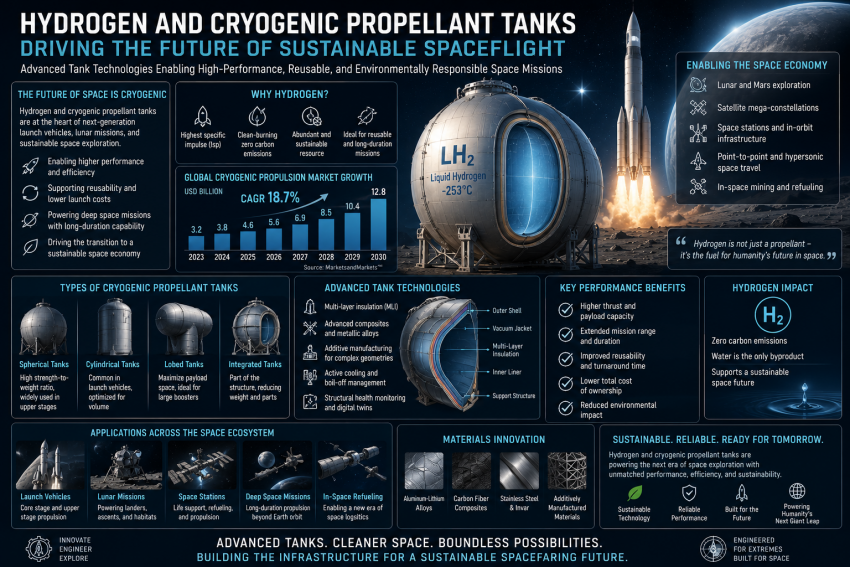
The future of space exploration is increasingly tied to sustainability, efficiency, and long-duration mission capability. As governments and private launch providers push toward lunar bases, Mars expeditions, reusable launch systems, and orbital refueling infrastructure, hydrogen and Cryogenic propellant tanks are emerging as critical technologies that will define the next era of space mobility. These advanced storage systems are enabling spacecraft to carry high-energy fuels more efficiently while supporting the broader transition toward cleaner and more sustainable propulsion architectures.
Hydrogen has long been considered one of the most powerful rocket fuels because of its exceptionally high specific impulse and clean combustion characteristics. When paired with liquid oxygen, liquid hydrogen generates only water vapor as exhaust while delivering the performance needed for deep-space missions. However, storing hydrogen in liquid form requires temperatures near -253°C, creating enormous engineering challenges for aerospace manufacturers. Cryogenic propellant tanks are therefore becoming central to the evolution of sustainable spaceflight systems.
Modern space programs increasingly rely on cryogenic storage technologies because they enable lightweight, high-capacity propulsion systems capable of supporting reusable and long-duration missions. NASA and other global agencies have identified cryogenic fluid management as a major enabling technology for Moon and Mars exploration architectures.
Download Brochure Analyst-Verified Insights @ https://www.marketsandmarkets.com/pdfdownloadNew.asp?id=195002624
Rising Importance of Liquid Hydrogen in Space Propulsion
Liquid hydrogen offers one of the highest energy-to-mass ratios among chemical rocket fuels. Its ability to produce high thrust efficiency makes it especially attractive for upper-stage propulsion, interplanetary transfer vehicles, and future nuclear thermal propulsion systems. Studies focused on deep-space transportation consistently identify hydrogen as a preferred propellant for sustainable exploration missions.
The transition toward reusable launch systems is also accelerating interest in cryogenic hydrogen technologies. Reusability requires lightweight structures, efficient thermal management, and long-duration fuel stability. Advanced cryogenic tanks help reduce overall launch mass while preserving propellant quality during repeated operations.
In addition, hydrogen aligns with the broader global movement toward decarbonization. Although space launches currently contribute a relatively small percentage of global emissions, sustainable propulsion technologies are becoming strategically important as launch frequency increases. Hydrogen-based propulsion provides a pathway toward cleaner launch systems compared to traditional hypergolic fuels that generate toxic exhaust products.
Engineering Challenges of Cryogenic Propellant Storage
Despite its performance advantages, hydrogen presents serious storage difficulties. Cryogenic liquids continuously absorb heat from surrounding environments, causing gradual vaporization known as boil-off. Even minor thermal leakage can result in propellant loss, pressure buildup, and reduced mission efficiency.
Research on cryogenic propellant management highlights boil-off losses as one of the major barriers to long-duration missions and in-space refueling systems.
The core challenge arises from maintaining extremely low temperatures in the harsh thermal environment of space. External solar radiation, onboard electronics, structural conduction, and dynamic mission operations all contribute to heat transfer into the tank. Over extended missions, this can significantly reduce usable fuel reserves.
Another major issue is fluid behavior in microgravity. Without gravity-driven settling, cryogenic fluids can stratify, slosh, or generate unstable vapor regions within tanks. These behaviors complicate fuel transfer, pressure regulation, and engine feed systems. NASA and international research organizations are actively studying two-phase fluid dynamics to improve tank reliability during long-duration missions.
Advances in Zero-Boil-Off Technologies
To overcome these challenges, aerospace engineers are developing zero-boil-off storage technologies designed to eliminate or dramatically reduce cryogenic fuel losses. These systems combine advanced insulation materials, active cooling systems, cryocoolers, thermal shields, and intelligent fluid management techniques.
NASA recently demonstrated innovative two-stage cooling systems intended to maintain liquid hydrogen at stable temperatures for extended durations. These technologies circulate ultra-cold helium through external cooling tubes attached to tank walls, preventing heat accumulation and minimizing vaporization losses.
Zero-boil-off concepts are considered essential for sustainable lunar logistics and future Mars transportation systems. Long-duration missions require spacecraft to preserve cryogenic fuels for months or even years without significant losses. NASA researchers emphasize that future crewed Mars missions cannot rely solely on oversized propellant margins because the required tank volumes would become impractical.
Advanced cryocoolers are also playing a transformative role in cryogenic storage systems. Modern reverse turbo-Brayton cryocoolers and distributed cooling architectures are being optimized to reduce system mass, improve efficiency, and support large-scale liquid hydrogen storage.
Lightweight Composite Tanks Revolutionizing Spacecraft Design
The next generation of cryogenic tanks is increasingly shifting from traditional metallic structures toward lightweight composite materials. Carbon-fiber reinforced polymer tanks offer significant mass reductions while maintaining structural strength under cryogenic conditions.
The European Space Agency’s Phoebus program is exploring large-scale carbon-fiber cryogenic tanks for future launch vehicles. The project aims to replace conventional metallic upper-stage tanks with advanced composite alternatives capable of storing liquid oxygen and hydrogen while reducing total launch weight.
Lightweight cryogenic tanks deliver several advantages for sustainable spaceflight. Lower structural mass increases payload capacity, reduces launch costs, and improves vehicle reusability. Composite materials also offer greater design flexibility for future in-space depots, orbital transfer vehicles, and lunar surface infrastructure.
As commercial spaceflight expands, demand for modular and scalable tank systems is expected to rise significantly. Commercial operators pursuing satellite servicing, orbital refueling, and deep-space cargo transport are increasingly investing in advanced cryogenic storage platforms capable of supporting multiple mission profiles.
In-Space Refueling and Orbital Propellant Depots
One of the most transformative applications of cryogenic tank technology is the emergence of orbital propellant depots. These facilities would allow spacecraft to refuel in space instead of carrying all required propellant from Earth, dramatically reducing launch mass and mission costs.
Research on cryogenic propellant management identifies orbital refueling as a critical enabler for sustainable exploration architectures.
Orbital depots could support lunar cargo systems, crewed Mars missions, reusable landers, and deep-space exploration vehicles. However, such systems require reliable long-term storage and transfer of cryogenic fuels under microgravity conditions. Zero-boil-off technologies, autonomous tank monitoring systems, and advanced pressure-control systems are therefore becoming strategically important.
Emerging AI-driven forecasting systems are also being developed to improve autonomous cryogenic fluid management. Real-time predictive algorithms can optimize pressure control, temperature regulation, and transfer operations while reducing computational requirements for onboard systems.
Sustainability and the Future Space Economy
Hydrogen and cryogenic propellant technologies are not only improving spacecraft performance but also helping establish the infrastructure needed for a long-term space economy. Sustainable exploration requires reusable transportation systems, efficient resource utilization, and reduced mission costs. Advanced cryogenic storage technologies directly support all of these objectives.
Future lunar and Martian missions may eventually produce hydrogen and oxygen locally through in-situ resource utilization systems. These locally generated cryogenic fuels could then be stored in advanced propellant tanks for surface operations and return missions. Such capabilities would fundamentally reshape deep-space logistics and reduce dependence on Earth-based resupply chains.
The growing integration of hydrogen propulsion with reusable launch vehicles, orbital servicing systems, and deep-space exploration platforms is expected to accelerate investment across the aerospace sector. Governments, defense organizations, commercial launch providers, and private space infrastructure companies are all actively pursuing advanced cryogenic storage technologies as part of broader sustainability strategies.
Conclusion
Hydrogen and cryogenic propellant tanks are becoming foundational technologies for the future of sustainable spaceflight. As space missions evolve from short-duration exploration toward permanent lunar presence, Mars expeditions, and commercial in-space operations, the ability to safely store and manage cryogenic fuels will become increasingly important.
Innovations in zero-boil-off systems, lightweight composite tanks, autonomous thermal management, and orbital refueling infrastructure are rapidly transforming how spacecraft are designed and operated. These technologies are enabling cleaner propulsion systems, longer mission durations, higher payload efficiency, and greater reusability across the global space industry.
The future of deep-space transportation will depend not only on powerful propulsion systems but also on the advanced cryogenic tanks that preserve and deliver those fuels efficiently. Hydrogen-powered propulsion and next-generation cryogenic storage systems are therefore positioned to become key pillars of the emerging sustainable space economy.