
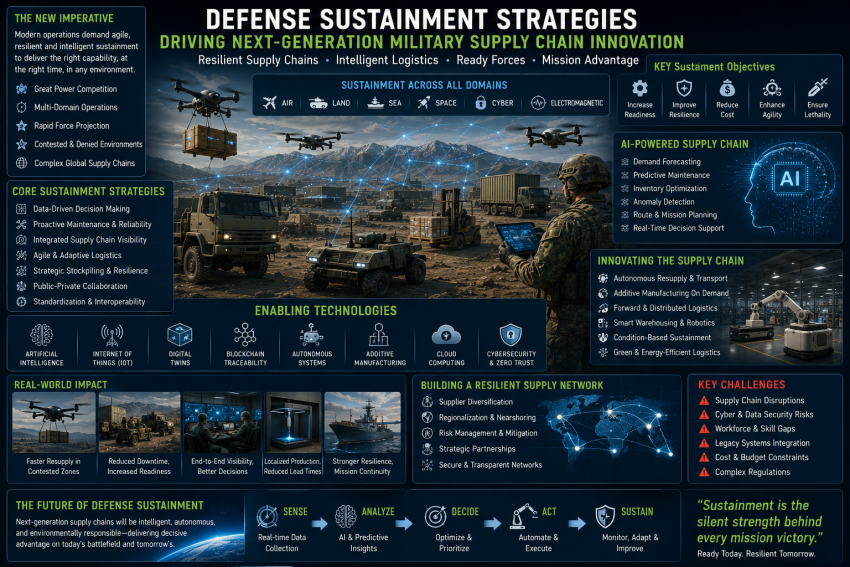
The global defense sector is undergoing a major transformation as modern military forces prioritize resilient, agile, and technology-driven sustainment strategies to support increasingly complex operational environments. Defense sustainment is no longer limited to traditional logistics and maintenance activities—it has evolved into a strategic capability that directly influences operational readiness, force mobility, mission endurance, and battlefield superiority.
As military operations become more distributed, autonomous, and data-centric, next-generation military supply chain innovation is accelerating across logistics management, predictive maintenance, inventory optimization, autonomous transportation, and digital sustainment ecosystems. Defense organizations worldwide are investing heavily in advanced technologies that improve supply chain visibility, operational resilience, and rapid response capability across multi-domain battlefields.
Download Free Sample of Report: https://www.marketsandmarkets.com/pdfdownloadNew.asp?id=155479010
Growing Strategic Importance of Defense Sustainment
Defense sustainment encompasses the systems, infrastructure, and operational processes required to maintain military readiness throughout peacetime, conflict, and extended deployments.
Key sustainment functions include:
- Supply chain management
- Equipment maintenance and repair
- Fuel and ammunition distribution
- Transportation and mobility
- Medical logistics
- Spare parts management
- Operational support services
In modern warfare, sustainment effectiveness directly impacts force survivability, mission success, and long-term operational sustainability.
As geopolitical tensions rise and military operations become increasingly globalized, defense agencies are prioritizing supply chain resilience and logistics modernization to reduce vulnerabilities and improve force responsiveness.
Military Supply Chains Becoming More Complex
Modern military supply chains are significantly more complex than traditional defense logistics networks. Current sustainment ecosystems must support:
- Distributed force structures
- Autonomous military systems
- Rapid deployment operations
- Multi-domain mission environments
- Joint and coalition operations
- High-tempo combat scenarios
This growing complexity is driving demand for highly integrated, digitally connected, and AI-enabled sustainment architectures capable of operating across contested and rapidly changing operational conditions.
Artificial Intelligence Transforming Defense Logistics
Artificial intelligence is emerging as one of the most influential technologies driving next-generation military supply chain innovation.
AI-enabled sustainment systems improve logistics efficiency through:
- Predictive maintenance analytics
- Demand forecasting
- Inventory optimization
- Automated logistics planning
- Dynamic transportation routing
- Real-time operational visibility
Machine learning algorithms continuously analyze large volumes of operational and maintenance data to improve forecasting accuracy and optimize sustainment decision-making.
AI technologies also help reduce operational downtime, improve fleet availability, and increase overall combat readiness.
Autonomous Logistics Expanding Military Capabilities
Autonomous logistics systems are rapidly reshaping military supply chain operations.
Modern defense organizations are deploying AI-enabled autonomous technologies for:
- Unmanned cargo transportation
- Drone-based resupply missions
- Robotic warehouse automation
- Autonomous convoy operations
- Battlefield medical evacuation
- Automated fuel delivery
These systems improve operational flexibility while reducing risks to logistics personnel operating in contested areas.
Autonomous logistics capabilities are particularly valuable for:
- Remote battlefield sustainment
- High-threat operational zones
- Distributed force support
- Rapid deployment missions
As autonomous military systems become more common, logistics networks are evolving toward greater automation and decentralized operational models.
Digitalization Driving Supply Chain Visibility
Digital transformation is becoming central to next-generation defense sustainment strategies.
Modern digital logistics ecosystems integrate:
- Cloud-based logistics platforms
- Real-time asset tracking
- Internet of Things (IoT) sensors
- Blockchain-enabled traceability
- Digital twin technology
- Advanced data analytics
These systems provide enhanced visibility across military supply chains and enable faster decision-making during dynamic operational conditions.
Improved digital connectivity allows commanders to:
- Monitor equipment readiness in real time
- Track supply movements globally
- Identify logistical bottlenecks
- Optimize resource allocation
- Improve operational forecasting
Digitalized sustainment architectures are helping military organizations achieve greater agility and resilience.
Supply Chain Resilience Becoming a Strategic Priority
Recent geopolitical instability, supply disruptions, and semiconductor shortages have highlighted vulnerabilities within global defense supply chains.
As a result, defense organizations are increasingly prioritizing:
- Domestic manufacturing capabilities
- Supplier diversification
- Strategic stockpile management
- Nearshoring production facilities
- Resilient procurement strategies
- Cyber-secure logistics infrastructure
Supply chain resilience is becoming a core national security concern, particularly for critical defense technologies and advanced military systems.
Governments and defense contractors are investing heavily in strengthening industrial capacity and reducing dependency on fragile global supply networks.
Additive Manufacturing Accelerating Sustainment Innovation
Additive manufacturing, commonly known as 3D printing, is becoming an important enabler of modern military sustainment.
3D printing technologies allow defense organizations to:
- Produce spare parts on demand
- Reduce inventory requirements
- Improve battlefield repair capability
- Shorten supply lead times
- Enable decentralized manufacturing
Additive manufacturing is particularly valuable for remote operations where rapid access to replacement components may be limited.
Future military logistics networks are expected to incorporate mobile and forward-deployed additive manufacturing capabilities to support expeditionary operations.
Explore In-Depth Industry Analysis: https://www.marketsandmarkets.com/Market-Reports/military-vehicle-sustainment-market-155479010.html
Challenges Affecting Next-Generation Sustainment Adoption
Despite significant technological progress, several challenges remain.
Legacy Infrastructure Limitations
Older logistics systems often lack compatibility with modern digital technologies.
High Implementation Costs
Modernization programs require substantial investment in technology and workforce development.
Data Integration Complexity
Integrating data across multiple military platforms and systems remains challenging.
Workforce Skill Gaps
Personnel require advanced digital, analytical, and AI-related training.
Interoperability Concerns
Coalition operations demand compatibility across allied logistics systems.
Addressing these challenges will be critical for achieving fully integrated and resilient defense sustainment ecosystems.
Defense sustainment strategies are rapidly evolving into highly intelligent, automated, and digitally connected ecosystems that support next-generation military operations. As defense organizations continue modernizing force structures and adopting autonomous technologies, military supply chain innovation will remain a key priority for maintaining operational superiority.
The future of military logistics will increasingly depend on speed, adaptability, resilience, and intelligent automation. In emerging operational environments, sustainment superiority will become just as strategically important as combat capability itself, enabling armed forces to maintain readiness, mobility, and mission effectiveness across highly dynamic global battlefields.