
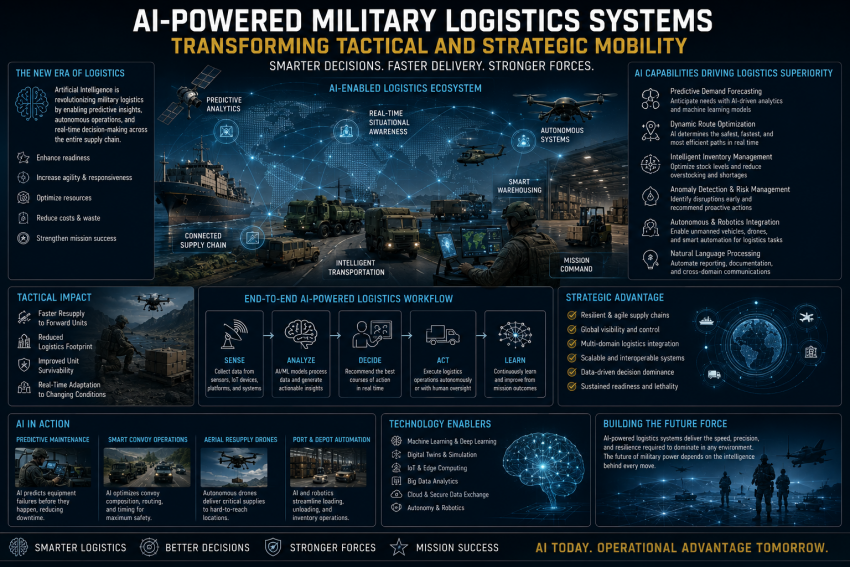
Modern warfare increasingly depends not only on advanced weapons and combat platforms but also on the speed, precision, and resilience of military logistics systems. In today’s highly dynamic operational environments, armed forces must rapidly transport personnel, fuel, ammunition, medical supplies, and critical equipment across contested and geographically dispersed battlefields. As military operations become more data-intensive and multidomain in nature, artificial intelligence is emerging as a transformative force in tactical and strategic logistics mobility.
AI-powered military logistics systems are redefining how defense organizations manage supply chains, predict equipment failures, optimize transportation routes, and sustain operational readiness. By integrating machine learning, predictive analytics, autonomous systems, and real-time battlefield intelligence, modern logistics architectures are becoming faster, more adaptive, and increasingly autonomous. These capabilities are enabling military forces to improve decision-making while reducing operational delays and sustainment vulnerabilities.
Download Brochure Analyst-Verified Insights @ https://www.marketsandmarkets.com/pdfdownloadNew.asp?id=155479010
Governments and defense agencies worldwide are investing heavily in AI-enabled logistics modernization initiatives to support future multidomain operations and enhance mission effectiveness. The growing complexity of modern conflicts, combined with rising pressure for operational efficiency, is accelerating the adoption of intelligent logistics technologies across land, naval, air, and space defense domains.
The Growing Complexity of Military Logistics Operations
Military logistics has always been one of the most challenging aspects of warfare. Modern defense operations involve massive coordination among transportation networks, maintenance facilities, supply depots, command centers, and frontline units. In multidomain combat scenarios, logistics systems must support simultaneous operations across air, sea, land, cyber, and space environments.
Traditional logistics systems often struggle with fragmented data, delayed communication, manual inventory tracking, and limited predictive capability. In rapidly changing combat conditions, these limitations can lead to supply shortages, mission delays, equipment downtime, and operational inefficiencies.
AI is helping overcome these challenges by enabling logistics systems to process enormous volumes of operational data in real time. Machine learning algorithms can analyze battlefield conditions, transportation status, equipment health, fuel consumption, weather data, and threat intelligence to optimize supply chain decisions dynamically.
Defense analysts increasingly recognize logistics superiority as a decisive factor in future conflicts. Military organizations are therefore shifting toward AI-driven sustainment ecosystems capable of operating in highly contested and disconnected environments.
Predictive Maintenance Enhancing Fleet Readiness
One of the most impactful applications of AI in military logistics is predictive maintenance. Modern military vehicles, aircraft, naval platforms, and unmanned systems generate large amounts of operational and sensor data during missions. AI-powered predictive maintenance systems analyze this data to identify early indicators of component degradation or system failure.
Instead of relying solely on scheduled maintenance intervals, defense forces can now perform condition-based maintenance using AI-generated forecasts. This approach significantly reduces downtime, lowers maintenance costs, and improves fleet availability.
For tactical operations, predictive maintenance is especially critical because equipment failures in combat zones can compromise mission success and endanger personnel. AI systems can monitor engine performance, hydraulic systems, vibration signatures, temperature fluctuations, and structural stress patterns to anticipate failures before they occur.
Military aviation programs are already integrating AI-based maintenance analytics to improve aircraft mission readiness and reduce lifecycle sustainment costs. Similar technologies are being deployed for armored vehicles, naval propulsion systems, and autonomous defense platforms.
As military fleets become increasingly digitized, predictive logistics systems will continue evolving toward fully autonomous sustainment frameworks capable of self-diagnosing and coordinating repair operations in real time.
Autonomous Logistics Vehicles Reshaping Battlefield Mobility
Autonomous and semi-autonomous logistics platforms are transforming tactical mobility in modern warfare. AI-enabled unmanned ground vehicles, autonomous cargo drones, robotic supply convoys, and intelligent maritime resupply vessels are reducing the risks associated with transporting supplies through hostile environments.
Traditional supply convoys are highly vulnerable to ambushes, improvised explosive devices, electronic warfare attacks, and drone surveillance. Autonomous logistics systems reduce personnel exposure while maintaining continuous supply chain operations in contested regions.
AI-powered convoy systems can dynamically adjust routes based on terrain conditions, enemy activity, weather patterns, and operational priorities. These systems use computer vision, sensor fusion, and advanced navigation algorithms to operate with minimal human intervention.
Cargo drones are also playing a growing role in tactical logistics operations. Autonomous aerial resupply systems can rapidly deliver ammunition, medical equipment, food supplies, and communications gear to remote or isolated units. This capability is particularly valuable in mountainous terrain, disaster zones, and denied-access operational environments.
Naval forces are similarly exploring autonomous resupply vessels for distributed maritime operations. These intelligent platforms can transport fuel, spare parts, and mission-critical supplies across long distances while minimizing crew requirements and operational risks.
AI-Driven Supply Chain Optimization
Modern military supply chains involve highly complex global procurement networks and inventory systems. AI is significantly improving the efficiency of defense supply chain management by enabling intelligent forecasting, inventory optimization, and automated logistics coordination.
Machine learning systems can analyze historical demand patterns, mission requirements, operational tempos, geopolitical risks, and transportation constraints to optimize stockpiles and supply distribution. AI-driven forecasting reduces excess inventory while ensuring critical supplies remain available during high-intensity operations.
Real-time logistics visibility is becoming increasingly important in multidomain warfare. AI platforms integrate satellite imagery, sensor data, RFID tracking systems, and battlefield communications to provide commanders with comprehensive supply chain awareness.
Advanced logistics algorithms can automatically reroute shipments around disrupted infrastructure, cyberattacks, or enemy-controlled areas. This adaptive capability improves resilience in contested operational environments where traditional supply routes may become inaccessible.
Cloud computing and edge AI architectures are further enhancing distributed logistics coordination by enabling rapid data processing closer to operational theaters. These systems improve decision speed while reducing communication latency during tactical operations.
Tactical Decision Support and Battlefield Intelligence
AI-powered logistics systems are increasingly integrated with battlefield command-and-control networks. This integration allows logistics planners to synchronize sustainment operations with combat maneuvers, intelligence updates, and mission priorities in real time.
Advanced AI decision-support systems can recommend optimal transportation methods, prioritize medical evacuations, allocate fuel resources, and coordinate supply delivery schedules under rapidly changing combat conditions. These tools improve operational agility while reducing human cognitive workload.
In future multidomain operations, logistics AI platforms may autonomously coordinate with unmanned combat systems, ISR networks, and cyber defense infrastructures. Such integration would create highly interconnected military ecosystems capable of responding dynamically to emerging threats and operational disruptions.
AI-driven simulation models are also supporting military planning by evaluating multiple logistics scenarios before deployment. Defense organizations use these systems to test supply chain resilience, force projection capabilities, and sustainment strategies under different battlefield conditions.
Cybersecurity and Resilient Logistics Networks
As military logistics systems become more digitized and interconnected, cybersecurity is becoming a critical concern. AI-enabled logistics architectures rely heavily on networked communications, cloud platforms, autonomous systems, and data-sharing infrastructures, all of which present potential cyberattack surfaces.
Adversaries increasingly target logistics systems because disrupting fuel supplies, transportation networks, or maintenance operations can severely weaken military effectiveness. AI is therefore being used not only to optimize logistics but also to strengthen cybersecurity defenses.
Machine learning algorithms can detect anomalous network behavior, identify cyber intrusions, and isolate compromised systems before attacks spread across military logistics networks. AI-driven cyber defense tools improve situational awareness and accelerate threat response times.
Resilient logistics architectures are also incorporating decentralized communication systems, edge computing, and redundant operational pathways to maintain functionality during cyber warfare or electronic jamming conditions.
Future Trends in AI-Powered Military Logistics
The future military logistics landscape will likely feature increasingly autonomous and interconnected sustainment ecosystems. Emerging technologies such as digital twins, quantum computing, advanced robotics, and generative AI are expected to further accelerate logistics modernization.
Digital twin technology will allow defense organizations to create virtual replicas of supply chains, transportation networks, and maintenance infrastructures for predictive analysis and operational planning. AI-powered digital twins can simulate equipment failures, supply disruptions, and combat scenarios to improve readiness strategies.
Swarm robotics may eventually support autonomous battlefield resupply missions involving coordinated fleets of unmanned aerial and ground systems. These distributed logistics networks could improve survivability while enabling rapid sustainment operations in highly contested zones.
AI-driven additive manufacturing is also expected to transform military sustainment by enabling on-demand production of spare parts near operational theaters. Combined with predictive analytics, this capability could significantly reduce supply chain dependency and maintenance delays.
Discover Growth Opportunities & Trends @ https://www.marketsandmarkets.com/Market-Reports/military-vehicle-sustainment-market-155479010.html
Conclusion
AI-powered military logistics systems are rapidly transforming the future of tactical and strategic mobility. By integrating predictive analytics, autonomous transportation platforms, intelligent supply chain management, and real-time battlefield awareness, defense organizations are creating faster, more adaptive, and more resilient logistics ecosystems.
As modern warfare evolves toward multidomain operations and distributed combat architectures, logistics superiority will become increasingly critical to mission success. AI technologies are enabling military forces to improve operational readiness, reduce sustainment vulnerabilities, optimize resource allocation, and maintain battlefield mobility under highly dynamic conditions.
The continued advancement of autonomous systems, predictive maintenance, digital logistics networks, and AI-enabled decision support will fundamentally reshape military sustainment operations in the coming decades. Intelligent logistics capabilities are no longer simply support functions but are becoming strategic enablers that directly influence combat effectiveness, force projection, and long-term defense readiness.