
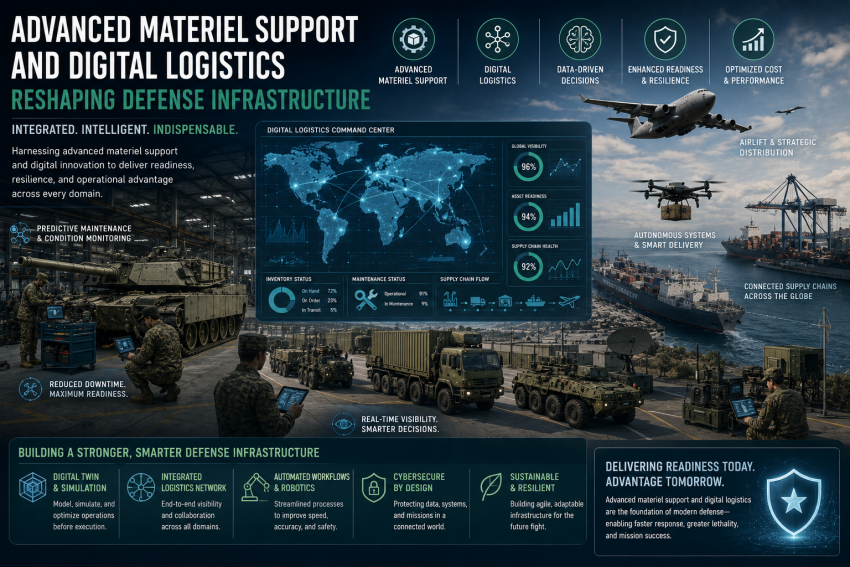
The modernization of global defense infrastructure is increasingly centered on the ability to sustain military operations through efficient materiel support and digitally enabled logistics. As armed forces prepare for multi-domain operations, rapid deployments, and prolonged missions in contested environments, the traditional logistics model is evolving into an integrated ecosystem powered by artificial intelligence (AI), automation, cloud computing, predictive analytics, and real-time data sharing. Advanced materiel support and digital logistics are now fundamental to improving operational readiness, supply chain resilience, and mission success.
Materiel support encompasses the acquisition, storage, distribution, maintenance, repair, and lifecycle management of military equipment, weapons, vehicles, spare parts, fuel, and other mission-critical resources. Digital logistics enhances these functions by connecting supply chains, maintenance systems, transportation networks, and command centers through intelligent technologies that enable real-time visibility and faster decision-making. Together, these capabilities are reshaping how defense organizations manage resources across increasingly complex operational environments.
Defense organizations such as the U.S. Department of Defense, NATO, and major defense companies including Lockheed Martin, Northrop Grumman, BAE Systems, RTX, and General Dynamics are investing in next-generation sustainment technologies that strengthen logistics performance while supporting military modernization initiatives. These investments recognize that logistics superiority is as critical to mission success as advanced combat capabilities.
Get Detailed Market Size & Forecast Data: https://www.marketsandmarkets.com/pdfdownloadNew.asp?id=155479010
One of the most important developments is the shift toward data-driven materiel management. Modern logistics platforms collect and integrate information from sensors, warehouses, maintenance facilities, transportation assets, and deployed military units into unified digital environments. This real-time visibility allows commanders and logistics personnel to monitor inventory levels, equipment readiness, transportation status, and supply chain performance across global operations, enabling faster and more informed decision-making.
Artificial intelligence is playing an increasingly significant role in digital logistics. AI-powered systems analyze operational data to forecast demand, optimize inventory levels, recommend transportation routes, and identify potential supply chain disruptions before they affect mission readiness. Machine learning algorithms continuously improve logistics planning by recognizing patterns in equipment usage, maintenance history, and operational requirements, helping military organizations reduce waste while improving resource availability.
Predictive maintenance has become another cornerstone of advanced materiel support. Modern military platforms—including aircraft, naval vessels, armored vehicles, and missile systems—are equipped with sensors that continuously monitor mechanical performance and system health. AI-driven maintenance platforms evaluate this information to predict component failures before they occur, enabling scheduled repairs that reduce downtime, improve equipment availability, and lower lifecycle sustainment costs.
Automation is transforming logistics operations throughout the defense sector. Automated warehouses, robotic inventory systems, autonomous material handling equipment, and digital asset-tracking technologies improve speed, accuracy, and efficiency while minimizing human error. These technologies accelerate the movement of supplies and spare parts, ensuring that frontline forces receive mission-critical resources with minimal delay.
Autonomous logistics systems are further expanding operational capabilities. Unmanned ground vehicles, autonomous cargo convoys, robotic resupply platforms, and unmanned aerial delivery systems are increasingly being deployed to transport equipment and supplies in high-risk or contested environments. By reducing personnel exposure to threats and improving logistics responsiveness, these systems enhance both operational safety and sustainment effectiveness.
The growing adoption of cloud computing is enabling defense organizations to build globally connected logistics ecosystems. Cloud-based platforms allow secure data sharing among military branches, coalition partners, logistics centers, and operational commands. This interconnected infrastructure supports collaborative planning, rapid information exchange, and synchronized sustainment activities across geographically dispersed operations.
Additive manufacturing is also reshaping materiel support by enabling decentralized production of critical components. Forward-deployed 3D printing capabilities allow military units to manufacture replacement parts closer to operational areas, reducing dependence on extended supply chains and accelerating equipment repairs. Combined with digital inventory management and predictive maintenance systems, additive manufacturing significantly improves operational flexibility and sustainment resilience.
Multi-domain operations are creating new demands for integrated logistics infrastructure. Modern military campaigns require synchronized support across land, air, maritime, space, and cyber domains. Digital logistics platforms enable seamless coordination between these domains by providing real-time situational awareness, optimizing resource distribution, and supporting dynamic mission planning. This integration ensures that sustainment operations remain agile even in rapidly evolving combat environments.
Cybersecurity has become an essential component of digital defense logistics. As logistics systems become increasingly networked, they face growing risks from cyberattacks targeting supply chains, communications, and operational data. Defense organizations are strengthening cyber resilience through encrypted communications, secure cloud architectures, zero-trust security frameworks, and advanced threat detection technologies to protect mission-critical logistics infrastructure.
Space-enabled capabilities are also enhancing modern materiel support. Satellite communications, positioning services, and Earth observation systems provide accurate tracking of military assets, optimize transportation routes, improve operational awareness, and strengthen global logistics coordination. As military operations become more dependent on space-based infrastructure, these capabilities will continue to play a vital role in sustaining global defense operations.
Sustainability is emerging as an additional priority within defense logistics modernization. Military organizations are exploring energy-efficient transportation systems, hybrid support vehicles, intelligent fuel management, and environmentally responsible logistics practices to reduce operational costs and improve long-term resilience. These initiatives align with broader efforts to modernize defense infrastructure while maintaining mission effectiveness.
Explore In-Depth Industry Analysis: https://www.marketsandmarkets.com/Market-Reports/military-vehicle-sustainment-market-155479010.html
Looking ahead, advanced materiel support and digital logistics will continue to evolve through innovations in artificial intelligence, robotics, digital twins, autonomous systems, edge computing, and advanced analytics. Future defense infrastructure will rely on interconnected, intelligent logistics networks capable of predicting operational needs, adapting to changing battlefield conditions, and delivering seamless support across global theaters.
As defense forces modernize to meet emerging security challenges, advanced materiel support and digital logistics will remain foundational to operational readiness and force sustainment. By integrating intelligent technologies with resilient supply chains and automated logistics systems, military organizations can improve equipment availability, accelerate decision-making, enhance mission flexibility, and maintain a decisive operational advantage in the increasingly complex defense landscape.