
The global Laboratory Informatics Market, valued at US$4.8 billion in 2023, is forecasted to grow at a robust CAGR of 10.4%, reaching US$5.3 billion in 2024 and an impressive US$8.7 billion by 2029. There are significant development prospects for the laboratory informatics industry in emerging economies such as China, India, Japan, Singapore, Brazil, and the Middle Eastern nations. A noteworthy trend in the market is the growing adoption of cloud-based models that can be attributed to the increasing creation of data volume in laboratories and the resulting decrease in the total cost of ownership. For instance, in December 2023, Revvity, Inc. (US) launched the Signals Research Suite, a unified, cloud-based SaaS platform that advocates the complete drug development process—from early research, in-vitro testing, and safety to the new product development of specialty chemicals by integrating the Revvity Signals Notebook, VitroVivo, and Inventa applications into one platform. However, there are a few major barriers to the expansion of the laboratory informatics business, including a lack of technical competence and interoperability problems.
Key Players:
Prominent companies in this market include Thermo Fisher Scientific Inc. (US), LabVantage Solutions Inc. (US), LabWare (US), STARLIMS Corporation (US), Agilent Technologies (US), Waters Corporation (US), LabLynx, Inc. (US), Dassault Systèmes (France), Revvity (Perkinelmer) (US), Accelerated Technology Laboratories (US), Labworks (US), IDBS (UK), Xybion Digital Inc. (US), Novatek International (Canada), Agaram Technologies (India), Siemens (Germany), Caliber Technologies (US), Clinsys (US), LABTrack (US), Labkey (US), Benchling (US), CloudLIMS (US), SciNote LLC (US), L7 Informatics, Inc. (US), and QBench (US).
Driver: Growing need for laboratory automation
Laboratory automation has become an effective solution for managing the shortage of qualified laboratory staff and the need to minimize manual intervention in laboratory operations. Dedicated workstations and software can be used to program devices that, in turn, can help automate common laboratory activities to increase productivity and free up time for researchers to adjust their focus on more critical tasks. Since pipetting and shifting plates are repetitive, lab automation helps automate these tasks and eliminate human errors, enhancing the outcome precision. Research published in the Journal of Lab Automation states that error rates range from 1 to 5% for completely automated activities, 1 to 10% for semi-automated operations, and 10 to 30% for manual operations. The proper use of integrated workstations, automated analyzers, and total laboratory automation (TLA) enables re-assigning skilled laboratory staff to tasks that contribute a much higher value to operations. The rise in data produced by lab systems and instruments has generated the need for productive data storage, analysis, and sharing systems. Laboratory informatics solutions significantly facilitate, advance, and improve the productivity and efficiency of laboratory processes, responding to this demand.
Pharma and biotech companies face immense pressure to comply with stern regulatory guidelines for preclinical and clinical testing before launching new drugs. Regulatory requirements such as 21 CFR Part 11 and Clinical Laboratory Improvement Amendments (CLIA) involve documentation and audit trails from R&D and testing to production and quality control. In addition to these regulations, appropriate labeling and advertising guidelines must also be followed.
Owing to data management and security concerns, most laboratories have adopted lab informatics solutions to simplify their workflows and adhere to stringent regulatory requirements. These systems ensure that laboratories meet regulatory standards without compromising process versatility. These solutions are expected to increase the demand for lab informatics solutions in target industries.
Restraint: High Implementation, maintenance, and service costs
Lab informatics solutions offer several benefits in streamlining laboratory workflows and improving data management across laboratories; the costs involved in implementing and maintaining these systems can pose challenges for end users, especially mid-size and smaller laboratories or those with limited budgets allocated towards digitalization or automation. The adoption of lab informatics solutions may be delayed due to limited budgets available at organizations, which may force them to allocate resources to other critical areas in the laboratories, which are of paramount importance. Owing to this, many potential customers find it financially difficult to invest, hindering the growth prospects of the lab informatics market.
Per industry experts, the service cost of the solutions is typically more than the actual price of the software. Maintenance and product support costs represent a recurring expenditure, accounting for approximately 15–25% of the total cost of software licenses. Around 55–60% of the project’s total cost is incurred during the first year of execution as implementation charges.
Lab informatics solution providers also aim to explore options such as tiered pricing models, cloud-based solutions with subscription-based pricing, or service agreements that offer flexible support packages to neutralize the impact of high implementation, maintenance, and service costs. Furthermore, ensuring a transparent cost structure, a clear description of value-added services, and customer-centric support can help alleviate concerns and foster the growth of the lab informatics market.
Opportunity: High demand for real-time data and analytics
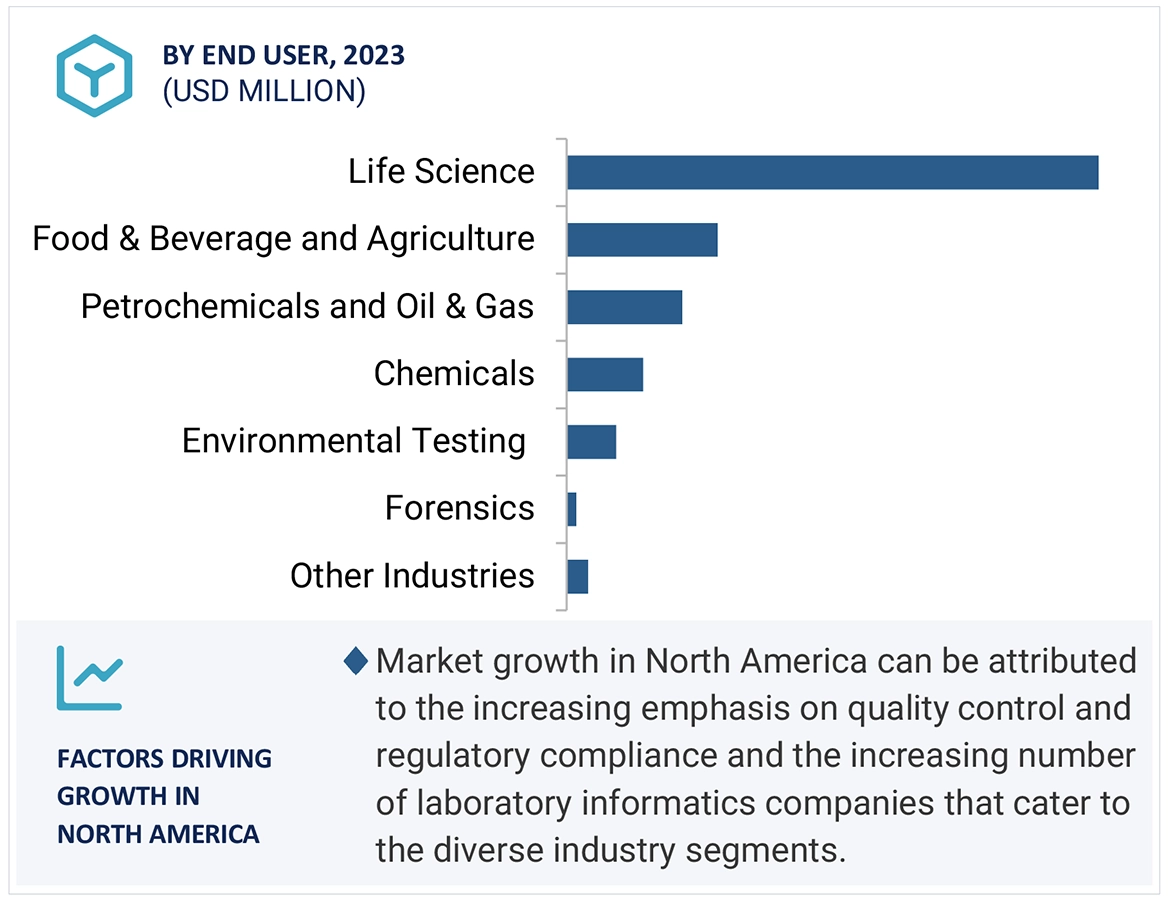
Lab informatics solutions demonstrate a lot of potential due to the surging demand for real-time data analytics solutions across various industries, including the life sciences, food & beverage, petrochemical, chemicals, and other industries. Since these sectors are heavily reliant on data-driven decision-making, technologically advanced lab informatics solutions, such as LIMS, ELN, CDS, etc., offer quick access to precise and useful data are paramount.
Real-time data analytics are used in the pharma and life sciences sectors to manage the enormous data volume generated during research, optimize clinical trials, and ensure timely regulatory submissions. In the food & beverage and chemical industries, analytics can enhance quality control, improve traceability, and optimize processes. The smooth flow of data in the company is ensured by integrating lab informatics solutions with laboratory equipment and other enterprise systems that foster better communication and more informed decision-making. The increasing demand for real-time insights is expected to drive industry expansion and innovation, leading to a rise in the use of advanced lab informatics systems.
Challenge: Limited adoption of lab informatics solutions in SMEs
SMEs often operate on smaller budgets, making the upfront investment and ongoing expenses associated with lab informatics a barrier. The lack of financial resources and limited IT infrastructure can deter SMEs from adopting lab informatics solutions, reducing the growth potential of the market.
Moreover, SMEs may lack the internal expertise required for successful lab informatics implementation. Implementing lab informatics involves technical knowledge, customization, and training, for which SMEs may not have dedicated resources; this knowledge gap can result in hesitation or reluctance to adopt lab informatics, inhibiting market expansion. Additionally, SMEs may already have established processes and systems that they consider sufficient for their current needs. Transitioning to lab informatics may disrupt their operations and require a learning curve, which could discourage adoption. Without SME participation, the growth potential of the market is limited.
North America Region Holds the Largest Share of the Laboratory Informatics Market.
The laboratory informatics market is studied for the five major regions: North America, Europe, the Asia Pacific, Latin America, and the Middle East & Africa. The North American region dominated the laboratory informatics market owing to factors such as the region’s high per-capita healthcare expenditure, ongoing developments in technologies integrated with lab systems, and the integration of lab instruments with informatics solutions such as LIMS, ELN, CDS, and SDMS. The increasing number of biobanks, the increasing emphasis on quality control, regulatory compliance, the adoption of digitization in laboratory processes, developed infrastructure, and growth in the demand for digitalized technologies across North America further propels the growth. Moreover, the competitive landscape in North America encourages innovation among market players, driving continuous growth in technology and service offerings by various market vendors.
Recent Developments OF Laboratory Informatics Industry
- In July 2024, LabKey announced the release of version 24.3, featuring enhanced capabilities in Server SDMS, Sample Manager, and Biologics LIMS. Highlights include improved data handling in SDMS studies, streamlined sample management in Sample Manager, and advanced functionality in Biologics LIMS for electronic lab notebooks and molecule property calculations.
- In July 2024, Xybion Corporation partnered with Envol Biomedical to enhance lab operations by implementing its Pristima LIMS. This collaboration streamlined the non-clinical processes, improved data integrity, and ensured regulatory compliance within EnvolBio’s R&D efforts.
- In May 2024, LabVantage acquired SEIN Infotech (South Korea) to enhance its environmental compliance offerings and integrate EHS management solutions. This acquisition strengthened LabVantage’s position in the Asia Pacific region and expanded its capabilities for global energy and chemical industries.
- In February 2024, LabVantage expanded its integrated R&D ecosystem with semantic search (AILANI), advanced analytics, and LIMS to enhance efficiency and reduce operational costs, achieving up to a 30% reduction in experimental repetition. The platform integrates AI and business intelligence for streamlined data processing, storage, and analysis, improving collaboration and decision-making across scientific workflows.
Content Source:
https://www.marketsandmarkets.com/Market-Reports/lab-informatic-market-203037633.html
https://www.marketsandmarkets.com/PressReleases/lab-informatic.asp
https://finance.yahoo.com/news/laboratory-informatics-market-worth-8-143000412.html