
The global battery manufacturing equipment market stands at the forefront of the energy revolution, projected to surge from USD 13.09 billion in 2024 to USD 36.94 billion by 2030, achieving a robust CAGR of 18.8 percent. This explosive growth stems from skyrocketing demand for lithium ion batteries in electric vehicles, renewable energy storage, and industrial uses. Automation, AI driven quality control, and predictive maintenance are revolutionizing production lines, boosting efficiency and slashing costs for manufacturers worldwide.
Download PDF Brochure:
https://www.marketsandmarkets.com/pdfdownloadNew.asp?id=168163488
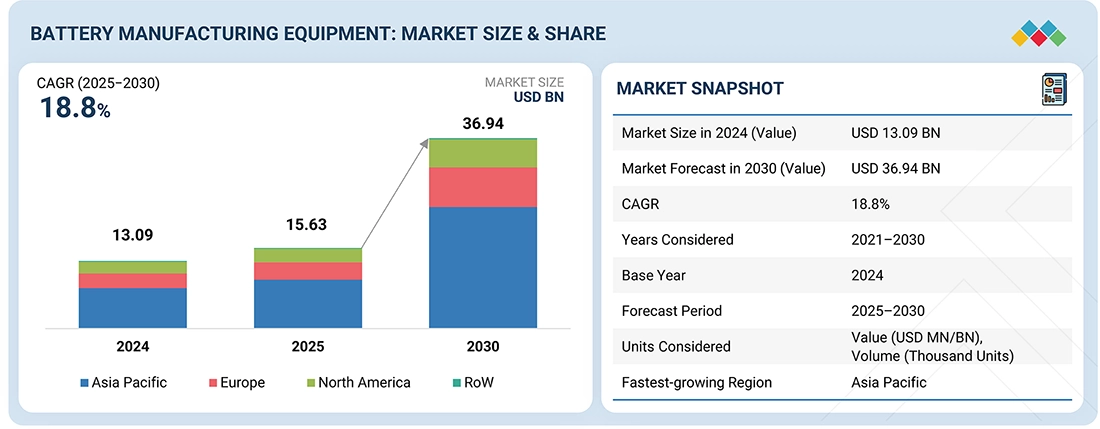
Market Growth Drivers and Projections
Rising electric vehicle adoption fuels the need for next generation manufacturing technologies, with global gigafactory expansions accelerating investments in precision machinery. The automotive segment leads applications, poised for the highest CAGR of 20 percent from 2025 to 2030, as EV production ramps up alongside government incentives. Renewable energy integration further propels demand, with large scale storage systems requiring advanced electrode coating, cell assembly, and formation equipment to stabilize grids and support solar and wind power.
Dominant Segments and Regional Leadership
Formation and testing machines command the largest share at 31.6 percent in 2024, essential for validating battery safety, performance, and reliability in high volume lithium ion production. Lithium iron phosphate or LFP batteries dominate by type, favored for safety, long cycle life, and cost savings over nickel based chemistries, driving specialized equipment for scalable manufacturing. Asia Pacific holds 59.9 percent market share, spearheaded by China, Japan, South Korea, and India through gigafactories, policy support, and established supply chains, positioning it as the fastest growing region.
Key Players and Recent Innovations
Leading innovators include Hitachi High Tech Corporation, Dürr Group, Lead Intelligent Equipment, ANDRITZ Schuler, Bühler, and Yinghe Technology, excelling in automation and process optimization. Recent breakthroughs highlight progress: Dürrs October 2025 XCellify DC dry coating system cuts energy use by 70 percent and space by 65 percent, while Leads PHM System achieves 85 percent fault prediction accuracy to minimize downtime. Yinghes ultra high speed stacking machine delivers 99.5 percent yield at 0.1 seconds per piece, enhancing gigafactory throughput.
Challenges and Future Opportunities
Capital intensive setups pose barriers for smaller players, alongside rapid shifts in chemistries like LFP and solid state demanding flexible upgrades. Yet, opportunities abound in AI integration, digital twins, and solvent recovery for sustainable operations, as end users prioritize yield and throughput. With EV electrification and clean energy mandates, this market promises pivotal roles in global sustainability, urging stakeholders to invest in cutting edge equipment for competitive edge.
Ask for Sample Report:
https://www.marketsandmarkets.com/requestsampleNew.asp?id=168163488
Top key players in the battery manufacturing equipment market include Hitachi High-Tech Corporation, Dürr Group, Lead Intelligent Equipment Co., Ltd., ANDRITZ Schuler GmbH, Bühler, and Yinghe Technology Co., Ltd.
Specific numerical market shares for these companies are not publicly detailed in available reports, as the industry is fragmented with many players and data often proprietary or aggregated.
Lead Intelligent Equipment is positioned as a market leader (Star) due to its comprehensive portfolio in electrode processing, coating, stacking, and AI-driven systems.
Hitachi High-Tech, Dürr, and Yinghe are recognized as star players for advanced automation and partnerships.
The overall market reached USD 13.09 billion in 2024, led by Asia Pacific firms amid gigafactory expansions.