
The Crystal Oscillator Market continues to expand as precise timing solutions become increasingly critical across telecommunications, automotive electronics, industrial automation, aerospace, medical devices, and consumer electronics. Crystal oscillators serve as the heartbeat of electronic systems, generating stable clock signals that synchronize processors, communication modules, and data transmission networks. As digital transformation accelerates and connectivity becomes ubiquitous, the demand for high-accuracy, low-jitter frequency control devices is rising steadily.
The evolution of next-generation communication technologies such as 5G, satellite communication, cloud computing, and edge processing has placed greater emphasis on synchronization accuracy and signal integrity. At the same time, trends such as miniaturization, energy efficiency, and higher integration density are reshaping oscillator design and packaging strategies.
Mounting Scheme Dynamics: Transition Toward Surface Mount Dominance
The mounting scheme plays a significant role in determining product adoption across end-use industries. Surface Mount Devices (SMD) have emerged as the dominant configuration due to their compact footprint, compatibility with automated assembly processes, and improved electrical performance in high-density circuit boards. The growing use of multilayer PCBs in smartphones, wearables, automotive control units, and IoT modules has reinforced the demand for SMD crystal oscillators. Their reduced parasitic inductance and enhanced resistance to mechanical stress make them particularly suitable for modern compact electronics.
Through-hole crystal oscillators, while gradually declining in mainstream consumer applications, maintain importance in industrial, military, and aerospace systems where durability and mechanical robustness are prioritized. These configurations are often preferred in legacy systems and environments that require easier manual servicing or enhanced physical anchoring under vibration-intensive conditions.
Download PDF Brochure @ https://www.marketsandmarkets.com/pdfdownloadNew.asp?id=943
Circuitry Advancements: From Basic Oscillators to Precision-Controlled Systems
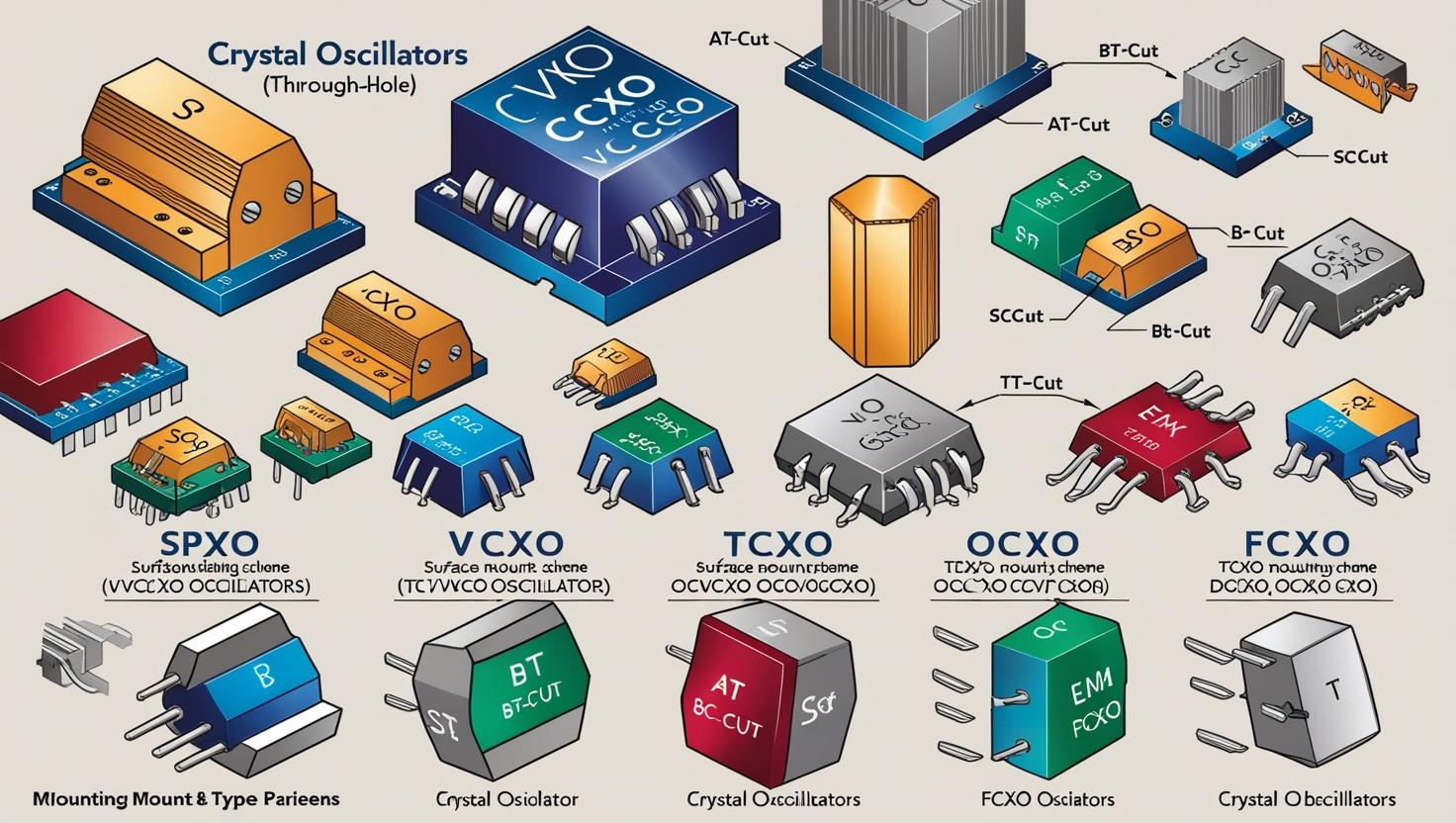
The circuitry configuration significantly influences oscillator stability, accuracy, and cost structure. Simple Packaged Crystal Oscillators (SPXO) represent the most fundamental type, offering reliable frequency output at a cost-effective price point. These are widely used in general-purpose electronics where moderate stability is sufficient.
As application complexity increases, Voltage-Controlled Crystal Oscillators (VCXO) and their advanced variants such as Temperature-Compensated VCXO (TCVCXO) and Oven-Controlled VCXO (OCVCXO) play a critical role in communication infrastructure. These devices enable frequency tuning through control voltage, making them essential for synchronization in telecom base stations, networking systems, and broadcasting equipment. The growing demand for accurate timing in 5G deployments and fiber-optic networks has further strengthened the VCXO segment.
Temperature-Compensated Crystal Oscillators (TCXO) are designed to maintain stable output across wide temperature ranges. They are widely deployed in GPS systems, wireless communication modules, and automotive telematics, where environmental fluctuations can impact signal stability. The increasing adoption of connected vehicles and IoT devices has accelerated TCXO demand due to their balance between precision and power efficiency.
Oven-Controlled Crystal Oscillators (OCXO), including advanced forms such as Double Oven-Controlled Crystal Oscillators (DOCXO) and Energy-Minimized OCXO (EMXO), represent the highest tier of precision timing solutions. By maintaining the crystal at a constant elevated temperature, OCXOs deliver exceptional frequency stability and minimal phase noise. These are extensively used in aerospace navigation systems, defense communication equipment, data centers, and high-frequency trading networks, where even microsecond-level deviations can be critical.
Frequency-Controlled Crystal Oscillators (FCXO) are factory-calibrated to meet strict output specifications and are commonly used in systems that must comply with rigid communication standards. Their growing use in regulated telecom and industrial environments supports steady segment growth.
Crystal Cut Technology and Its Influence on Performance
The crystal cut determines how the quartz crystal vibrates and directly impacts frequency behavior, temperature stability, and long-term performance. AT-cut crystals dominate the market due to their reliable temperature characteristics and suitability for frequencies above 1 MHz. Their cost-effectiveness and versatility make them the preferred choice for consumer electronics, industrial control systems, and communication devices.
BT-cut crystals are typically used for lower-frequency applications and offer specific performance characteristics suited to industrial timing requirements. While less temperature-stable compared to AT-cut, they remain relevant in certain specialized use cases.
SC-cut crystals provide superior frequency stability and reduced sensitivity to environmental factors such as temperature and mechanical stress. These characteristics make SC-cut oscillators ideal for aerospace, satellite communication, and advanced telecom infrastructure, where long-term stability and low aging rates are essential. As high-precision applications expand, demand for SC-cut solutions is expected to grow in niche yet high-value segments.
Impact of Telecom, Automotive, and Data Infrastructure Growth
Telecommunications infrastructure continues to be one of the strongest growth drivers for the crystal oscillator market. The rollout of 5G networks requires tight synchronization across distributed network architectures, increasing the adoption of high-stability VCXO and OCXO devices. Similarly, cloud computing and hyperscale data centers depend on precise clock management to maintain data integrity and minimize latency.
In the automotive sector, the integration of advanced driver assistance systems (ADAS), infotainment platforms, electric vehicle power electronics, and vehicle-to-everything communication systems has elevated the need for temperature-stable oscillators. Automotive-grade TCXO and compact SMD solutions are increasingly in demand as vehicles become more electronically sophisticated.
Industrial automation and Industry 4.0 initiatives are also contributing to growth, as synchronized control systems and connected machinery require dependable timing components. Medical electronics and aerospace systems further support demand for high-reliability oscillator variants.
Competitive Landscape and Technological Innovation
The competitive environment in the crystal oscillator market is characterized by continuous innovation in miniaturization, thermal stability, and power optimization. Manufacturers are investing in advanced packaging technologies, improved phase noise reduction, and hybrid integration approaches. The emergence of MEMS-based timing solutions introduces competitive dynamics, yet quartz crystal oscillators continue to maintain a strong market position due to their superior long-term stability and proven reliability.
Supply chain resilience and regional manufacturing expansion have also become strategic priorities, particularly following global semiconductor disruptions. Companies are focusing on capacity enhancement and technological differentiation to secure long-term contracts in telecom, automotive, and aerospace sectors.
Future Outlook
Looking ahead, the crystal oscillator market is expected to witness sustained growth driven by 5G expansion, IoT proliferation, AI-enabled data processing, and automotive electrification. The shift toward smaller, more power-efficient, and thermally stable oscillators will continue to shape product development strategies. Advanced circuitry types such as OCXO and TCXO are projected to gain further traction in high-performance applications, while surface mount configurations will remain dominant due to ongoing miniaturization trends.
As electronic systems demand ever-greater synchronization precision and operational reliability, crystal oscillators will continue to serve as a fundamental enabling technology powering the global digital infrastructure.
Frequently Asked Questions (FAQ): Crystal Oscillator Market
What is a crystal oscillator and why is it important?
A crystal oscillator is an electronic component that uses the mechanical resonance of a quartz crystal to generate a stable frequency signal. It acts as a timing reference in electronic circuits, ensuring accurate synchronization of processors, communication modules, and data transmission systems. Without crystal oscillators, modern devices such as smartphones, telecom equipment, vehicles, and industrial systems would not maintain reliable clock accuracy.
What are the main types of crystal oscillators available in the market?
The primary types include Simple Packaged Crystal Oscillators (SPXO), Voltage-Controlled Crystal Oscillators (VCXO), Temperature-Compensated Crystal Oscillators (TCXO), Oven-Controlled Crystal Oscillators (OCXO), and Frequency-Controlled Crystal Oscillators (FCXO). Each type differs in terms of stability, temperature performance, adjustability, and intended application. SPXO is typically used for general-purpose applications, while OCXO and TCXO are designed for high-precision and temperature-sensitive environments.
What is the difference between Surface Mount and Through-Hole crystal oscillators?
Surface Mount Devices (SMD) are compact oscillators designed for automated PCB assembly and high-density electronics. They dominate modern consumer and automotive applications due to their smaller size and better electrical performance. Through-hole oscillators are larger and mounted using leads inserted into PCB holes. They are often preferred in industrial, aerospace, and legacy systems where mechanical strength and durability are essential.
How does crystal cut affect oscillator performance?
Crystal cut determines how the quartz crystal vibrates and directly impacts frequency stability and temperature behavior. AT-cut crystals are widely used due to their good temperature stability and cost efficiency. BT-cut crystals are suitable for specific lower-frequency applications. SC-cut crystals offer superior stability and minimal frequency drift, making them ideal for aerospace, telecom infrastructure, and precision instrumentation.
Which industries drive the growth of the crystal oscillator market?
Telecommunications, automotive electronics, consumer electronics, aerospace and defense, data centers, and industrial automation are the primary growth drivers. The expansion of 5G networks, connected vehicles, IoT ecosystems, and cloud computing infrastructure significantly increases demand for precise timing components.