
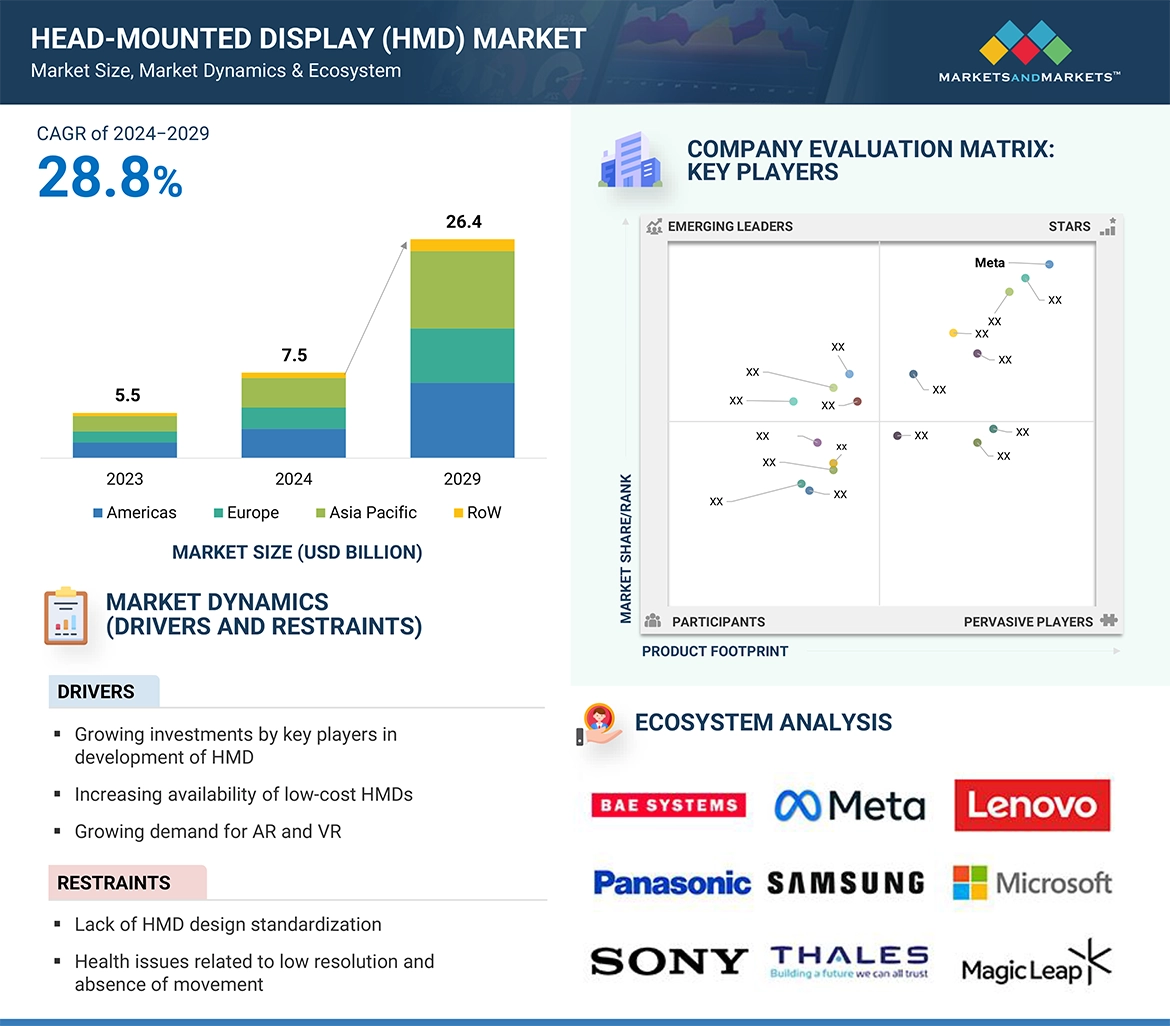
The Head Mounted Display (HMD) Market is set to experience strong growth through 2029, driven by accelerating innovation and increasing investments in immersive technologies. As augmented reality, virtual reality, and mixed reality applications mature, HMD devices are evolving from niche products into mainstream tools for both consumer and enterprise use. The market outlook reflects a convergence of advanced hardware, intelligent software, and high-speed connectivity, all contributing to a more immersive and accessible user experience. This transformation is positioning the HMD market as a key pillar in the broader digital and spatial computing ecosystem.
Innovation in display and optical technologies is a major factor shaping the future of the HMD market. Advancements in high-resolution displays, microOLED and microLED panels, and improved lens systems are enhancing visual clarity and realism. These improvements are reducing issues such as motion blur and screen door effects, creating more seamless immersive environments. At the same time, innovations in form factor, including lightweight materials and compact designs, are improving wearability and comfort. These developments are making HMDs more suitable for extended use, which is critical for enterprise applications and long-duration consumer experiences.
Download PDF Brochure @ https://www.marketsandmarkets.com/pdfdownloadNew.asp?id=729
The integration of artificial intelligence and spatial computing is further accelerating innovation in HMD systems. AI is enabling real-time data processing, object recognition, and personalized user experiences, while spatial computing allows devices to understand and interact with physical environments. This combination is transforming HMDs into intelligent platforms capable of supporting complex applications such as remote collaboration, industrial maintenance, and advanced simulations. As these technologies continue to evolve, they are expected to unlock new use cases and expand the market’s potential.
Investment trends in the HMD market are increasingly focused on enterprise adoption. Organizations across industries are investing in immersive technologies to enhance productivity, reduce costs, and improve training outcomes. HMDs are being deployed for applications such as workforce training, virtual prototyping, remote assistance, and data visualization. These use cases offer tangible benefits, including reduced operational risks and improved efficiency, making them attractive for long-term investment. As digital transformation initiatives continue to gain momentum, enterprise spending on HMD solutions is expected to rise significantly.
Inquiry Before Buying @ https://www.marketsandmarkets.com/Enquiry_Before_BuyingNew.asp?id=729
The consumer segment remains an important driver of investment, particularly in gaming and entertainment. Virtual reality gaming continues to attract significant funding, with companies focusing on both hardware development and content creation. The emergence of social VR platforms and interactive digital experiences is expanding the role of HMDs beyond traditional gaming. Investments in content ecosystems, including developer tools and platforms, are enhancing the overall value proposition of HMD devices. As affordability improves and content availability increases, consumer adoption is expected to grow steadily.
The development of the metaverse is another major factor influencing investment in the HMD market. Companies are investing heavily in creating immersive digital environments where users can interact, work, and socialize. HMDs serve as the primary interface for accessing these virtual worlds, driving demand for advanced devices. The growth of the metaverse is encouraging investments in both hardware and software, as well as in supporting infrastructure such as cloud computing and network connectivity. This trend is expected to play a significant role in shaping the market’s long-term growth.
Connectivity advancements, particularly the expansion of 5G networks, are also supporting innovation and investment in the HMD market. High-speed, low-latency connectivity enables real-time streaming of high-quality content and supports cloud-based processing. This reduces the need for powerful on-device hardware, allowing for lighter and more efficient HMD designs. Investments in network infrastructure are enabling more seamless and responsive experiences, further enhancing the appeal of HMD systems across applications.
View detailed Table of Content here – https://www.marketsandmarkets.com/Market-Reports/head-mounted-display-hmd-market-729.html
Regional investment patterns are contributing to the global expansion of the HMD market. North America and Europe continue to lead in terms of technological innovation and early adoption, supported by strong research and development activities. Meanwhile, Asia-Pacific is emerging as a high-growth region, driven by increasing investments in technology, manufacturing capabilities, and a growing consumer base. Countries such as China, Japan, and South Korea are playing a key role in driving both innovation and adoption, creating significant opportunities for market players.
Despite the positive outlook, the HMD market faces challenges that could influence its growth. High device costs, content limitations, and user comfort issues remain barriers to widespread adoption. However, ongoing innovation and increasing competition are expected to address these challenges over time. As technologies mature and economies of scale are achieved, HMD devices are likely to become more affordable and accessible to a broader audience.
The HMD market outlook for 2029 is defined by strong innovation and investment trends. Advancements in display technologies, AI integration, and connectivity are enhancing device capabilities and expanding application areas. Increasing investments from both enterprise and consumer segments, along with the development of the metaverse, are driving market growth. As challenges are gradually addressed, the HMD market is expected to experience sustained expansion, playing a central role in the future of immersive and interactive digital experiences.