
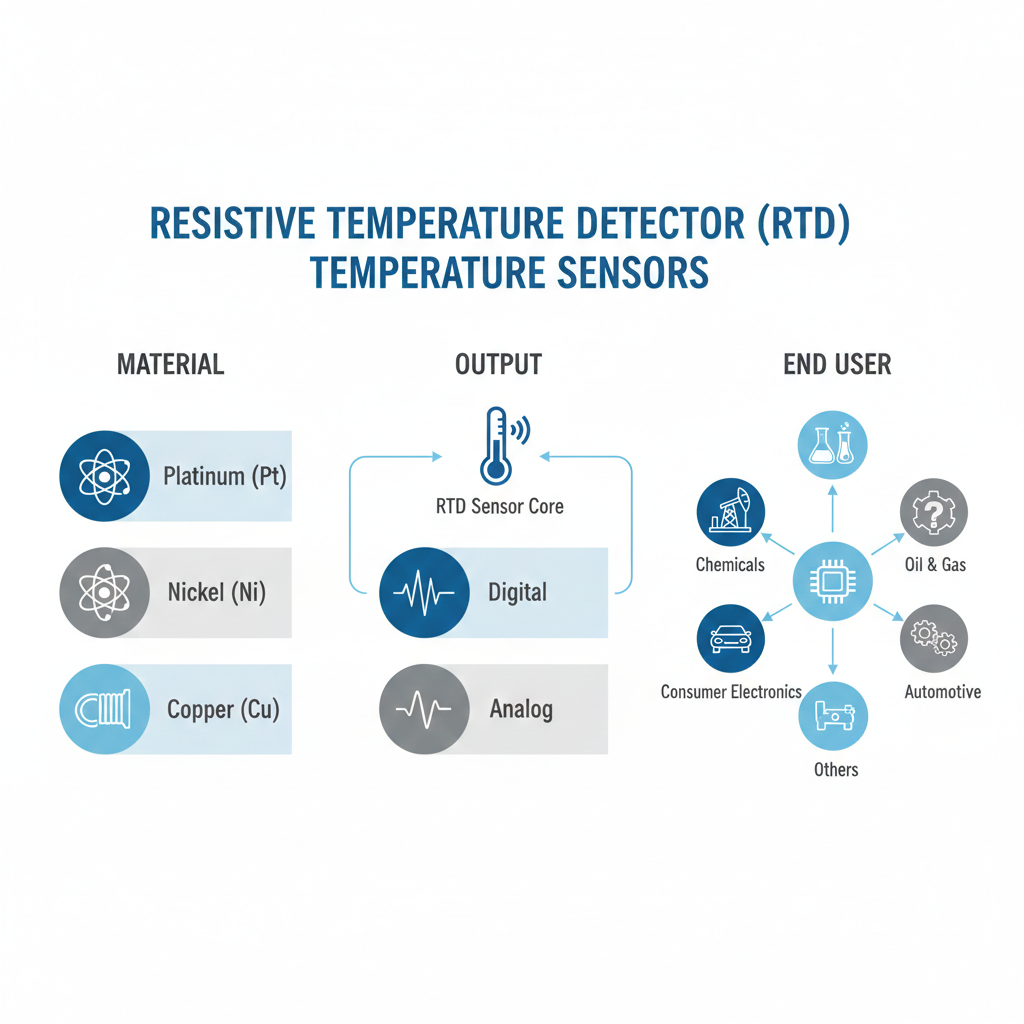
The future of Resistive Temperature Detector (RTD) Temperature Sensor Market looks highly promising, driven by rapid industrialization, increasing automation, and the growing demand for precision temperature measurement across industries. RTD sensors, known for their accuracy, stability, and wide temperature range, are essential components in sectors such as energy, healthcare, automotive, and industrial manufacturing.
Key Trends Shaping the Future of RTD Temperature Sensor Market
Several trends are influencing the future of Resistive Temperature Detector (RTD) Temperature Sensor Market:
Industrial Automation and Industry 4.0:
The adoption of smart factories and automated processes is driving demand for high-precision RTD sensors. Accurate temperature monitoring ensures optimal performance and safety in automated production lines.
Integration with IoT and Smart Devices:
The integration of RTD sensors with IoT platforms allows real-time temperature monitoring and predictive maintenance. This trend is expected to significantly boost the future of RTD Temperature Sensor Market as industries seek smarter, connected solutions.
Download PDF Brochure @ https://www.marketsandmarkets.com/pdfdownloadNew.asp?id=167152360
Miniaturization and Enhanced Accuracy:
Advances in sensor technology are enabling smaller, more precise RTDs that can operate reliably under extreme conditions. These innovations are crucial for applications in aerospace, healthcare, and high-tech manufacturing.
Energy Efficiency and Environmental Monitoring:
As industries focus on energy optimization and environmental compliance, RTD sensors are increasingly used for monitoring critical parameters in HVAC systems, renewable energy plants, and industrial processes.
Opportunities in the Future of RTD Temperature Sensor Market
The future of Resistive Temperature Detector (RTD) Temperature Sensor Market presents multiple growth opportunities:
Healthcare Applications: RTDs are increasingly used in medical equipment for patient monitoring and laboratory analysis, offering precise and reliable measurements.
Automotive Industry: With the rise of electric vehicles and autonomous systems, RTD sensors help manage battery systems and thermal control.
Renewable Energy Sector: RTDs are crucial for monitoring solar panels, wind turbines, and energy storage systems to ensure efficiency and longevity.
Global Expansion: Emerging economies in Asia-Pacific and the Middle East are investing in industrial infrastructure, boosting the adoption of RTD sensors.
Market Forecasts
The future of Resistive Temperature Detector (RTD) Temperature Sensor Market is expected to witness robust growth over the next decade. Analysts project steady expansion due to:
- Rising demand for high-precision temperature measurement across industries
- Increasing investment in smart manufacturing and automation
- Technological advancements in RTD design, including wireless connectivity and AI integration
- North America and Europe currently lead the market in technology development, while Asia-Pacific is projected to be the fastest-growing region due to industrialization and urbanization.
The future of Resistive Temperature Detector (RTD) Temperature Sensor Market is poised for significant growth, driven by innovation, industrial automation, and expanding applications across multiple sectors. Companies and investors focusing on precision temperature measurement and smart sensor technologies are well-positioned to capitalize on these emerging opportunities.
Investor FAQ
1. Why should investors be interested in the future of RTD temperature sensor market?
The future of Resistive Temperature Detector (RTD) Temperature Sensor Market offers high growth potential due to rising industrial automation, energy efficiency initiatives, and increasing adoption across automotive, healthcare, and smart manufacturing sectors. Investors can benefit from early exposure to innovative sensor technologies.
2. Which industries are driving the growth of RTD temperature sensors?
Key industries fueling the future of RTD temperature sensor market include:
-
Industrial automation and smart factories
-
Automotive (EVs, battery management, autonomous systems)
-
Healthcare and medical devices
-
Energy and renewable energy (solar, wind, power plants)
-
Aerospace and defense
3. What trends should investors watch in this market?
Investors should monitor trends such as:
-
IoT-enabled and smart RTD sensors
-
Miniaturization and higher accuracy sensors
-
Integration with AI and predictive maintenance solutions
-
Adoption in emerging markets like Asia-Pacific and the Middle East
4. Which regions show the most potential for investment?
-
North America & Europe: Technology leaders and early adopters with high-value industrial applications
-
Asia-Pacific: Fastest-growing market due to industrialization, urbanization, and expanding manufacturing sectors
5. What are the main opportunities for investors?
-
Investing in companies producing high-precision RTD sensors
-
Supporting startups innovating in wireless and IoT-connected RTDs
-
Participating in industries adopting smart manufacturing and energy-efficient solutions