
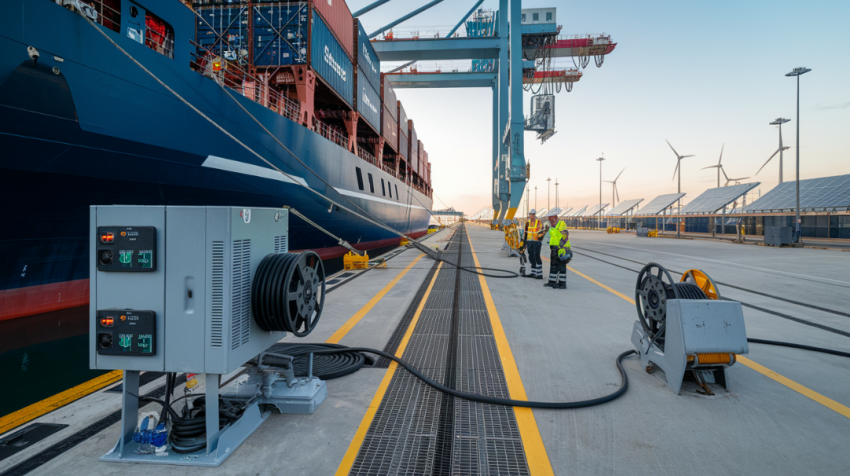
The US Shore Sower Market size is projected to grow from USD 0.53 billion in 2025 to USD 0.96 billion by 2030 at a CAGR of 12.6% during the forecast period. A major factor driving the US shore power market is expanding federal and state funding for port electrification projects. Programs such as the EPA’s Clean Ports Program and the US Department of Transportation’s Port Infrastructure Development Program provide grants to upgrade terminals with high-voltage shore connections, distribution networks, and related clean equipment. These subsidies help multi-berth, large shore power projects become financially viable more quickly, and by speeding up project timelines, lowering the upfront investment required by ports. Specific funding for individual ports, such as Los Angeles, New York, New Jersey, Galveston, and Miami, has been approved for retrofitting of old berths or integrating shore power into new terminal designs. As more US ports embark on this kind of infrastructure development, shipping lines have greater incentives to equip vessels with matching onboard systems, serving to amplify the benefits of a positive feedback loop of adoption throughout the maritime network.
Download PDF Brochure: https://www.marketsandmarkets.com/pdfdownloadNew.asp?id=184499771
Frequency converters segment is expected to grow in the US shore power market from 2025 to 2030.
The frequency converters segment is projected to grow in the US shore power market, as these systems are crucial in creating compatibility between shoreside electrical grids and the varied power needs of vessels. Most of the US ports operate on a 60 Hz grid. In contrast, a large number of international vessels, particularly cruise ships, cargo vessels, and container ships, operate with a 50 Hz system onboard. Frequency converters fill this gap to guarantee safe, stable, and efficient power transfer at berth. As US ports continue to expand shore power infrastructure amid CARB regulations and federal clean-energy mandates, the need for advanced converters with large-capacity, high-voltage handling ability is escalating. Furthermore, major ports’ modernization initiatives are becoming characterized by the adoption of modular and digital converter systems that would ensure energy efficiency and grid stability. Thus, with the increased adoption of standardized high-voltage shore connections and traffic from global fleets, frequency converters have been an indispensable entity for the dominant share in the US market.
Shipside segment is likely to witness the highest CAGR during the forecast period.
The shipside segment is expected to witness the highest CAGR in the US shore power market during the forecast period, due to the increased adoption of onboard systems by vessel operators, enabling the connection to port electrification infrastructure. In line with the expansion of the CARB’s At-Berth Regulation and similar emission-reduction initiatives, shipping lines calling at US ports are forced to upgrade vessels with onboard switchgear, connectors, and compatible electrical interfaces. Cruise lines, container carriers, and Ro-Ro operators increasingly invest in shipside retrofits to avoid penalties and restricted operations. As more US ports deploy high-voltage shore connection systems, vessel-side upgrades are becoming crucial for ensuring compatibility, safety, and standardized power transfer. This is enabling rapid growth in the shipside segment, where port infrastructure expansion increasingly aligns with vessel readiness.
Request Sample Pages: https://www.marketsandmarkets.com/requestsampleNew.asp?id=182033223
The US shore power market is dominated by major players that have a wide regional presence. Key players in the US shore power market include General Electric Company (US), Siemens (Germany), Schneider Electric (France), ABB (Switzerland), Cavotec SA (Switzerland), Eaton (Ireland), and Wartsila (Finland).
A major factor creating a growth opportunity for players in the US shore power market is the strong policy-backed funding, combined with strict state-level emission regulations. States such as California mandate the use of shore power for vessels at berth to reduce air pollution in port cities, creating guaranteed demand. In parallel, substantial federal funding under programs like the Bipartisan Infrastructure Law and the Inflation Reduction Act is supporting port electrification projects. This combination of regulatory certainty and financial incentives reduces investment risk, accelerates retrofits at existing ports, and attracts private capital, making the US a highly attractive market for shore power technology providers.