
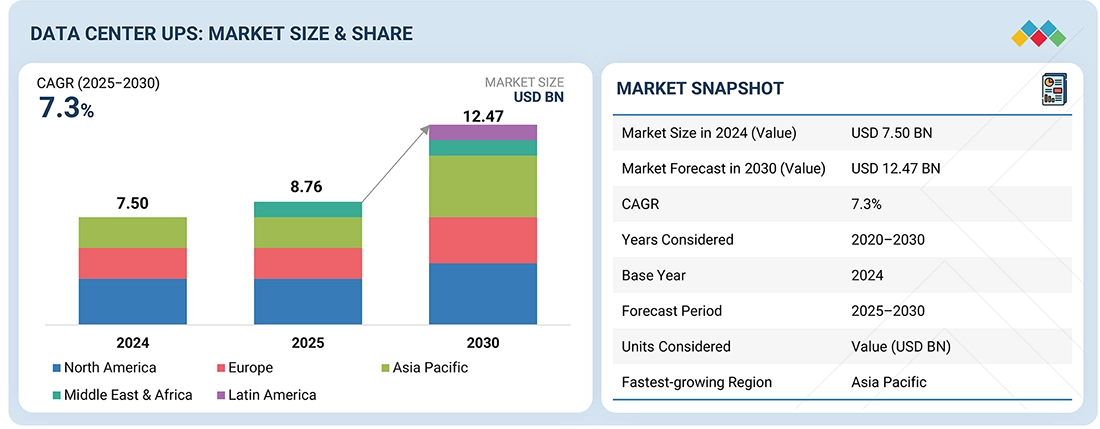
According to a research report “Data Center UPS Market by Capacity (201-500 kVA, 501-1,000 kVA, above 2,000 kVA), Phase Type (Single-phase, Three-phase), Configuration Type (Online Double Conversion, Line-interactive, Offline), Design Type (Modular, Monolithic) – Global Forecast to 2030″ published by MarketsandMarkets, the data center UPS market is expanding rapidly, with its market size anticipated to rise from USD 8.76 billion in 2025 to USD 12.47 billion by 2030, registering a CAGR of 7.3%.
Data center UPS systems have redefined power resilience by integrating advancements such as modular architectures, lithium-ion batteries, and intelligent monitoring, ensuring uninterrupted operations and energy efficiency at scale. These innovations deliver improved power usage effectiveness, reduced energy losses, and compliance with evolving efficiency standards, driving adoption across hyperscale, colocation, and enterprise facilities. By embedding high-efficiency power conversion technologies and predictive analytics into UPS infrastructure, operators achieve greater reliability, optimized load management, and lower operational costs for high-density workloads. This critical backbone supports AI-driven computing, cloud services, and continuous digital operations with enhanced stability while minimizing power waste and environmental impact.
Browse 250 market data Tables and 220 Figures spread through 300 Pages and in-depth TOC on “Data Center UPS Market”
Download PDF Brochure @ https://www.marketsandmarkets.com/pdfdownloadNew.asp?id=182806703
By configuration type, online double conversion segment to account for largest market share during forecast period
The evolution of double online conversion UPS systems is reshaping data center power infrastructure as facilities prioritize ultra-reliable, energy-efficient designs. The latest systems integrate advanced inverter control, modular architecture, and high-efficiency operating modes to reduce total energy losses without compromising protection. Vendors are investing in next-generation semiconductor materials, such as silicon carbide and gallium nitride, to improve switching efficiency and thermal performance. In February 2025, Riello UPS launched its Multi Power2 MP2 300 and MP2 600 series, achieving 98.1% efficiency in double conversion mode. ABB had introduced its HiPerGuard medium-voltage UPS in September 2023, delivering 98% efficiency at voltages up to 24 kV. These developments highlight how double conversion designs now merge reliability with sustainability, supporting AI, hyperscale, and HPC workloads that require consistent, disturbance-free power. For vendors and solution providers, the competitive edge lies in developing double conversion systems that blend efficiency with digital intelligence. Integrating advanced monitoring, adaptive load sharing, and AI-based fault prediction will enable data centers to achieve lower operational costs and reduced carbon impact. Vendors that emphasize serviceability, modular expansion, and regulatory alignment will benefit most as customers seek scalable systems that sustain uptime while meeting energy compliance targets. The market opportunity is moving from power protection alone to holistic energy-aware resilience.
By design type, modular segment to register significant growth rate during forecast period
The modular UPS segment is expected to exhibit a high CAGR in the data center UPS market. Modular UPS systems represent a distinct class of data center power protection solutions built from scalable, self-contained modules rather than a monolithic block. Each module typically includes its own inverter, rectifier, and control electronics. In an active modular architecture, the system aggregates module outputs to supply critical loads, enabling direct redundancy and hot-swappable replacement of individual modules without interrupting operation. This design supports pay-as-you-grow deployment, aligns with double conversion online topologies, and facilitates granular scaling in response to changing demand. Because modules can be added or maintained in an isolated fashion, modular UPS suites dramatically reduce single points of failure and aid operational continuity. Adoption of modular UPS is being reinforced by vendor innovation and strategic partnerships. In December 2024, Schneider Electric unveiled its Galaxy VXL modular UPS series, delivering 500 to 1,250 kW in a compact footprint while achieving up to 97.5% efficiency in double conversion mode. This signals that modular conversion is becoming viable even in high-density and high-load environments. For solution providers, modular UPS offers an opportunity to differentiate through tailored scaling, dynamic redundancy, and lifecycle services. By embedding intelligence, predictive maintenance, and modular topologies into their portfolios, emerging vendors can capture share in greenfield and retrofit deals. The path forward lies in aligning modular UPS offerings with evolving client demands for availability, flexibility, and total cost control in dense, AI-centric, and mission-critical data centers.
North America to account for largest market share during forecast period
The North America data center UPS market, encompassing the US and Canada, is expanding rapidly as hyperscale and AI-driven workloads accelerate power density and uptime requirements. CBRE reported that primary-market inventory reached 8,155 MW in H1 2025, up 43% year-over-year, with vacancy dropping to a record low of 1.6% amid strong preleasing. Rising pricing for 10 MW-plus leases in core hubs is prompting operators to adopt modular, high-efficiency UPS architectures optimized for 40–100 kW-per-rack environments and rapid scalability. In the US, Northern Virginia leads with 2,078 MW under construction and 538 MW of net absorption. Meanwhile, utilities are reshaping power economics through new tariffs, grid flexibility programs, and regulations, such as Texas SB 6 and PJM curtailment mandates, which emphasize on-site or backup generation. UPS systems are evolving from traditional standby functions to grid-interactive energy assets, increasingly integrated with battery energy storage to support grid stability and AI-heavy campus operations. Supplier investment is intensifying, with Schneider Electric committing over USD 700 million to expand its US production capacity. In Canada, Ontario plans to build 16 new data centers over the next decade, representing approximately 13% of the province’s projected power demand, while Hydro-Québec anticipates an additional 4.1 TWh of data center load by 2032. Québec currently has nearly 500 MW under construction, while Alberta lists over 10 GW of proposed capacity. The AWS Canada West (Calgary) region is driving new hyperscale activity, collectively boosting demand for scalable, high-efficiency UPS systems across the region’s clean energy, cold climate data center landscape.
Request Sample Pages @ https://www.marketsandmarkets.com/requestsampleNew.asp?id=182806703
The major players in the data center UPS market include Schneider Electric (France), Vertiv (US), Eaton (Ireland), Huawei (China), ABB (Switzerland), Delta Electronics (Taiwan), Legrand (France), Hitachi (Japan), and Toshiba (Japan).
About MarketsandMarkets™
MarketsandMarkets™ has been recently recognized as one of America’s best management consulting firms by Forbes, as per their recent report.
Founded in 2009, MarketsandMarkets™ recognized uncharted business potentials within disruptive trends, forecasting a surge of $25 trillion in new B2B revenues by 2030. In our 16-year journey, we’ve collaborated with over 10,000 companies, generating $140+ billion in revenue impact. From a market research publisher, we’ve transformed into a growth-enabling leader, backed by a 1500+ strong team.
Contact:
Mr. Rohan Salgarkar
MarketsandMarkets™ INC.
1615 South Congress Ave.
Suite 103, Delray Beach, FL 33445
USA: 1-888-600-6441
UK +44-800-368-9399