
The global orthopedic devices market is entering a new era of accelerated innovation and clinical transformation. Valued at USD 51.6 billion in 2024, the market is projected to reach USD 68.5 billion by 2030, growing at a steady CAGR of 4.8%. Rising musculoskeletal disorders, aging populations, advanced biomaterials, and the rapid adoption of digital surgery platforms continue to drive this evolution.
As minimally invasive procedures, personalized implants, and smart orthopedic technologies gain global traction, the orthopedic landscape is shifting toward improved outcomes, faster recovery, and more accessible care.
Why the Market Is Growing: Key Catalysts
- Rising Musculoskeletal Disorder Burden
Global prevalence of arthritis, osteoporosis, spinal disorders, and sports injuries continues to surge—especially among the aging population. This rising patient pool is fueling demand for joint reconstruction, trauma fixation, and orthopedic support devices.
- Breakthroughs in Implant Materials & Design
The industry is transitioning from traditional metal implants to bioresorbable materials, porous titanium, and hybrid polymer-ceramic systems. These innovations improve osseointegration, reduce revision rates, and provide better biomechanical performance.
- From Conventional Surgery to Robotics & Smart Systems
Robotic-assisted platforms, navigation-guided surgery, and AI-based pre-operative planning are now central to orthopedic care. Smart implants with sensor and IoT integration allow remote monitoring and data-driven postoperative insights.
- Rise of Minimally Invasive & Outpatient Procedures
Ambulatory surgical centers (ASCs) and trauma units are becoming major growth hubs, driven by shorter recovery times, lower costs, and enhanced patient convenience.
Market Snapshot: Key Takeaways
- North America holds 43.1% of global revenue (2024), driven by strong reimbursement and high adoption of advanced technologies.
- Orthopedic replacement devices will grow at the highest CAGR of 5.9%.
- Foot & ankle procedures expected to expand fastest from 2025–2030.
- Fracture treatment & recovery dominates supplement form-based segmentation.
- Ambulatory care centers and trauma units remain the fastest-growing end-use spaces.
Trends Redefining Orthopedic Care
➡ Digital Surgery & Smart Implants
Hospitals are increasingly integrating:
- Patient-specific 3D models
- Digital surgery consoles
- Sensor-enabled implants
- Connected postoperative care ecosystems
These systems reduce intraoperative errors, improve patient outcomes, and support value-based care models.
➡ Outcome-Based OEM Services
Manufacturers are shifting from device-only offerings to:
- Remote monitoring
- Predictive analytics
- Lifecycle implant management
➡ Sustainability Becomes a Differentiator
Global players are adopting:
- Recyclable implant materials
- Low-energy additive manufacturing
- Eco-friendly packaging
These practices are influencing procurement decisions and regulatory priorities.
Market Dynamics
Drivers
- Growing geriatric population
- Rise in orthopedic disorders
- Telemedicine & telesurgery adoption
Restraints
- High surgery & device costs
- Surgical risks and procedural complications
Opportunities
- Rapid growth in orthobiologics
- Expansion of robotics & 3D printing in orthopedics
Challenges
- Shortage of skilled orthopedic surgeons
- Increasing pricing pressure and market competition
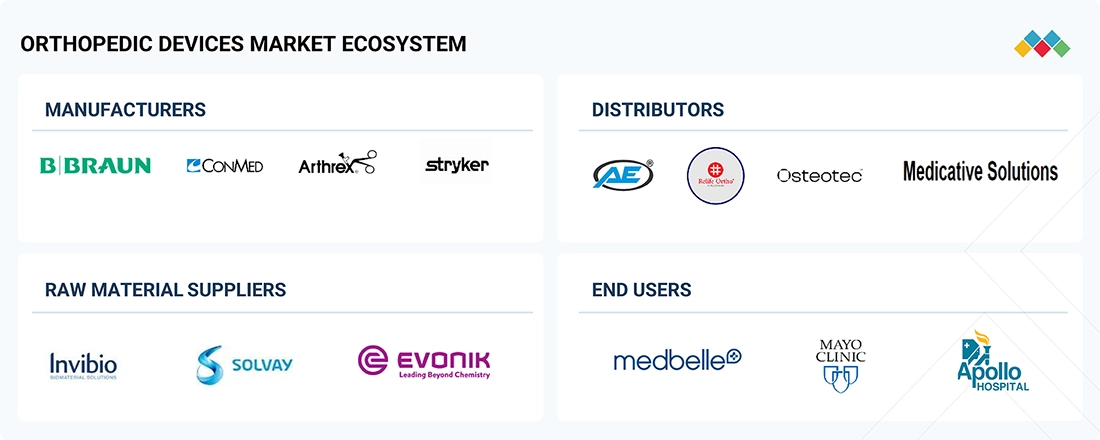
Ecosystem Overview
The orthopedic devices ecosystem includes:
- Implant manufacturers
- Material and biomaterial suppliers
- Robotics and digital surgery solution providers
- Hospitals, ASCs & distributors
- Regulatory authorities
- AI and digital health innovators
Emerging technologies include:
- AR-guided surgery
- Sensor-integrated prosthetics
- AI-driven surgical planning
- Bio-ceramic & nanostructured implants
Collaboration between OEMs and software companies is intensifying, accelerating the shift toward data-driven orthopedics.
Regional Outlook: Asia Pacific Leads the Growth Curve
While North America dominates in revenue share, Asia Pacific is the fastest-growing region due to:
- Expanding medical tourism
- Rapid infrastructure upgrades
- Increasing government investments
- Rising middle-class healthcare spending
- Adoption of robotic surgery programs
India, China, and South Korea are emerging as regional innovation and manufacturing hubs.
Competitive Landscape & Evaluation Matrix
The market is consolidated with major players:
- Stryker (US)
- Johnson & Johnson MedTech (US)
- Zimmer Biomet (US)
- Smith+Nephew (UK)
- B. Braun (Germany)
Key competitive priorities include:
- Robotic-assisted surgery platforms
- Digital integration & AI-enabled solutions
- Next-generation biomaterials
- Custom 3D-printed implants
- Smart postoperative monitoring
M&A activity is accelerating as companies expand portfolios and strengthen their presence in high-growth Asia Pacific markets.
Recent Industry Developments
- January 2025: Stryker announces divestiture of its spinal implant business to Viscogliosi Brothers, forming VB Spine, LLC.
- December 2024: Zimmer Biomet receives FDA 510(k) clearance for its OsseoFit Stemless Shoulder System.
- July 2024: Smith+Nephew partners with Healthcare Outcomes Performance Company (HOPCo) to enhance ASC-focused digital analytics and surgical solutions.
Conclusion: A Future Built on Precision, Personalization & Digital Care
The orthopedic device market is transforming rapidly, driven by:
- Advanced biomaterials
- Robotics and AI
- Smart implant ecosystems
- Personalized, patient-specific treatments
As healthcare systems embrace value-based models, device manufacturers that combine clinical innovation with digital capabilities will lead the next phase of competitive differentiation.
The future of orthopedics is personalized, predictive, and precision-driven—ushering in a new era of mobility, recovery, and quality of life for millions worldwide.