
The Europe variable frequency drive market is anticipated to be valued at USD 5.50 billion in 2025 and USD 6.78 billion by 2030, growing at a CAGR of 4.3% during the forecast period. The high pressure of regulatory requirements, the rising cost of energy, and sustainability goals boost the adoption of variable frequency drives (VFDs) in several industries, such as oil & gas, water & wastewater treatment, and data centers. VFDs can help streamline the performance of the motor, minimize electrical costs, and lower operational costs. There has been a strong focus on automating industries and using renewable sources of energy, which involves the use of VFDs in energy portfolios to maximize efficiency. Sophisticated energy management systems (EMS), Internet of Things (IoT)-based predictive maintenance, and demand response systems allow power delivery monitoring, optimization, and flexibility in real-time. The Europe variable frequency drive market is growing due to the high degree of decarbonization under the EU Green Deal, which aims to reduce greenhouse gas emissions by 55% by 2030 and achieve climate neutrality by 2050.
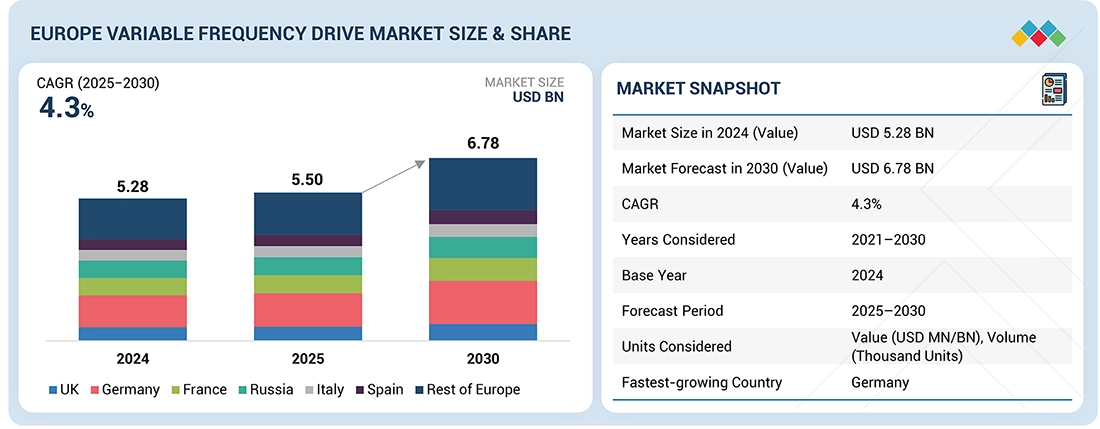
Intensive retrofitting of existing systems in heavy motor-driven manufacturing facilities, commercial buildings, and government infrastructure is being accelerated by increasingly stringent sustainability policies and rising energy costs. These aggressive regulatory mandates and decarbonization targets are making clean power variable frequency drives an essential tool for achieving substantial energy-efficiency gains, reducing operational expenses, and meeting compliance requirements. Companies are adopting high-efficiency variable frequency drives (VFDs) as a substitute for fixed-rate motors to address the requirements of the Ecodesign Directive (ErP), which requires minimum performance standards to be satisfied by electric motors and drives.
Download PDF Brochure @ https://www.marketsandmarkets.com/pdfdownloadNew.asp?id=73726507
Based on type, the AC drives segment is expected to be the fastest-growing in the Europe variable frequency drive market between 2025 and 2030. AC drives are segmented into low-voltage and medium-voltage. Industries and manufacturers are compelled to shift to flexible motor control solutions that guarantee energy optimization and will contribute to the decarbonization of industrial processes. Increasing automation of industries, integration of IoT to predict required maintenance, and expanding the use of smart manufacturing systems further fuel the segmental growth. Furthermore, digital transformation leads to improved monitoring and control of motor performance in various industries. This factor creates an opportunity for players offering AC drives, further influenced by government policies and incentives towards energy efficiency and sustainability.
By end user, power is projected to grow at a commendable rate in the Europe variable frequency drive market during the forecast period. Generation firms and power utilities focus on the implementation of energy-efficient operations with minimum capital outlay and warrant significant savings of energy. Growing utilities use VFDs in power generation plants, transmission, and distribution, in search of operational efficiency, better grid stability, and carbon neutrality objectives. VFD projects are further complicated by the heightened integration of renewable energy sources, i.e., wind turbines and solar inverters. The growing integration of renewable energy sources, such as wind turbines and solar inverters, into the power grid creates challenges related to intermittency, voltage fluctuations, and frequency variations. Clean power VFDs are critical in enabling smoother and more intelligent coupling of these renewable sources with the grid by providing precise control, reactive power support, and harmonic mitigation.
Based on country, the UK is expected to hold a prominent position in the Europe variable frequency drive market, owing to the stringent energy efficiency standards, such as the UK Minimum Energy Efficiency Standards (MEES), and alignment with EU Ecodesign/IE efficiency norms, encouraging industries to adopt VFDs to reduce energy consumption and operating costs. Growing investments in renewable energy, water & wastewater infrastructure, and smart manufacturing further accelerate VFD adoption across pumps, fans, compressors, and conveyors. Key end-use sectors, including oil & gas, food & beverage, pharmaceuticals, and HVAC systems, increasingly leverage VFDs to enhance process control, reliability, and sustainability. Additionally, the UK’s strong focus on net-zero emissions and electrification of industrial processes continues to reinforce demand for VFD solutions.
Request sample pages @ https://www.marketsandmarkets.com/requestsampleNew.asp?id=73726507
The Europe variable frequency drive market is experiencing strong growth, supported by mandatory minimum efficiency standards for motors (aligned with IE3/IE4 levels), increasing retrofitting initiatives in energy-intensive facilities, and supportive policies under the Net Zero Strategy and Carbon Budget Delivery Plans. The government has introduced incentives, such as subsidies, tax reliefs, and funding, through programs such as the Industrial Energy Transformation Fund to promote energy-saving technologies. Organizations such as the Department for Energy Security and Net Zero (DESNZ), along with industry bodies, play a pivotal role in providing guidance, harmonizing standards, and advocating for broader deployment. Additionally, the focus on offshore wind expansion, grid stability, and electrification of heat and transport has driven significant demand for VFDs in pumps, fans, compressors, and renewable energy applications, solidifying its leadership in sustainable motor control solutions within Europe.