
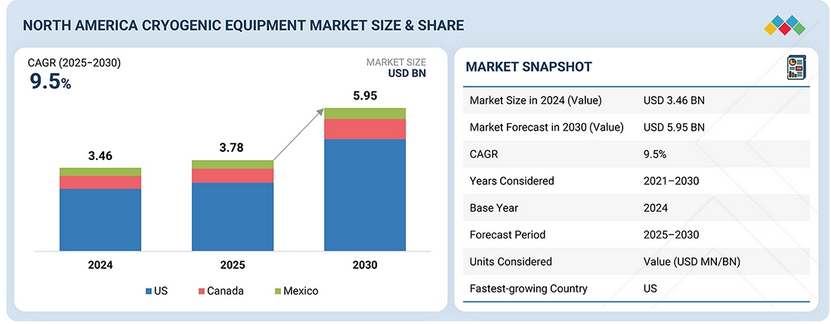
The North America cryogenic equipment market is projected to be valued at USD 3.78 billion in 2025 and USD 5.95 billion by 2030, registering a CAGR of 9.5% during the forecast period.
The North America cryogenic equipment market is growing in several key industries. For example, in the metal industry, low temperature helps make metals robust, which is helpful in making equipment for airplanes and cars. The energy & power industry is also a key end user of cryogenic equipment, as they need it for facilities that turn natural gas into liquid for storing hydrogen and for systems that store energy. Cryogenic solutions are majorly adopted by the transportation sector, such as LNG-powered vehicles, hydrogen fuel-cell systems, and rocket propulsion in commercial spaceflight. Furthermore, the power generation facilities utilize cryogenic air separation for cleaner combustion processes. These industries collectively fuel substantial investment in advanced cryogenic equipment across the region.
Download PDF Brochure @ https://www.marketsandmarkets.com/pdfdownloadNew.asp?id=253954850
“LNG is expected to be the fastest-growing segment between 2025 and 2030”
The LNG segment is projected to exhibit the highest CAGR in the North America cryogenic equipment market during the forecast period. The US is focusing on exporting gas and is also expanding its domestic energy infrastructure, contributing to the segmental growth. The country has also become one of the LNG exporters worldwide. There are several liquefaction terminals being built along the Gulf Coast, and more are planned for the coast. The demand for energy from countries, especially Europe and Asia, is getting higher, leading to increased investment in LNG. Additionally, the transition to natural gas from coal for power generation, coupled with the reliance on LNG to address renewable energy needs, leads to sustained demand across North America.
“Metallurgy segment is anticipated to account for the largest market share during the forecast period”
The metallurgy segment is crucial in the North America cryogenic equipment market, as the region has an extensive manufacturing base. Cryogenic processing is necessary to ensure that metals resist wear and last longer, especially in industries such as aerospace, automotive, and defense. Cryogenic processing is used to treat metals, cutting tools, and precision parts needed for advanced manufacturing. Metal fabrication facilities also use cryogenic gases for cutting, welding, and heat treatment. The metallurgy segment and the cryogenic equipment market are closely related. The US has a propelling aerospace sector, which drives the demand for cryogenically treated components that meet stringent performance standards. Therefore, this well-established industrial infrastructure, along with technological advancements and quality requirements, drives the demand for metallurgy as the largest end user for cryogenic equipment in North America.
“US is expected to capture the largest share of the North America cryogenic equipment market in 2030”
US is a developed country harboring many industries and has strong economic growth, thus it is the largest country in North America in the cryogenic equipment market. Additionally, the country is the largest exporter of LNG globally, as it has several liquefaction facilities along the Gulf Coast. It has companies that make industrial gases, and they have facilities all over the country. It is also growing in terms of space exploration, with NASA and companies such as SpaceX. The country needs cryogenic equipment for its space program. Furthermore, the healthcare sector’s size drives medical gas and cryopreservation equipment needs. Combined with significant research and development investment, robust energy infrastructure, and a strong manufacturing base, the country grows in terms of cryogenic equipment demand and innovation.
Speak to Analyst @ https://www.marketsandmarkets.com/speaktoanalystNew.asp?id=253954850
Key Market Players
The report profiles key players, such as Linde plc (Ireland), Chart Industries (US), Cryofab Inc. (US), Air Products and Chemicals, Inc. (US), and Taylor-Wharton (US).